Are the Junji Itō Maniac: Japanese Tales of the Macabre Stories Based on Real-Life Events?



All manga fans know the name Junji Itō. Itō never became a mainstream author like Oda, Kubo, or Kishimoto, but that is not because he was bad or inferior to them, but because he had a very limited audience. Itō writes horror manga and is arguably the single best horror manga author of all time and one of the best horror writers of all time. His macabre and bizarre stories, with their morbidly intriguing visuals, are not for everyone’s tastes and that is why Itō never became a mainstream author. Still, he is globally famous and immensely popular, which is why we are dedicating this article to him. With the Junji Ito Maniac: Japanese Tales of the Macabre anime series coming soon to Netflix, we have decided to tell you whether any real-life events inspired Itō’s stories.
Junji Itō’s stories are not inspired by real-life events, although they do take inspiration from actual phobias, most of which are Itō’s own. He has also been inspired by several authors like Hideshi Hino, Shinichi Koga, Yasutaka Tsutsui, Edogawa Ranpo, and H. P. Lovecraft, but also by his own experiences with learning anatomy when he was in college. Most of his works are related to the body and cosmic horror.
The rest of this article is going to discuss Junji Itō and his work. We are not going to talk about the upcoming anime that much because this topic has more to do with Junji Itō’s stories than their adaptations. That is why we are going to dig deeper into the psychology of Junji Itō’s works and explain everything you need to know about them.
What are Junji Itō’s stories based on?
Junji Itō born in Nakatsugawa in 1963. He is best known as a horror mangaka whose bizarre stories are popular around the world. Junji Itō studied to become a dental technician, but after several years of working as one, he became a full-time mangaka, which was his childhood love, as he drew his first manga when he was only four years old. Junji Itō’s stories are known for their grotesque imagery and a sense of lingering doom we can do nothing about, much like that present in the works of famous American horror author, H.P. Lovecraft. This is why Junji Itō’s works are usually described as body horror and/or cosmic horror.
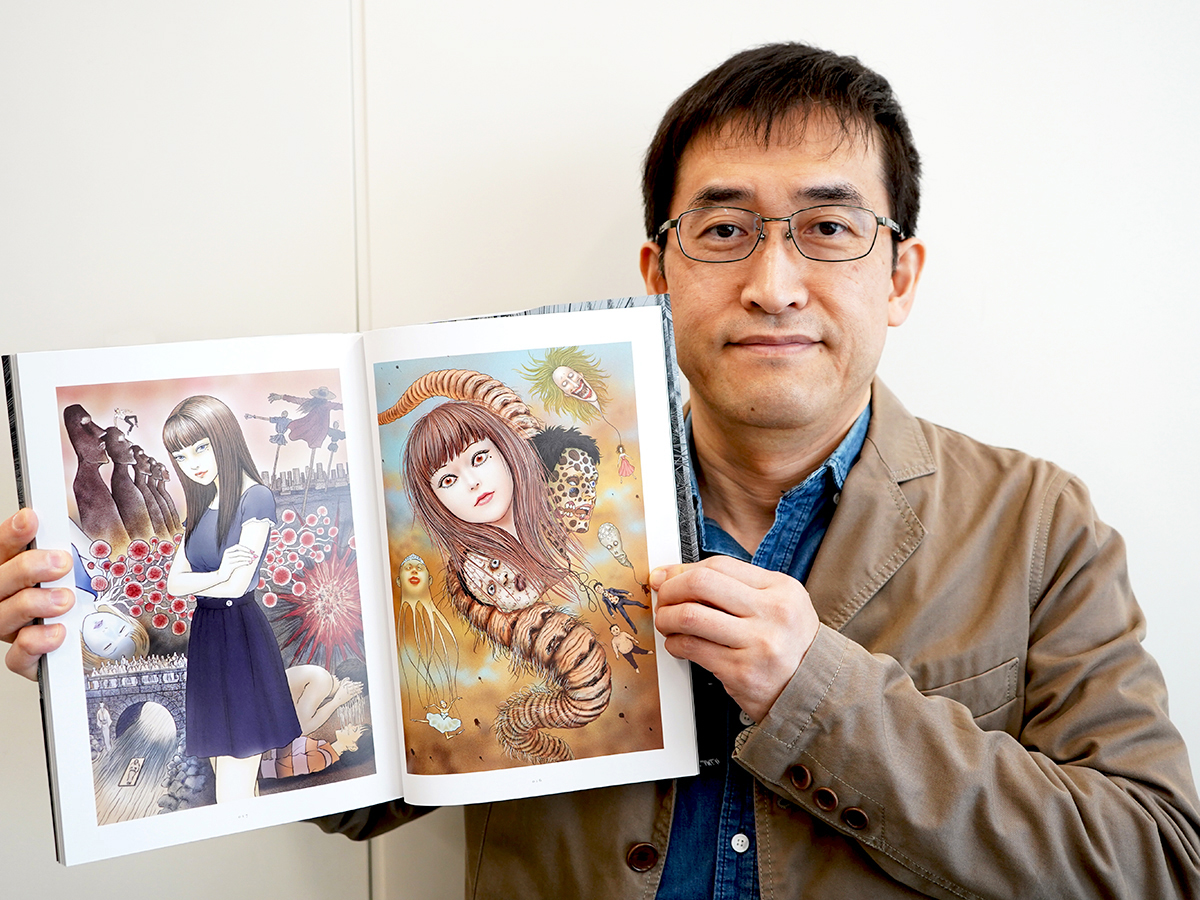
Sometimes, people wonder whether Junji Itō’s works are inspired by real-life events (which are then altered and made more bizarre), or not, but we can confirm that they are not; there might be some stories inspired by actual real-life events, but on a general level, Junji Itō’s stories are fictional. Now, what they are inspired by are Junji Itō’s own experiences and phobias, which makes them more authentic, but they are not what we would describe as being inspired by real-life events. In this article, we are going to discuss the three groups of influences that helped shape Junji Itō’s work. Some of the information is taken from a lengthy interview that Junji Itō gave to grape Japan in 2019, which is available online so we have to give credit to our colleagues from the site. The interview is available if you follow the previous link. Now, let us begin.
Childhood
Ben K: Since when have you been interested in horror as a genre?
(interview with Junji Itō, grape Japan, 2019)
Junji Ito (Ito): When I was very small, maybe 4 or 5 years old, my two older sisters would read Kazuo Umezu and Shinichi Koga in magazines and I read them too. That was my first experience. I was hooked. I began reading horror manga after that.
Ben K: Did you also watch horror movies?
Ito: Yes, when I was very young, I watched Dracula or Frankenstein when they showed it on TV. I lived in the countryside where there were no movie theaters nearby, so I could only see movies on TV. In the 70s, when the occult boom began, I saw The Exorcist on TV as well. So, I watched many occult films, like Dario Argento’s Suspiria, for example.
Nobushi: I was wondering about something. You say you began reading horror manga at 4 or 5. Kids that age scare very easily. But you were fine with it?
Ito: Yes. The manga I was reading wasn’t that scary. On the other hand, TV shows where they went into haunted houses or had a medium who could summon spirits, I thought those were scary. Interesting, but scary. I couldn’t go to the bathroom by myself. Especially since the bathroom in my house was at the end of an underground tunnel. When they showed photos with ghostly apparitions on those shows, that was scary. I was scared by things that seemed real to me. As for manga, of course, some of it was scary but for the most part, I found it interesting and intriguing. I loved Kazuo Umezu’s drawings. Strange creatures, the grotesque. They fascinated me, so I enjoyed reading his manga. But that bathroom was scary…
Ben K: And if you had to go underground, there must have been insects, like centipedes and the like?
Ito: That’s right. In my house, when you went down into the tunnel, we had a storage shed there with an earthen floor. Today, the foundation would be concrete but, in those days, it was exposed earth. And spider crickets would often be there. They look like crickets. We used to call them toilet crickets because they often showed up in those countryside toilets. They have spotted bodies, rounded backs and very long legs, with which they would jump all over the place as soon as you got near them. They really frightened me.
Ben K: I can imagine. So, such experiences were later reflected in your manga.
Ito: They were indeed.
Nobushi: Would you say that most of your works are based on experiences you had and information you learned in your childhood?
Ito: Yes. For example, “The Hanging Balloons” was based on a childhood dream.
Nobushi: That dream must have really left an impression on you…
Ito: Yes. The impressions you have as a child are very strong and stay with you for the rest of your life.
Ben K: Was there a specific experience you had with balloons?
Ito: I lived in the countryside, but I occasionally went into town. I would see ad balloons floating above the buildings, and they were symbols of life in the big city which I aspired to. Also, I liked flying saucers as a kid, UFOs. Strange, unidentified, mysterious objects in the sky. So, I combined elements which I liked and incorporated them into my work.
One of the major inspirations for Junji Itō’s work, as you can see from the above-cited passage from the interview, was his childhood. After being exposed to horror at a very young age, Junji Itō was profoundly influenced by the genre and it helped shape his future works. Of course, he must have been a very creative child with a vivid imagination, as he imagined much more bizarre stories than those he had actually experienced. On top of that, the fact that Junji Itō managed to memorize his experiences so profoundly that he was able to work off them later in life is simply amazing. This gave his stories a sense of authenticity and that is why they are so great, because – although completely surreal – they somehow feel realistic.
Aside from the works quoted, other works that inspired him during his childhood include occult horror films of the 1970s (such as Dracula and Frankenstein), period dramas that include ghosts, Rakugo storytellers and their Kaiden ghost stories, and even Jaws. Also, Itō confirmed that some specific moments inspired some of his stories. For example, the death of a classmate inspired Tomie, Gyo was inspired by his childhood fear of war, Long Dream by research about dreams being instantaneous that his sister once mentioned and Slug Girl was actually inspired by a moment when Itō personally moved his tongue across a mirror and found that it resembled a slug.
Other artists
As with every other author, Itō was, of course, inspired by other authors and their styles and/or themes. Among the authors that he himself named as major inspirations for his work are Hideshi Hino, Shinichi Koga, Yasutaka Tsutsui, Edogawa Ranpo, and H. P. Lovecraft. Some of them he read as a child, some later in life, but it is quite understandable how Ranpo could have inspired his body horror works, and how Lovecraft did the same with his cosmic horror works. Lovecraft, particularly, inspired arguably his most known work, Uzumaki. Itō also stated that he liked the work of Guillermo del Toro, although it is not known how much of it influenced his own work. As for his artistic style, he has named H. R. Giger and Salvador Dalí as examples of artists that influenced his specific style.
Education
Ben K: Jumping forward a bit, you went to a vocational school and became a dental technician, correct?
(interview with Junji Itō, grape Japan, 2019)
Ito: Correct.
Ben K: And you were active as a manga artist while you were working as a dental technician?
Ito: Yes, I began working as a dental technician in around 1984, and then I began working on manga, so I was doing both for about three years…
Ben K: So then, did your experience as a dental technician have any influence in the world you depicted in your manga?
Ito: Well, since it was a medical school, I learned names of body parts in Latin and learned some basic anatomy. Beyond that, however, I learned not through school textbooks but rather illustrated anatomy books for medical students which I bought for myself at bookstores. I don’t remember exactly how it was, but I do remember looking at those pictures to draw muscles, for example.
Ben K: And then in the story “Black Paradox,” you talk about the pylorus.
Ito: The pylorus, right. In Japanese, it’s written yūmon 幽門, which has the kanji for ghost in it, which I liked, but there’s no deeper meaning beyond that.
Ben K: Yes, but isn’t it because you studied such words in vocational school that you had the idea?
Ito: Ah, yes, you could say that.
Ben K: And then there’s “Frankenstein,” which came up later in your work…
Ito: Yes, there’s a scene where body parts are attached together, so I think my experience was somewhat useful there. But what {my dental technician experience} really helped me the most was for the pens I use to draw manga, the tools of the trade. I learned techniques I could use to customize those tools, such as cutting and whittling down pens to make them shorter, cutting grooves into the base so they would be easier to hold, sanding them down to make them smooth and clean. That all came from the techniques I learned to shape and finish dentures.
Interestingly enough, Itō also confirmed that his education also played an important role in his formation as a mangaka. Namely, Itō studied to be a dental technician and he learned about human anatomy during college. He had the opportunity to see anatomical sketches of humans and that actually influenced his artistic style in a major way. Also, being a dental technician helped him actually decide that he wanted to become a mangaka professionally, so you can imagine how much fun he had.
But yes, the body horror element is omnipresent in Itō’s works, and from what he has said – as quoted above – the influences behind that are quite obvious. They are, somewhat, a reflection of his experiences with anatomy, as he said that cutting and sewing body parts together fascinated him, as well as the sketches of human muscles, which is evident if you look at his illustrations, which often feature such odd anatomical features and traits. That is why most people call Itō a master of body horror and why his works, in this aspect as well, feel so authentic.