Top 10 Coolest Things About Ellie (The Last of Us)



Ellie’s journey in the game world of The Last of Us is packed with details that reward careful players. From unique mechanics tied to her character to story beats that reshape how you approach encounters, she brings systems and moments that feel specific and thoughtfully built.
This list focuses entirely on the game side. You will find mechanics, design choices, and narrative facts that define Ellie across the original release, the Left Behind story content, and Part II, with a clear look at how those pieces actually work during play.
Immunity that drives the mission

Ellie is bitten before the events of the main story and does not turn, which is revealed through a positive test and a scar that never progresses. Her condition becomes the reason different factions want to move her across quarantine zones and outposts.
In the Left Behind story content the bite occurs during a night at an abandoned mall with Riley. The fallout from that moment explains why Ellie is being escorted and why her status matters to the Fireflies throughout the first game.
Playable evolution from companion to lead

In the first game Ellie begins as an AI partner who calls out enemies, tosses ammo, and distracts with bricks or bottles. She later becomes fully playable in the Winter chapter where her smaller profile and different loadout change how you navigate combat spaces.
Left Behind expands on that by giving Ellie stealth-heavy scenarios and environmental puzzles on her own. In Part II she is the primary playable character for large sections, with a move set that includes dodging, going prone, squeezing through gaps, and using ropes to create traversal options.
Switchblade stealth without shiv crafting
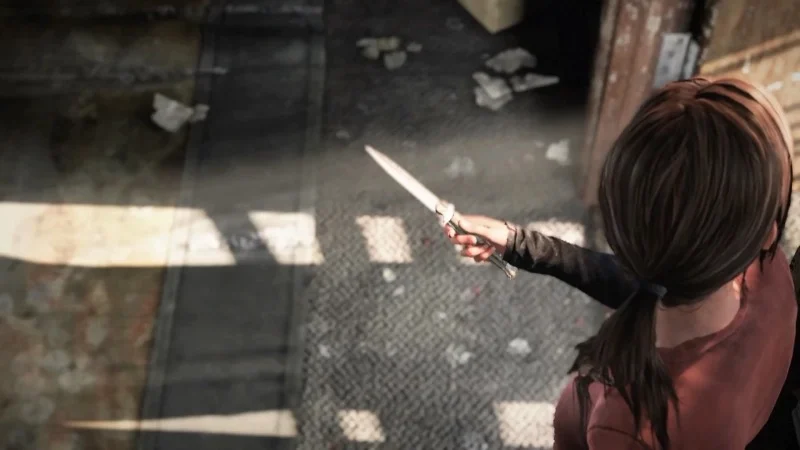
Ellie carries a switchblade that enables silent takedowns when she is under player control. This removes the need to craft disposable shivs for standard stealth eliminations and supports a lighter, more mobile playstyle.
The blade also lets her save crafting materials for items like medkits and throwable tools. The result is a different resource rhythm compared to characters who must constantly spend bindings and blades to maintain stealth options.
Listen mode and awareness upgrades
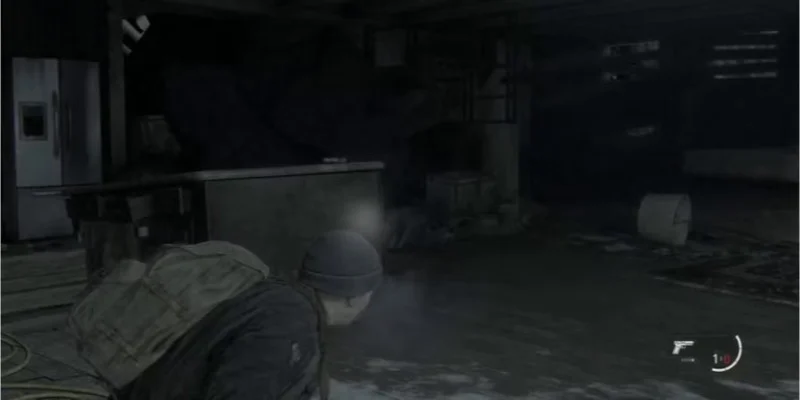
Ellie uses listen mode to visualize enemy positions through walls as faint silhouettes. It is affected by distance and movement, encouraging slow pacing and careful route planning in tight spaces.
In Part II players can invest supplements into upgrades that extend listen range and speed up focus time. Combined with the ability to go prone, this allows precise tracking of patrols while crawling under vehicles and vegetation.
Crafting that supports flexible tactics
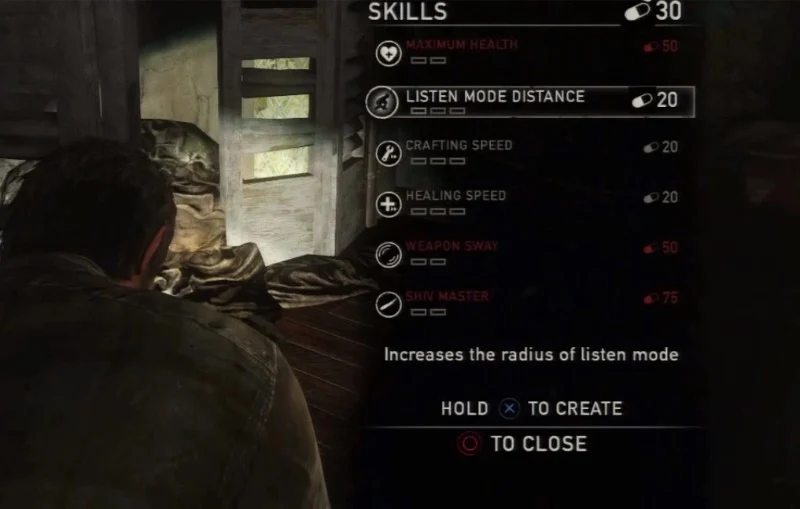
Ellie can craft medkits, Molotovs, and other throwables from scavenged components like rags, alcohol, binding, and explosives. Quick crafting during encounters is mapped for rapid access, so you can swap from healing to area denial without breaking flow.
Part II adds trap mines and the ability to craft improvised suppressors for certain pistols. Those suppressors degrade after a few shots, which turns them into short windows for quiet eliminations before you return to pure stealth or switch to louder tools.
Bow mastery and quiet eliminations

Ellie’s bow offers silent takedowns at medium range with a draw system that affects damage and drop. Fully drawn shots are more lethal and fly flatter, while partial draws allow quicker releases when time is tight.
Arrows can sometimes be recovered from bodies or scenery, which helps sustain long stretches without firing a gun. Workbench upgrades improve draw speed and stability, making the bow a reliable stealth anchor across larger combat arenas.
Environmental problem solving with a smaller frame

Ellie can slip through vents, crawl spaces, and small openings that are inaccessible to bulkier characters. Designers use this to create alternate routes, flanking paths, and puzzle solutions that reward exploration.
Several sections rely on moving pallets, dragging ladders, and boosting through gaps to unlock doors from the other side. These pieces let Ellie bypass chokepoints and set up angles for stealth chains without direct confrontation.
Encounters shaped by scent and dogs in Part II
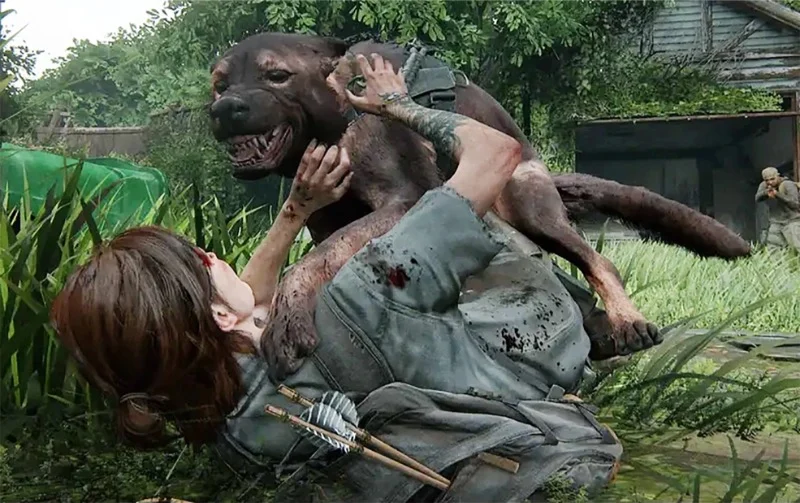
Part II introduces patrol dogs that can track Ellie by scent, which appears as a faint trail when using listen mode. Staying on the move, circling with wind direction, or placing distractions becomes essential when squads deploy handlers.
This system pushes you to relocate after each takedown and makes tall grass or undercarriage hiding spots temporary rather than permanent solutions. It ties stealth to movement and timing rather than static cover.
Guitar system with fully playable chords

Ellie can pick up a guitar and actually play it using analog input for strumming and a chord wheel for selections. The simulation supports fingerpicking, sustained notes, and on-the-fly chord changes.
Players can experiment freely during these scenes and even create custom progressions. The mechanic appears in quiet narrative moments and acts as an interactive break from exploration and combat.
Left Behind structure that intercuts past and present

Left Behind interweaves two timelines. One follows Ellie on a supply run in a snowbound mall while caring for an injured ally. The other flashes back to her night with Riley in a different mall before the main story begins.
The flashback timeline features optional activities like a photo booth, an arcade cabinet you play through descriptive prompts, and a water gun duel. These sequences deepen Ellie’s background while the present-day timeline sharpens her solo stealth and scavenging skills.
Share your favorite Ellie moments from the game in the comments so everyone can compare notes on the details you noticed.