Predicting the Unpredictable: Why People are Obsessed with Patterns in Fiction (And Real Life)

People love patterns. After all, what is a word but a pattern? Our brains and bodies are literally built of repeating, regular arrangements of matter. Is it any wonder then, that some of the greatest and most popular works of fiction of all time have the idea of patterns, chance and randomness at their very heart?
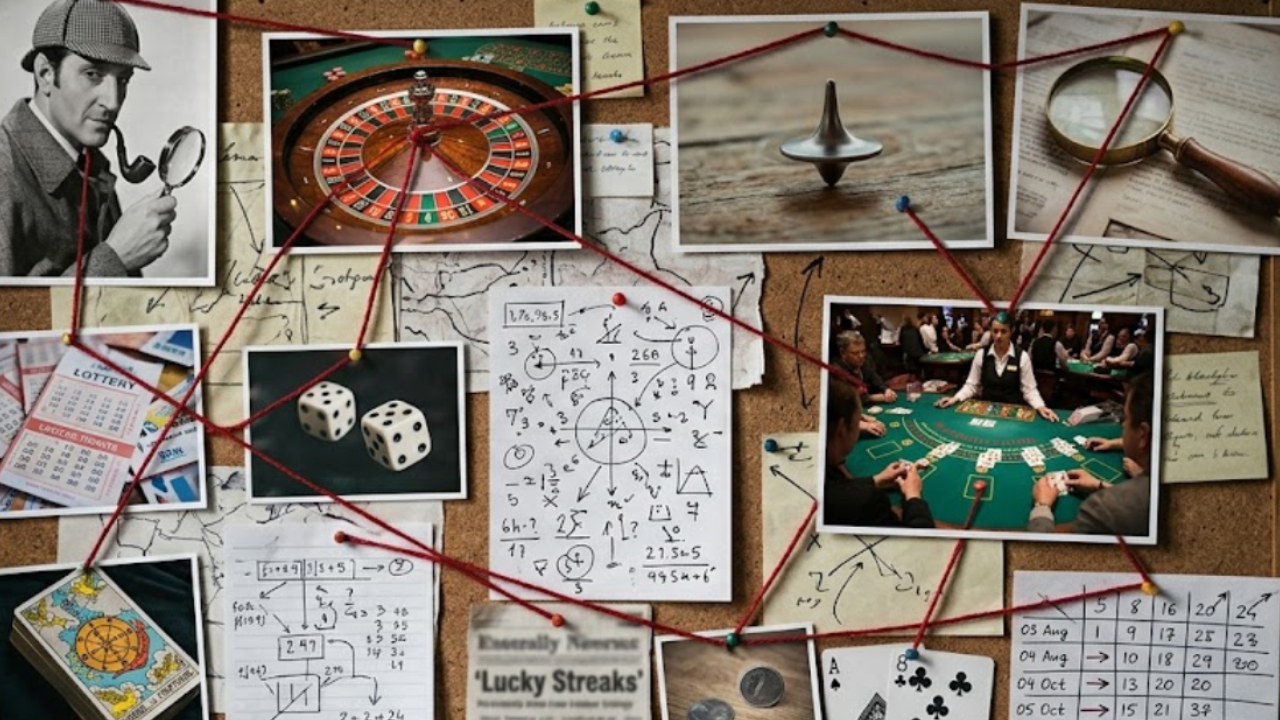
That, is obviously a very huge scope. Just like the concept of a pattern – from the micro to the macro to the cosmic. Thus, this article, like our own brains, must be selective with the patterns it can look at. Broadly, it will discuss three ways of looking at patterns and chance: detective fiction, gambling narratives and postmodern literature. These stories show the human desire to see patterns can be an incredibly useful tool, in the right hands, but also a flaw in our fundamental cognition, that can have wide-ranging consequences if extended too far.
Detective Fiction and Patterns as Truth
Sherlock Holmes is the archetypal reader of patterns in the modern consciousness. The character, whether you’re watching Benedict Cumberbatch in Sherlock or reading the original Conan Doyle novels, represents patterns as truth.
Crack the pattern, crack the case. Elementary, my dear Watson.
For Holmes, even the tiniest of patterns in a chaotic scene can reveal intricate details about what happened, is happening or may happen. Every part of a scene, a stuttered word, a paper left on the floor, a scuffed shoe – it can all be decoded if the right pattern is found.
Holmes does fall victim to false patterns, and this often becomes part of the narrative tension. Competing patterns, jostling for attention. However, the show and the novels ultimately always have a real pattern underneath that can be relied upon to shed light on the situation.
One of the very first detective stories, The Purloined Letter by Edgar Allen Poe, actually satirised this before Holmes even existed. The suave and intelligent Inspector Daupin finds a letter, hidden in plain sight, that the Paris Police did not find after a month of searching the scene.
Gambling Narratives Show Patterns Can Make (or Break) Fortunes
One of the most famous fictional gamblers of recent years has to be Daniel Craig’s James Bond in Casino Royale. Specifically, the high stakes poker scene, where Bond plays against the villain LeChiffre.
The tension at a poker table is about patterns in people, patterns in cards and patterns in strategy. Understanding these three concepts is key to winning at a poker. Although the scene has been ridiculed for its inaccuracy by pro poker players, it remains one of the most iconic recent scenes of gambling and chance in fiction.
Although non fictional, plenty of dramatized accounts have also been made of the MIT Blackjack team of the 1970s. They popularized card counting after they took Las Vegas casinos for millions of dollars – which inspired others to see if they could exploit patterns in gambling games too.
For example, today’s players might visit a casino comparison site that gives them statistics for Crazy Time – a popular live casino wheel spinning game by Evolution. These sites allow players to look at the history of games like these over thousands of spins, as well as other information like reputable casinos to play it at.
This level of interest in trying to find a pattern in a popular game, beyond the one that is embedded in the segmentation wheel, illustrates the enduring appeal of gambling. As if, secretly, everyone thinks they might be the next MIT Blackjack team and discover a pattern they can use to their advantage. Even though maths, science and the history of Las Vegas says that is unlikely. But might be worth a try though, eh?
Anyway. The human fascination with applying stats and numbers to what may be often considered overtly random, is often fiction mirrored in real life. In gambling, whether that’s at a casino or on the stock market, recognising patterns can be the difference between instant fortune or failure.
Postmodernism Treats Patterns as Illusory and Deceptive
On the flip side of the coin, postmodern fiction tells us that patterns are unreliable. Or maybe too reliable. Or they don’t exist at all…
Books like Thomas Pynchon’s Crying of Lot 49, or movies like Christopher Nolan’s Inception, play with the idea of what patterns can and don’t mean in bizarre, mind-bending ways.
In the fantastic Crying of Lot 49, the main character (and very Pynchon-named) Oedipa Mass follows a bizarre, communication network-based conspiracy – that may or may not be her own mind recognizing patterns where none are there.
Even the conclusion of the story leaves Oedipa, and the reader, in the metaphorical dark. By the end, although absorbing lots of information and seeing patterns along the way, she is even more unsure than when the narrative started. Compare with Sherlock Holmes, and you have an almost anti-detective story, if you were.
This theme of uncertainty and no pattern being meaningfully real can be seen in the famous ending of Inception. The wobbling spinning top in the final scene will fall if it is real life or never stop spinning if it is a dream. Yet neither the main character, nor the audience, ever get to know if it actually falls over – it only wobbles slightly as the movie abruptly cuts to black.