Did Soldier Boy Molest Gunpowder During Their Time in Payback?

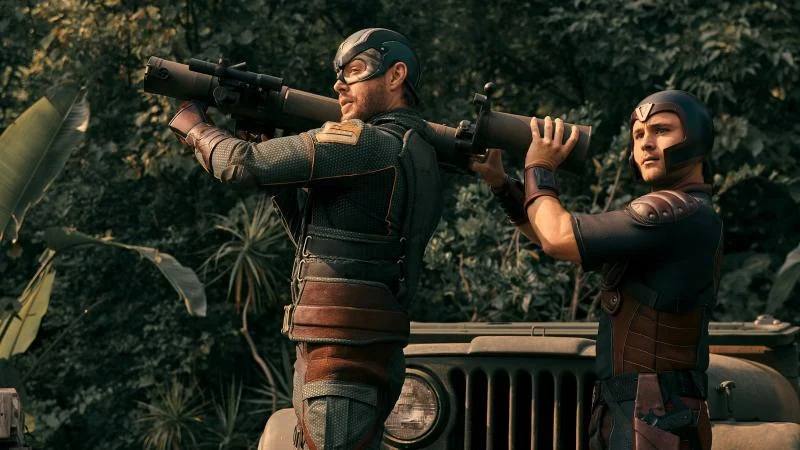

‘The Boys’ has never shied away from exploring the darkest and most disturbing corners of its superhero world. Among the most unsettling threads woven into the show is the implied history of abuse within Payback, the superhero team led by Soldier Boy.
When ‘The Boys’ brought Soldier Boy back into the spotlight, it also dragged painful secrets into the light. The dynamic between Soldier Boy and Gunpowder became one of the most discussed and disturbing elements of the entire series, raising serious questions about what exactly happened between these two characters during their years together on the team.
The Dark Legacy of Payback’s Team Dynamics
Payback was positioned as the premier superhero team of its era, a group that mirrored the cultural prestige of today’s The Seven. On the surface, it represented power, patriotism, and American heroism during the Cold War period. Beneath that polished image, however, was a culture of fear and control that Soldier Boy enforced through intimidation and violence.
The team members of Payback were not peers or colleagues in any meaningful sense. They were subordinates who existed under the thumb of a man who had no interest in leadership and every interest in dominance. Soldier Boy treated his teammates as extensions of his own ego, and those who stepped out of line faced consequences that went well beyond professional reprimand.
Gunpowder was one of the youngest and most vulnerable members of Payback during this period. His position on the team made him particularly susceptible to the kind of grooming and manipulation that Soldier Boy appeared to exercise over those around him. The power imbalance between them was enormous, and that context is essential to understanding what the show implies happened between them.
Gunpowder’s Trauma and the Abuse Allegations in ‘The Boys’
When Gunpowder appears in ‘The Boys’, something is immediately clear about how he responds to any mention of Soldier Boy. His body language, his defensiveness, and his willingness to publicly defend the man all point toward a deeply complicated and traumatic relationship. Victims of abuse often protect their abusers, particularly when the abuser held enormous power over their formative years.
The show never explicitly states in clear dialogue that Soldier Boy sexually abused Gunpowder. What it does instead is far more sophisticated from a storytelling perspective. It layers implication upon implication, using Gunpowder’s behavior and emotional reaction as a map of unspoken trauma that the audience is meant to read between the lines.
Hughie and Butcher’s encounter with Gunpowder is tense precisely because Gunpowder refuses to acknowledge anything negative about his former team leader. That level of protective denial, paired with visible distress, is a characterization choice the writers of ‘The Boys’ made deliberately. It communicates something the characters themselves cannot or will not say out loud.
Soldier Boy’s Pattern of Abuse and What the Show Confirms
Soldier Boy’s character is built around a very specific archetype. He is the product of a generation that treated power as license, and his behavior toward nearly every person around him reflects that worldview completely. He is physically abusive, emotionally cruel, and entirely indifferent to the suffering he causes.
The show draws a deliberate parallel between Soldier Boy and Homelander to illustrate how cycles of abuse repeat across generations. Soldier Boy was himself a victim of his father’s brutal conditioning, and he in turn became a predator toward those beneath him. That cycle of inherited cruelty is one of the central thematic concerns running through ‘The Boys’ as a whole.
Writers and producers connected to ‘The Boys’ confirmed through commentary that the relationship between Soldier Boy and Gunpowder was intended to carry the weight of implied sexual abuse. The framing of their shared history, the specificity of Gunpowder’s psychological responses, and the broader context of Soldier Boy’s documented behavior all align to support that interpretation.
Gunpowder’s death at Soldier Boy’s hands carries extra weight once that context is fully understood. It is not merely a villain eliminating a loose end. It is the silencing of a potential witness, an act that underscores just how much Soldier Boy feared accountability and exposure from those who knew the truth.
The Broader Impact on Storytelling in ‘The Boys’
The implied abuse between these two characters serves a larger purpose within the storytelling architecture of ‘The Boys’. The show is fundamentally about the corruption that comes with unchecked power, and this storyline is one of its most visceral illustrations of that theme. Superheroes in this world are not protected from moral failure. They are accelerated toward it.
By keeping the abuse implied rather than explicit, the show also makes a pointed statement about how these crimes are treated in real life. They happen in shadows, victims stay silent, and perpetrators are protected by institutions and carefully managed reputations. The narrative structure of ‘The Boys’ deliberately mirrors the social structures it is critiquing throughout its run.
Gunpowder’s arc, though brief, resonates long after his death precisely because of what it suggests about the world these characters inhabit. His story is not simply about one character’s suffering in isolation. It is a lens through which the show examines how powerful men exploit systems and people to avoid ever facing consequences for the profound damage they leave behind.