‘Kalank’s’ Ending Explores Sacrifice, Love, and the Shadow of Partition

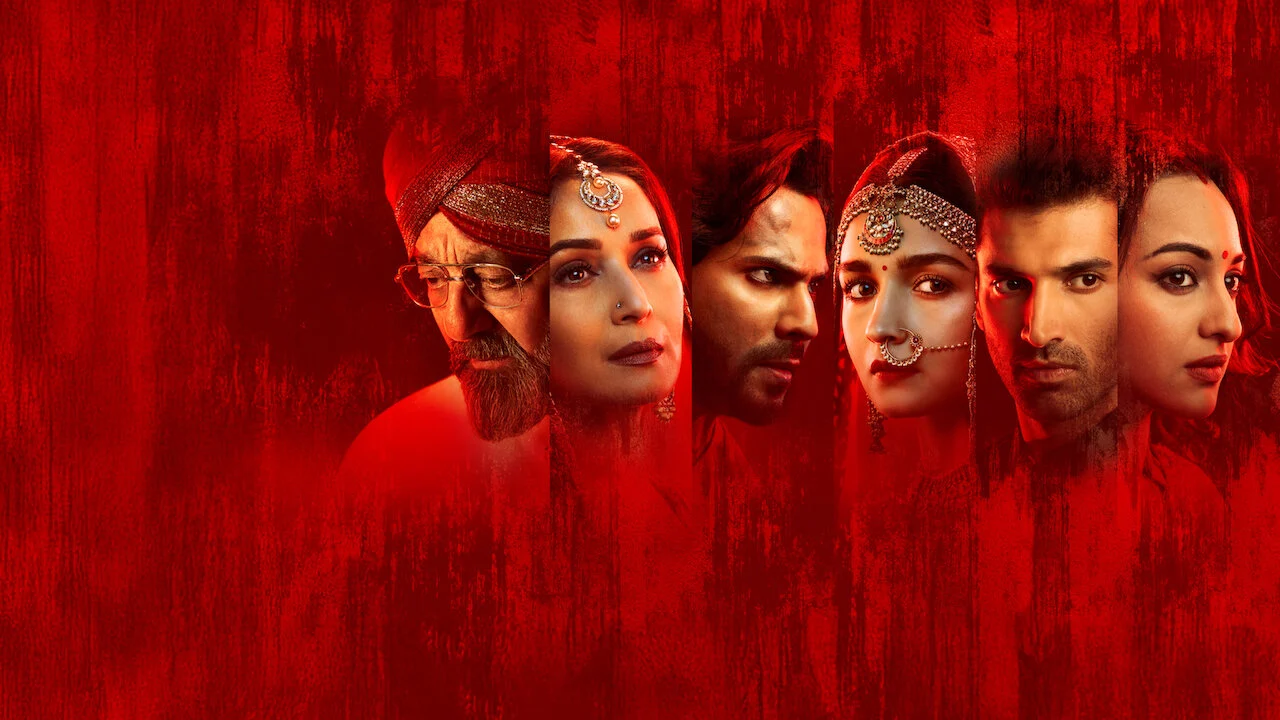

Few Bollywood period dramas have generated as much lingering conversation as ‘Kalank,’ a film whose emotionally tangled finale still prompts viewers to search for clarity years after its release. The story follows Roop, Dev, and Zafar as their personal choices collide with the political upheaval of pre independence India, and the ending ties those threads together in a way that rewards a closer look.
Understanding how ‘Kalank’ resolves its central love triangle means revisiting where the story begins and how each character’s motivations shift under the weight of duty, grief, and forbidden affection.
The Story Behind Kalank’s Central Love Triangle
The film opens in Lahore in 1946, when Satya Chaudhry learns from her doctor that she has cancer and does not have much time left , prompting her to return to her roots in a small village in Rajputana. Knowing her time is limited, she seeks out her childhood friend Roop and asks her to look after her husband Dev Chaudhry, who runs a progressive newspaper , with Roop agreeing only on the condition that she marries Dev, a proposal Satya reluctantly accepts.
Once the marriage takes place, the emotional complications begin almost immediately. Dev confesses to Roop that his heart remains with Satya and that their relationship will be purely platonic, a revelation that leaves Roop devastated , sending her in search of comfort through music with Bahaar Begum, played by Madhuri Dixit. That search for solace is what eventually brings Roop into contact with Zafar, the character whose presence reshapes the rest of the story.
The film is set against the town of Husnabad, near Lahore, where the elite Chaudhry family exists alongside the very different world of Hira Mandi , and the story follows six characters entangled in a search for love while separated by the dichotomy between these two worlds. That collision of class and circumstance becomes the engine for everything that follows in the third act.
As the narrative progresses, communal tensions tied to the coming partition of India rise in the background, and the personal drama of the four central characters plays out against that backdrop , with the question ultimately becoming whether these characters will be defined by violence or by love.
How Kalank’s Ending Explained Ties Together Roop, Dev, and Zafar
The film’s climax arrives as Roop and Dev flee to Amritsar amid violent riots, and the personal revelations that follow carry tragic consequences for the family’s trusted maid and for Zafar , with the conclusion bringing together the intertwining destinies of Roop, Dev, and Zafar as they confront the consequences of their choices amid societal norms and personal desires.
At the emotional center of that climax is Zafar’s fate , whose love for Roop crosses barriers of class and convention and ultimately costs him his life. That sacrifice becomes the defining image of the film’s final stretch, reframing the love story as one shaped as much by loss as by devotion.
The film closes on a reflective note, with ‘Kalank’ ending on Roop remembering Zafar as her inner voice explains that the color of love and hate is red, though it is love that so often gets stigmatized or blemished , a line that directly echoes the meaning of the film’s title. That closing thought is why so many viewers come away from ‘Kalank’ feeling the ending functions less as a twist and more as a meditation on what gets sacrificed when love exists outside accepted boundaries.
Some viewers have debated smaller visual details in that final stretch, including whether certain characters are meant to be understood as alive or as memories, with one popular explanation noting that the coloring of the characters’ outfits in the final scene, with Roop in red and Zafar in white, signals that Roop is still alive during her closing monologue and is directly addressing the audience. That kind of frame by frame reading is common among fans revisiting the film years later.
The Cast That Brought Kalank to Life
‘Kalank’ features a genuinely stacked ensemble, with Madhuri Dixit, Sonakshi Sinha, Alia Bhatt, Varun Dhawan, Aditya Roy Kapur, and Sanjay Dutt leading a film directed by Abhishek Varman and produced by Karan Johar, Hiroo Yash Johar, and Apoorva Mehta under Dharma Productions, alongside Sajid Nadiadwala under Nadiadwala Grandson Entertainment. The film was distributed in association with Fox Star Studios, and its release marked the first film distributed by that studio following the acquisition of 21st Century Fox by Disney.
Character posters released ahead of the film’s debut showed Varun Dhawan as Zafar, Aditya Roy Kapur as Dev Chaudhry, and Sanjay Dutt as Balraj Chaudhry, followed shortly after by posters for Alia Bhatt as Roop, Sonakshi Sinha as Satya Chaudhry, and Madhuri Dixit as Bahaar Begum. That rollout, timed deliberately around International Women’s Day for the female leads, reflected how heavily the marketing leaned on the ensemble’s star power.
The performances themselves were among the more consistently praised elements of the finished film, with critics singling out the cast alongside the production’s technical craft , including its soundtrack, cinematography, production design, and costumes, even as other aspects of the film drew more mixed reactions.
Kalank’s Box Office Journey and Critical Reception
‘Kalank’ arrived in theaters on 17 April 2019 across roughly 5,300 screens worldwide, making it the widest Bollywood release of that year , though the film ultimately emerged as a box office disappointment despite recovering its production budget. Industry trackers noted that the film became the third highest first weekend Hindi collection movie of 2019, yet still finished as the ninth highest grossing Hindi film of that year overall , a gap that reflects how quickly its momentum slowed after opening weekend.
Critical reception followed a similar pattern, with reviewers praising the film’s craft while criticizing its execution , pointing specifically to its direction, story, screenplay, and length as weak points even as the soundtrack and cast performances were commended. That split verdict carried into awards season as well.
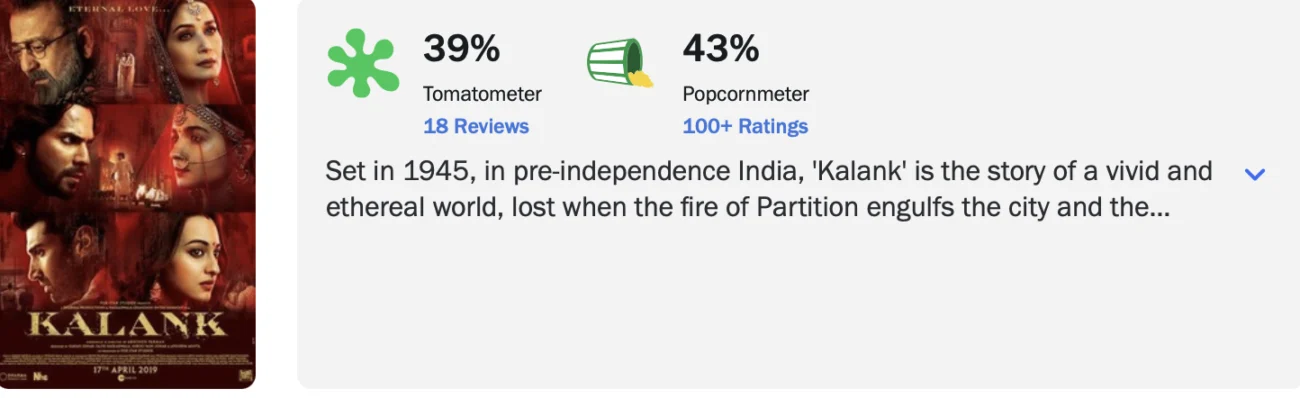
At the 65th Filmfare Awards, ‘Kalank’ picked up multiple nominations, including nods for Best Supporting Actress for Dixit and Best Music Director for Pritam, and the film won two awards, Best Male Playback Singer for Arijit Singh’s title track and Best Choreography for Remo D’Souza’s work on ‘Ghar More Pardesiya.’ Those wins offered a measure of recognition for a film whose commercial performance did not match its scale or ambition.
Given how much debate still surrounds Zafar’s fate and the meaning behind Roop’s closing words, it seems fair to ask which of ‘Kalank’s’ final scenes has stayed with you the longest, and whether you read that ending as tragedy or as quiet redemption.