Did Constance Langdon Die in ‘American Horror Story’? Her Fate Across the Anthology Explained

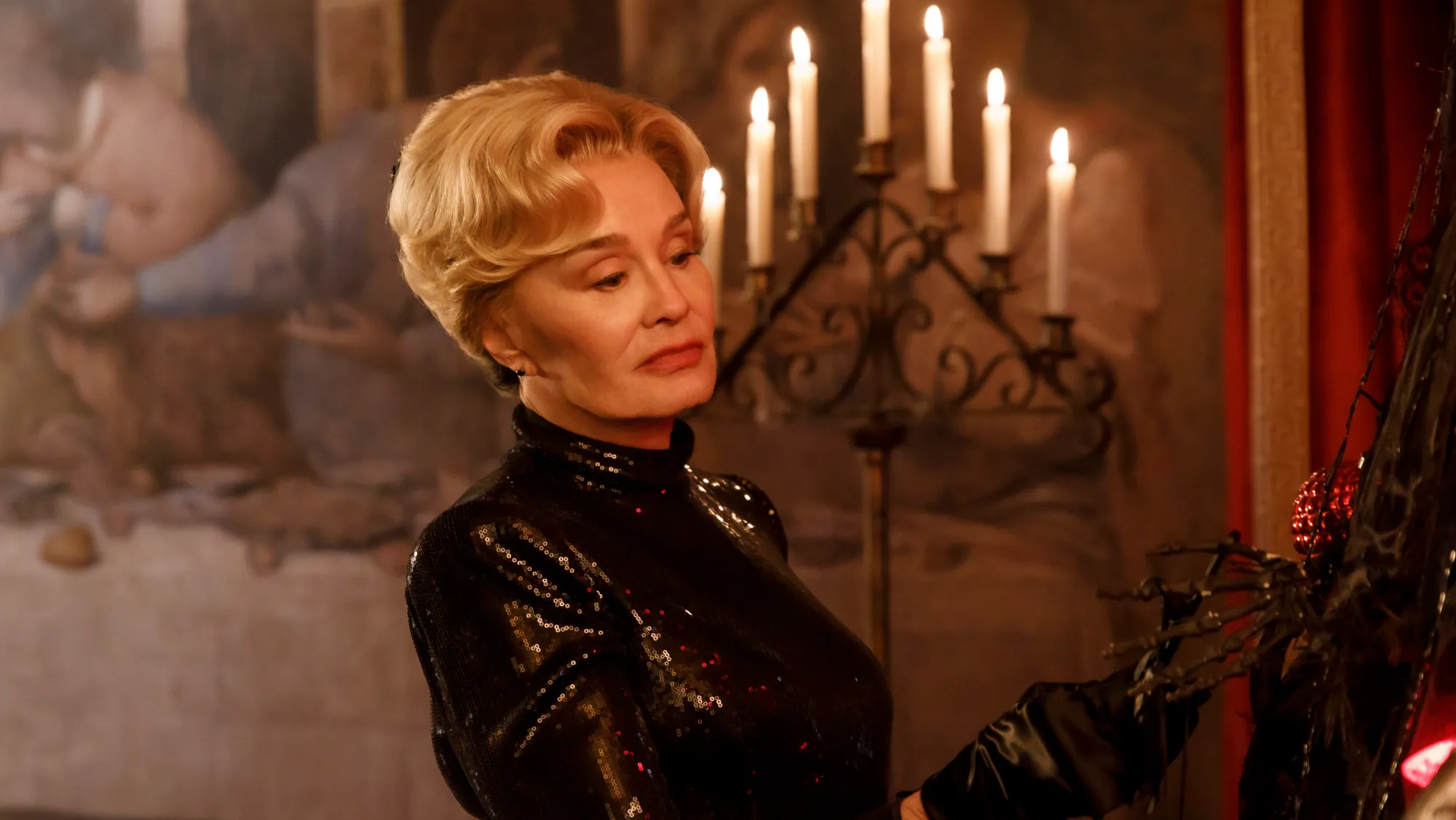

Few characters loom as large over ‘American Horror Story’ as Constance Langdon, the acid tongued matriarch played by Jessica Lange. Since the show’s first season, fans have debated whether Constance actually dies, and the anthology’s habit of jumping timelines and bringer characters back has only made the question more confusing.
The answer turns out to be more layered than a simple yes or no, since Constance’s fate stretches across three different chapters of the franchise. Looking at what actually happens to her in ‘Murder House’ and ‘Apocalypse,’ along with her recent reappearance, clears up a story that has been misremembered by casual viewers for years.
Constance Langdon’s Complicated History With the Murder House
Constance is introduced in the franchise’s debut season as the nosy, controlling next door neighbor of the Harmon family, and she is credited as the secondary antagonist of ‘Murder House’ before becoming a smaller presence in ‘Apocalypse.’ She is the mother of Tate Langdon, a ghostly mass murderer, and the matriarch of the Langdon family, with an obsession over the Murder House itself.
Despite everything Constance survives and orchestrates across that first season, she does not actually die during ‘Murder House.’ Technically, Constance Langdon did not die in American Horror Story season one, though she had a long history tied to the house, and several of her children, including Tate, ended up trapped there as ghosts. That distinction matters, since it means her body remains very much alive when the season ends, even as her family becomes part of the property’s ghostly population.
Her connection to the house only deepens in the years that follow, largely because so many of her children die within its walls. That includes Tate, who is shot by a SWAT team inside the home, and other Langdon children who never make it to adulthood.
By the time ‘Apocalypse’ revisits Constance years later, she is still alive and still fixated on regaining a place inside the Murder House, setting up the far darker turn her story eventually takes.
How ‘Apocalypse’ Confirms Constance’s Suicide
The real answer to whether Constance dies arrives in ‘Apocalypse,’ where her death is addressed directly rather than left to inference. Constance ended her own life so that she could be free of Michael and spend the rest of eternity with her deceased children. That single choice recontextualizes everything fans thought they understood about her survival instincts in earlier seasons.
The revelation comes out through a pointed exchange with Moira, the Murder House’s longtime maid, who does not mince words about how Constance died. Moira tells her that she took the coward’s way out, implying that she killed herself and remains bound to the Murder House alongside her late children. It is a blunt accusation, and it lands as one of the more quietly devastating moments in the character’s arc.
Constance later gives her own account of that decision when speaking with Madison Montgomery and Behold in a later episode. Out of hopelessness, she commits suicide inside the Murder House, where she is reunited with Tate, Beauregard, and her fourth child, a little girl born without eyes. That reunion with her children frames her death less as defeat and more as the closure she had been chasing the entire series.
The show also ties her suicide to a specific breaking point involving the child she raised after Tate’s death, rather than presenting it as a spontaneous or unmotivated act.
Michael Langdon’s Role in Her Tragic End
Constance’s death cannot be separated from her relationship with Michael, the child she took in and raised as her own after Vivien Harmon’s death. Michael Langdon, the Antichrist, was the reason Constance took her own life, and while she was raising him, he kept leaving her disturbing gifts, a habit that started with dead rats and escalated into murder as he got older. That escalation transforms what begins as an unsettling parenting arrangement into something genuinely threatening.
Constance eventually reaches a breaking point that pushes her out of the role entirely. She later admits that raising Michael shattered her, and that she kicked him out of the house after finding a murdered priest in his bedroom. The moment marks the collapse of whatever hope she had of raising a normal child after losing so many of her own.
In ‘Return to Murder House,’ Constance offers additional detail about how early the warning signs appeared. She tells Madison and Behold that she sensed evil in Michael from very early on, noting that he began by killing animals before eventually killing his own babysitter. That timeline suggests Constance understood the danger long before she was willing to act on it.
Her decision to end her life is ultimately framed as an escape from Michael rather than a random tragedy, giving her death a clear emotional throughline tied directly to the child she once hoped would give her a second chance at motherhood.
Constance Langdon’s Return for ‘American Horror Story’ Season 13
Constance’s story does not end with her suicide, since the character resurfaces again well after ‘Apocalypse’ concluded. Jessica Lange’s Constance Langdon appeared in the first three episodes of the newest season, seemingly playing a vital role in the installment’s central mystery. Her return has reignited interest in a character many assumed had been fully retired after her Apocalypse arc closed.
Part of the renewed confusion stems from how much time has passed since audiences first met her. Given that it has been fifteen years since she was introduced, fans can be forgiven for forgetting the nuances of this grieving mother’s story. That gap helps explain why so many viewers are revisiting the question of her death now rather than treating it as settled history.
Constance’s complicated status as both deceased and still narratively active is reinforced by how the ‘Apocalypse’ finale ultimately resolves her arc. Even though Constance dies in Apocalypse, Mallory reverses this using Tempus Infinituum, which reinforces her standing as one of the show’s central survivors. That time altering finale effectively gives Constance a second chance at the life her suicide had cut short.
Critics responded warmly to how the finale handled her reappearance, particularly her scenes opposite Michael. One review noted that time travel gave the finale an opportunity to bring back Jessica Lange as Constance again, calling her exchanges with Michael some of the best material on the show. That reception helps explain why Ryan Murphy’s team keeps finding reasons to write Constance back into the anthology’s ongoing mythology.
For a character whose death has been reversed, reframed, and revisited more than once, it makes sense that her presence in the newest season is raising the exact same question that has followed her since 2011, and fans watching her latest appearance unfold seem eager to debate what her return might mean for how her story finally ends.