Can the Green Lantern Ring Actually Come Off, and What Happens When It Does in HBO’s ‘Lanterns’

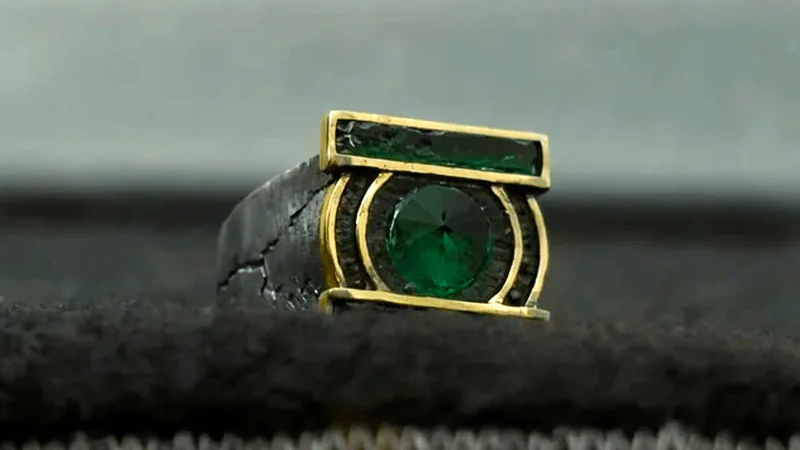

HBO’s ‘Lanterns’ has spent its first season treating the Green Lantern power ring less like a costume accessory and more like a living partner to whoever wears it. That framing has left viewers wondering just how easily Hal Jordan or John Stewart could slip the ring off and walk away, and what the cost of doing so would actually be.
The question is not just theoretical. Taking off a Green Lantern ring sounds simple, but in DC lore it is anything but a casual act, and fans watching HBO’s ‘Lanterns’ have plenty of reasons to wonder whether Hal Jordan or John Stewart could just slip the ring off their finger and walk away from the cosmic police force altogether. The answer draws on decades of comic history as well as the choices the show’s writers have made for their own version of the mythology.
Removing The Ring In Comic Book Canon
In the source material, a power ring absolutely can be taken off, and Green Lanterns do it more often than casual fans might expect. The uniforms Lanterns wear are generated by the ring itself, so when a member removes it, their clothing reverts to whatever they were wearing underneath before they put the ring on. That detail shows how thoroughly the ring reshapes a wearer’s entire physical presentation, not just their arsenal.
The stakes of removing the ring have not always been dramatic. In ‘Green Lantern’ number 3 from 1990, Hal Jordan and fellow Lantern Guy Gardner got so furious with each other that they settled things the old fashioned way, taking off their rings to have a straightforward fistfight. That story is a reminder that pulling the ring off does not always trigger a catastrophe, sometimes it is simply two stubborn characters choosing to argue with their fists instead.
Consent is treated as a bigger deal than the physical act of removal. Stories going back to the early 1960s have explored villains attempting to pull a ring off a Lantern against their will, and the recurring lesson is that the ring’s bond with its wearer is built on willpower, so forcibly separating a Lantern from it is treated as a major plot event rather than a throwaway detail. That willpower based bond is the foundation for almost everything else the ring is capable of.
What Happens To The Ring’s Power When It Comes Off
The ring does not simply shut down the instant it leaves a finger. If a Green Lantern loses their ring, the original wearer can still retain command over it as long as they have the will to do so, meaning a stray ring picked up by someone else could not simply be activated by that new possessor. That design choice is part of why the ring functions more like a partner than a piece of equipment.
The ring is also doing far more work while it is on than most viewers realize. It generates a force field around its wearer that filters stellar radiation and microscopic debris, creates a breathable atmosphere suited to the wearer’s biology, regulates body temperature, and even manages waste products, meaning a Lantern could theoretically use the ring as their entire life support system in space. Taking the ring off in a hostile environment is not a symbolic gesture, it is an immediate survival risk.
Losing access to the ring under duress can strip a Lantern of every advantage that made them formidable in the first place. In one animated adaptation, John Stewart finds himself unable to activate his ring at all after Despero deploys a dampening field, forcing his teammate Katma Tui to physically shield him while he is left powerless and vulnerable. That scene captures how quickly a Lantern can go from a cosmic powerhouse to an ordinary person the moment the ring stops responding.
How ‘Lanterns’ Reinterprets The Ring’s Bond
HBO’s series has introduced its own twist on what the ring means to its wearer. The show reveals that Green Lantern Corps members upload a backup of their consciousness to their rings weekly, so that a Hal Jordan hologram can appear and speak even after his body is gone. That mechanic means the ring functions as a repository of a wearer’s mind, not just a power source, which changes the meaning of taking it off or losing it.
That change is already central to the show’s mystery. By the end of the premiere, Hal Jordan has been murdered and his power ring is nowhere to be found, a disappearance that becomes one of the season’s core questions. Co-creator Tom King has weighed in on where the ring ends up, sharing on the Lanterns official podcast that Nathan Fillion’s Guy Gardner currently has possession of it rather than John Stewart, the character many assumed would inherit it.
The show has also built in an emotional reason for a Lantern to give up the ring voluntarily. After nearly dying when Hal crashed a car during a reckless training exercise, John reflects on how badly Hal has wanted to hold onto the ring and ultimately decides not to pursue becoming the DCU’s second human Green Lantern, walking away from everything he trained for. It is a rare instance in this franchise of a character choosing to step back from the ring rather than losing it in battle.
Series co-creator Chris Mundy has spoken about wanting to preserve the scope of the mythology even within a grounded, procedural story. Mundy told Entertainment Weekly that the Lanterns can conjure anything from the ring, that they do go off the planet, and that there are all these other powers that they have, while the team still wanted the series to feel like an upscale mystery. That balance between cosmic stakes and human scale is exactly what makes the ring’s rules feel consequential rather than decorative.
Why The Ring’s Rules Are Fueling Fan Debate
Some of the fan discussion has focused on continuity rather than power mechanics. Since ‘Superman’ is set in 2025 and Hal is killed in 2026 within the show, some fans have pointed out that Hal must have lost the ring well before his death, possibly years earlier, which has left the ‘Lanterns’ timeline feeling more tangled than expected. That kind of puzzle has kept comic book forums and comment sections active for weeks.
Casual viewers are also discovering how strange the ring’s responsibilities get outside of combat. Between the force field life support, the weekly consciousness backups, and the will based bond with its owner, the ring behaves less like a piece of jewelry and more like a full character in its own right, one with rules that shift depending on which era of comics or which television timeline is telling the story. That layered design is part of why ‘Lanterns’ has generated so much scrutiny from longtime readers.
The show has also made a point of restaging one of the franchise’s oldest rituals. A standard ring can reportedly hold a charge for roughly 24 hours before it needs to be replenished from a power battery, and Lanterns traditionally recite the oath while charging their rings, making the moment both a practical necessity and a ritual that connects individual members back to the larger Corps. That detail grounds the ring’s near mystical bond with its wearer in something closer to routine maintenance.
With Guy Gardner now holding the ring instead of John Stewart, and with the show still unpacking why the object bonds with one wielder over another, the mystery around who controls the most powerful weapon in the universe is far from settled. Do you think John Stewart made the right call walking away from the ring, or would you have held on no matter the cost.