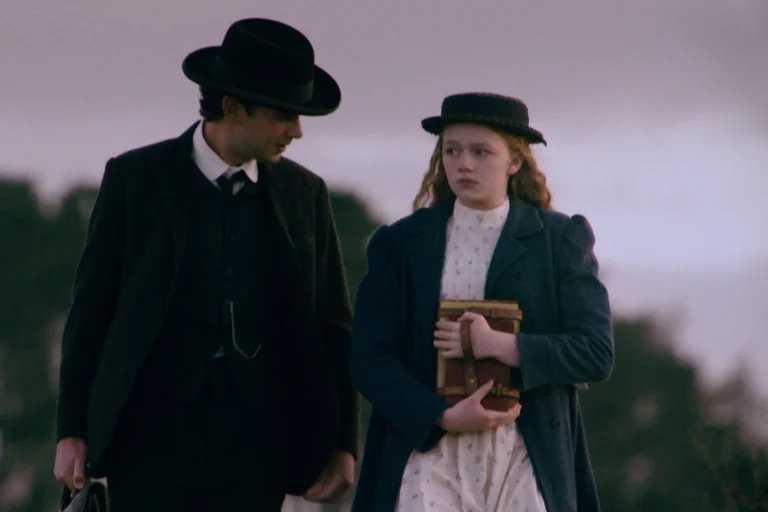
Chris Hansen’s India Trip Was Real, but ‘Primetime’ Rewrote What Happened There



Chris Hansen did travel to India, though the A24 film bends its timing and its subject to suit a darker story. The question surfaced because the film presents his time there as something close to folklore, and viewers reasonably wondered whether any of it happened. The answer is yes, but not in the form the movie shows.
That distinction sits at the center of the debate around the Chris Hansen India trip, which now overlaps with his public dispute over the film. Hansen has said the film is entirely fictional and keeps only his name and a couple of catchphrases. His real reporting in India offers a useful way to measure how far the movie departs from the record.
What the Chris Hansen India Trip Looks Like in ‘Primetime’
In the film, Hansen tells the decoy Dan about being in Pandalam in 1996, where a local asks whether he is covering the missing children. The story describes children disappearing at night across a southern state, villagers turning on one another, and authorities blaming wolves. It plays like a ghost story told over drinks.
The film cuts between Hansen talking to Dan and Hansen in India itself. One analysis argues that the India story demonstrates his conviction and does not reflect what happened in reality. That reading frames the sequence as character study more than biography.
The same analysis notes that it recontextualizes a question Hansen asks during the first sting, namely what would have happened if he was not there. Once the India story is known, the question widens to what would happen if Hansen was not making the show at all. The scene therefore carries more thematic weight than its brief running time suggests.
The ‘Primetime’ Monster Story and Its Symbolism
Glimpses of the monster appear in earlier moments of the film, but only when Hansen explains the bracelet he got in India does the reason for its presence become clear. In the film, he tells the young actor Dan Plum that an evil spirit, visualized as a ceremonial mask, was blamed for the disappearances of children from local villages.
One critic describes the scene as jarring and almost a non sequitur, except that the mask keeps returning, sometimes superimposed onto the face of Hansen’s whale. That reading ties the film to Moby-Dick, where the whale is a visible personification of evil, and neither Ahab nor Hansen finds the satisfaction they seek. The monster is a motif, and the India story is the key that unlocks it.
The critic also observes that Robert Pattinson is not trying to mimic Hansen in the usual way and instead exaggerates him into a larger than life enigma. That choice helps explain why the film feels comfortable with folklore. It is more interested in obsession than in documentary accuracy.
The Emmy Winning Silk Trade Investigation Behind the Story
The real Hansen did report from India, and the record is specific. His NBC profile credits him with an hour long report on child slave labor in India’s silk trade that earned international acclaim. That investigation won him an Emmy, but it covered child slave labor in the silk trade and not children vanishing from rural communities.
One explainer concludes that the film appears to merge two separate investigations into a single moment, most likely to make the story more dramatic. It points to Hansen’s separate investigation in Cambodia in 2003 into the sex trafficking of underage children. The monster tale, in other words, borrows from real reporting without reproducing it.
Some details do hold up. The bracelet is real and did come from his time in India. His NBC profile also notes that in March 2012 he reported from India, where he was detained, on how prescription drugs are approved. Hansen has a documented history of working in the country, which makes the film’s version a dramatization of a true foundation.
Hansen’s Legal Action Threat Over ‘Primetime’
The real Hansen is not a fan of the result. He spoke with Variety a few days after watching the film and called it a complete work of fiction, while discussing what legal action against A24 might involve. He said the filmmakers exploited him and his brand and his name and image for commercial enterprise.
The India monster tale is one example of what he sees as invention. His objections also reach the film’s account of the Conradt investigation, his love life and his relationships at NBC, and he says events and timelines were rearranged. The film covers the 2006 death of Louis William Conradt Jr., who died by suicide after police arrived at his home during an investigation.
Earlier reporting indicated that Hansen refused to sign an NDA that would have signed away rights to his name, image and brand, so he was not allowed to screen the film. He has since confirmed that lawyers are reviewing whether he should take action, and there is no confirmed lawsuit against A24. He has not ruled out a challenge but says there is no rush.
Despite his criticism, Hansen acknowledged the film’s box office performance and said he believes its success was partly driven by A24 and Pattinson. He also bought preshow advertising for every screening to promote his streaming network, TruBlu. If the India sequence was invented to make Hansen look like a man chasing a monster, does the real story of his silk trade reporting make for a stronger film, and should ‘Primetime’ have trusted it instead?