


Create Ghost Logos with AI: When Brands Hide Their Identity on Purpose

There is a weirdly powerful draw to absence. An empty bottle, a signless sign, a half-familiar shape glimpsed on the fly—all whisper, you know who I am. In a time of overstimulation, silence is a new form of signal. Brands now use “ghost logos”—a mark that is a suggestion, not a statement. A disturbance in negative space, a curve that suggests heritage, a color that conveys identity without spelling it out.
This is not laziness or obfuscation—it’s design maturity. And it’s propelled by platforms like Dreamina, which use an AI logo generator to allow designers to create invisible brand identities, but recognizable. It is about taking all that is not necessary away until memory, emotion, and undiluted recognition are left. If a symbol ever becomes a feeling, the logo doesn’t need to shout—it just needs to linger.
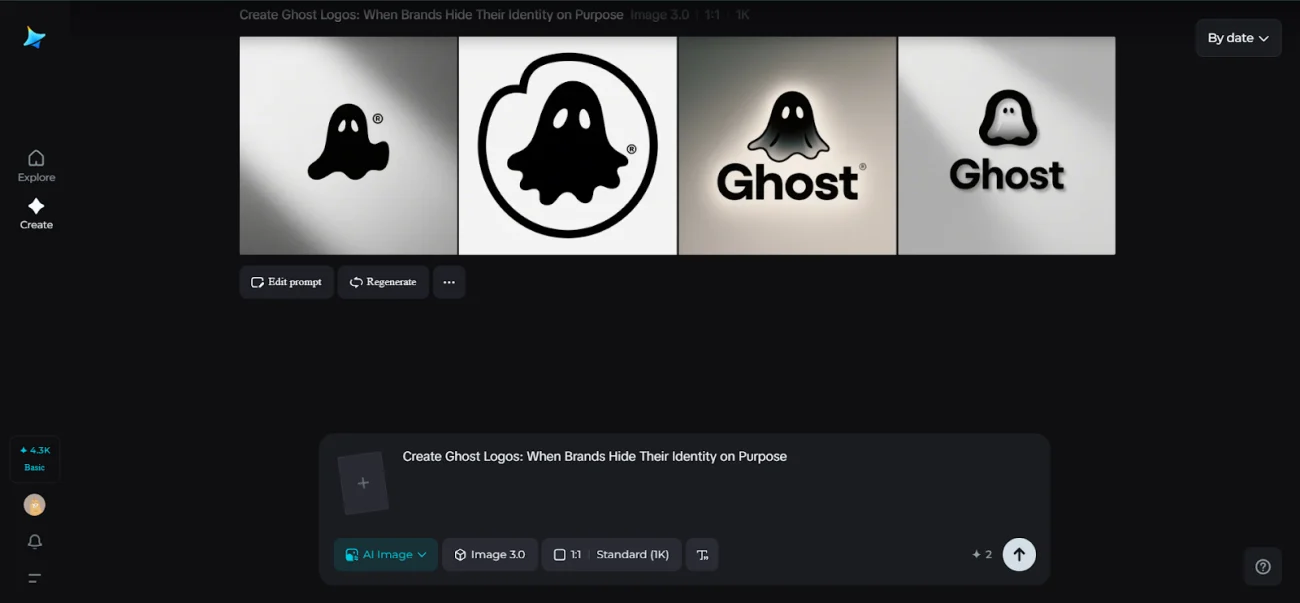
When less is legacy
The notion of “ghost logo” is thriving in a time when subtlety is sophistication. From luxury fashion brands taking the names off handbags, to drink makers sending out label-less bottles, the trend is not going away—it is asking us to reach into our memories. By distilling identity down to its consummate minimum, brands create connection.
The customer is an insider, one of a knowing few who can recognize a product by shape, tone, or bare form. That mutual recognition is intimate—like a secret handshake composed of design.
Here’s why this sneaky method succeeds:
- Mystery generates engagement. People stick around longer when they’re attempting to “solve” an image.
- Minimalism is bold. When a brand takes away its name, it implies its image says more than text.
- Silence generates value. Single images are felt like secrets communicated in a whisper.
Interesting is how designers employ AI to heighten it—pushing the boundaries of shape memory, emotional triggers, and even subconscious patterns of recognition that suggest a logo without ever displaying it.
Beyond the name: how AI reshapes identity
Visual identity is now emotional and psychological rather than literal. The brand of the future will not be based on typography or symbolism but on energy—the sensation that a form gives you. That’s why AI is transforming our understanding of brand essence.
Dreamina’s creative platform, particularly its AI picture creator, assists designers in probing out-of-focus versions of branding—textures, shadows, or moving marks that “echo” the energy of a logo without exhibiting it. It’s like designing the aura of a logo instead of the logo.
For example, an ecological brand might call up its icon in shimmering reflections mimicking the geometry of its signature monogram; a high-end brand might call up its symbol in patterns of light filtered through leaves. The consumer experiences the brand even when they can’t perceive it.
And for campaign visuals, Dreamina’s AI photo generator allows creators to integrate these ghosted identities into marketing materials—ads that bank on recognition rather than visibility.
The Dreamina flow: creating your ghost logo design
Step 1: Compose a text prompt
Go to Dreamina and start exploring the world of serene branding. Think in terms of atmosphere, material, and mood instead of concrete symbols. Tell Dreamina how your logo should feel, rather than how it appears.
Sample prompt in action: A minimalist symbol logo, white-on-white with subtle, embossed pattern, abstract curves; soft diffused light; sophisticated layout which suggests a luxury perfume brand while avoiding logo usage at all.
Dreamina takes these visual levers and audience cues into images that have a ghost-like sense of identity—and are particularly suited for visual exploration, which leads to true testing of how little, really, does the audience actually need to recognize you.
Step 2: Set parameters and generate
After that, refine your creation by adjusting Dreamina’s model, aspect ratio, size, and resolution. For 1k, high-quality visual assets work great for mockups, while if you’re working on a marketing layout or presentation style, 2k has the highest fidelity and clarity. Once you’re ready, click Dreamina’s icon to regenerate. In a matter of seconds, a visual that utters, more than shouts, a design that allows for more of your imagination than for the eye.
Step 3: Customize and save
Once created, edit your image with Dreamina’s editing tools. Employ inpaint to hide distracting details, expand to stretch white space, and erase any obvious marks that undermine the intrigue. A subtle retouch may mute texture or rebalance tone so that the design stays minimalist yet conveyingly expressive. When your ghost logo is complete—tasteful, refined, and unobtrusively confident—hit the Download icon to save and include it in your campaign.
The psychology of disappearance
Ghost logos are so effective because there’s a psychology behind disappearance. They turn our assumptions about branding upside down. Rather than identity being visible, it’s about recognition without visibility.
It activates something primal in the brain: we are programmed to finish incomplete forms. When a pattern leaves something out, our brains do it for us automatically—and the act of engagement develops deeper memory and emotional resonance.
Envision how brands could strategically leverage this power:
- In the case of luxury: Use minimal or blank logos to signal timeless sophistication.
- In the case of lifestyle brands: Create pattern-based identities that become recognizable through repetition of texture or shape.
- In the case of tech brands: Replace attention indicators with light trails, ripples of motion, or soft gradients that suggest brand fluidity.
This isn’t minimalism as a lack of personality; it is minimalism as an abstraction to its essence.
And in Dreamina, that essence can be designed with precision and artistic freedom.
Beyond visibility: storytelling through absence
A ghost logo isn’t a design—it’s a reverse-told story. It gets people curious right away. Makes them want to dig in deeper. And once they spot it, the payoff feels really good. It comes off like a straight-up statement. You know who I am already.
Imagine putting together a whole ad push. Just the empty spots forming your logo on some posters. Nothing else there. No text at all. No colors either. Only a faint raised edge or shadows shifting around. That unknown part hooks them every time. People lean right in close. They squint and try to make out what’s missing.
Dreamina’s AI poster generator masters this aesthetic. You can design posters that feature intricately lit softness, embossed textures, and imperceptible gradients to communicate identity through nothingness. Each photo is like a secret in the making.

Conclusion: The power of the unseen
In the age of boisterous marketing and endless scroll, the least noisy designs are the most effective. The ghost logo phenomenon is a counter-movement against over-sharing—a reversion to elegance, self-assurance, and restraint.
Dreamina lets designers handle that kind of subtle stuff. You know, like when you’re testing out emotional reactions or putting together stealth campaigns, or even doing minimalist branding for some new product coming up. Its AI tools help you build up the things that aren’t so obvious, just as much as the stuff that stands out right away.
It has this AI logo creator, plus the image one and the poster maker, too. All that sets up a pretty good spot for making brands that kind of whisper instead of yelling all over the place.
Because sometimes, the thing that really makes your brand stick in people’s minds is that space you leave empty behind it.