Does ‘Buddy’ Have a Post-Credits Scene, and What Its Ending Actually Sets Up


Horror comedy ‘Buddy’ has become one of the more talked about theatrical releases of late August, and a good portion of that conversation centers on a simple logistical question. Once the lights come up, do audiences need to sit through the credits for anything extra, or is it safe to head straight for the exit.
The film reimagines the wholesome format of 90s children’s television as something considerably darker, and that premise alone has generated enough buzz that viewers want to know exactly what they are walking into before they buy a ticket. This piece breaks down what happens once the credits start rolling, what the ending itself reveals, and how critics have responded to the movie since it opened.
What Happens After the Credits Roll in ‘Buddy’
For anyone specifically wondering about a stinger, the answer is straightforward. There is no post-credits scene in ‘Buddy,’ so audiences can leave the theater as soon as the movie ends without missing any additional footage. That confirmation has circulated across outlets tracking the trend of franchise films tacking on extra scenes to tease future installments.
There is one small detail worth knowing if a viewer does choose to stay through the credits anyway. The “Buddy” theme song from the fictional children’s show plays near the end of the credits roll, though it does not accompany any new footage or scene. It functions more as a callback to the film’s central conceit than as a traditional stinger.
That conceit is baked directly into the film’s structure rather than saved for after the credits. Buddy, the film’s title character, can reset the world of the show by hugging the children, which triggers the ending credits and the start of a new episode, healing any damage inflicted along the way. In other words, the credits sequence is already part of the story’s internal logic long before the actual end credits arrive.
So while there is nothing hidden to wait for, the way ‘Buddy’ uses its own credits as a narrative device is arguably more interesting than a traditional teaser would have been anyway.
How ‘Buddy’ Ending Explained Plays Out
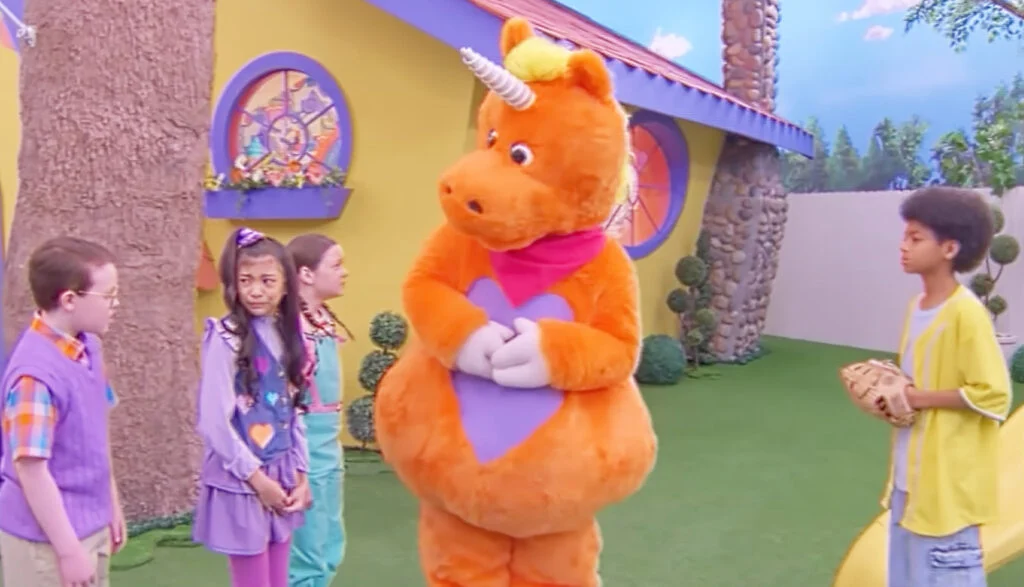
The film centers on a group of amnesiac children living inside the fictional world of “It’s Buddy,” a children’s program hosted by a bright orange, humanoid unicorn. When the children begin to defy their captor after one of the kids disappears, Buddy sends them on a perilous journey to the mythical Diamond City, while a traumatized suburban mother in the real world named Grace becomes drawn into Buddy’s world as well.
Early in the film, that darker undercurrent becomes explicit through the fate of one child. After a boy named Josh refuses to keep playing along, the episode ends with viewers hearing Buddy grab someone in the dark offscreen, and a new day dawns with Josh gone and replaced by another child named Hannah as if nothing had happened. A girl named Freddy is the only character who initially notices something is wrong.
That single moment sets the tone for the rest of the story, which follows the surviving children piecing together the truth about their situation and attempting an escape. The film’s satirical target becomes increasingly clear as it draws direct comparisons to the sunny, sing-along format of children’s programming from the era.
Director Casper Kelly has been open about leaving some of the mythology unresolved on purpose. Kelly told The Direct that not all of the lore he developed made it into the finished film, explaining that a filmmaker wants the movie to retain some mystery for the audience.
Critical Reception and Box Office for ‘Buddy’
Reviews for ‘Buddy’ have leaned positive since it premiered. The film held an 87 percent score on the Tomatometer shortly after release, reflecting strong reactions from both critics and audiences. That reception followed an earlier festival debut rather than a cold theatrical drop.
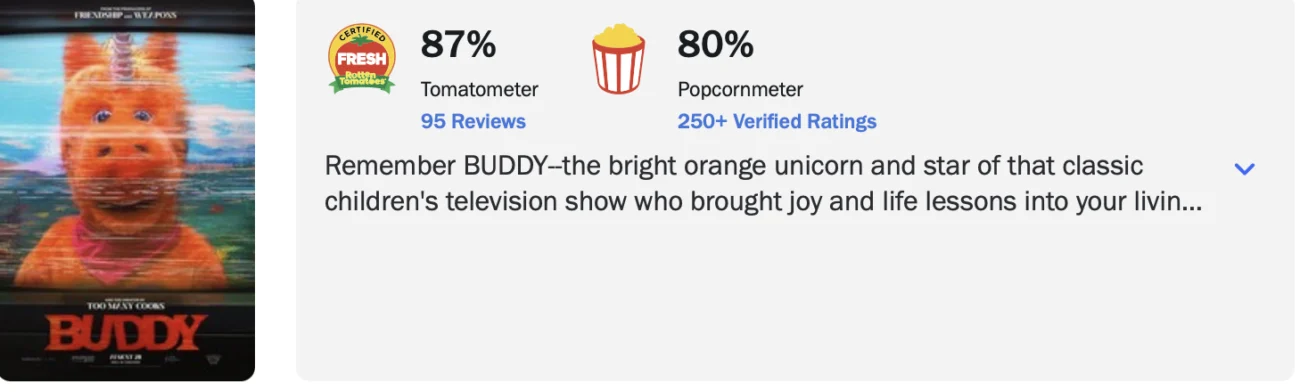
‘Buddy’ made its world premiere at the 2026 Sundance Film Festival as part of the event’s Midnight program, a sidebar section reserved for unconventional horror, dark comedy, and thriller titles, before opening in theaters nationwide on August 28, 2026. Aggregate scores have varied slightly depending on when they were checked, with Metacritic settling into a more measured range. Metacritic assigned the film a weighted score of 64 out of 100 based on 11 critics, which the site classifies as generally favorable.
Much of the critical conversation has focused on the film’s not so subtle homage to a specific piece of childhood nostalgia. Writers have pointed out that ‘Buddy’ plays on a long simmering cultural suspicion about Barney the Dinosaur, framing the purple children’s icon as a low key narcissist and pushing that idea into full blown horror territory.
The cast has also drawn praise beyond its lead performances. The film includes several notable cameos, including one from veteran character actor Clint Howard, alongside a voice performance from Michael Shannon. Keegan-Michael Key’s voice work as Buddy himself has been singled out repeatedly as a highlight, given how the role shifts between comforting and menacing within the same scene.
Sequel Possibilities for the ‘Buddy’ Franchise
Given the film’s reception and its deliberately incomplete mythology, questions about a follow up have already surfaced. Kelly has not been shy about wanting to keep building this world if given the chance.
Kelly indicated to The Direct that he would love to continue the story, noting that he has other ideas about aspects of pop culture he wants to satirize in a similar way, comparing the experience to feeling like a kid in a candy store. That kind of enthusiasm from a director whose film is performing well critically tends to carry some weight with studios weighing a follow up.
Nothing has been formally announced regarding a second film, and the story as released does function as a complete arc for the children at the center of it. Still, the combination of festival buzz, solid reviews, and a filmmaker openly discussing unused lore suggests this will not be the last anyone hears of ‘It’s Buddy’ as a franchise concept.
For now, moviegoers can settle one practical question with confidence, since there is nothing waiting in the credits, though the film itself leaves plenty to think about on the walk out of the theater. What do you make of Buddy’s reset mechanic as a twist on the usual horror villain who just will not stay dead?