‘Field of Dreams’ at 35 Years and Counting, The True Baseball History Behind the Kevin Costner Classic

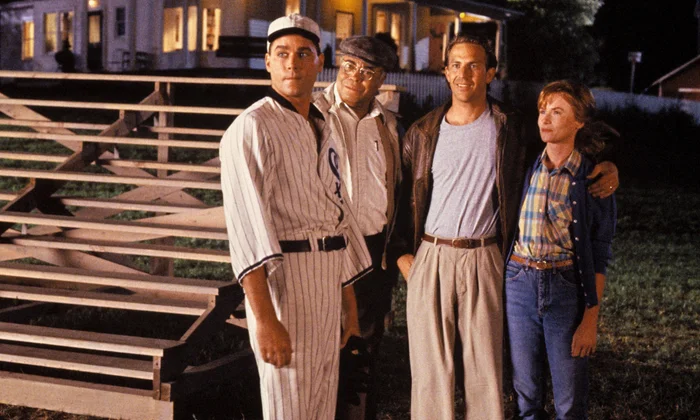

‘Field of Dreams’ has become one of those rare films that feels bigger every year rather than smaller. What started as a modest 1989 release has grown into a fixture of American baseball culture, complete with an actual Major League ballpark built near its Iowa filming site.
Fans revisiting the movie often want to know how much of it actually happened. ‘Field of Dreams’ is partially based on a true story, though the answer is more layered than a simple yes or no, and it says a lot about how Hollywood turns real scandal into myth.
The Novel That Inspired ‘Field of Dreams’
The film was written and directed by Phil Alden Robinson, and it is based on W.P. Kinsella’s 1982 novel titled ‘Shoeless Joe’. The idea originated when Kinsella attended a writers workshop and incorporated other short stories he had written about Jackson.
The book itself pulls from a real athlete rather than a fictional one. The novel is derived from the actual life and profession of baseball outfielder Joseph Shoeless Joe Jackson, who played for the Chicago White Sox.
The path from page to screen was not entirely smooth on the title front. The movie was originally set to keep the novel’s name until test audiences assumed it was about a hippie rather than a baseball player, which led to the change to ‘Field of Dreams’.
That final title stuck for good reason, and the film has since earned lasting institutional recognition. ‘Field of Dreams’ has been inducted into the National Film Registry as a work considered culturally, historically, or aesthetically significant.
The Black Sox Scandal Connection
The emotional core of ‘Field of Dreams’ is fictional, but the scandal underneath it is not. ‘Field of Dreams’ itself is not a true story, but its basis is true, rooted in the 1919 Black Sox scandal with Shoeless Joe Jackson at the center of it.
That scandal involved a group of players who conspired to throw the World Series, and the fallout was severe. Eight players were suspended from organized baseball for life despite later being acquitted, and one gambler’s interview about the botched World Series along with a subsequent investigation and player confessions brought the scheme to light.
The film does not shy away from that history, choosing instead to put the disgraced players front and center. All eight suspended players are depicted in ‘Field of Dreams,’ and the movie shapes how audiences remember these men even though its own plot is fiction.
The corn diamond and the ghostly ballplayers who emerge from it belong entirely to fiction. A corn farm in Iowa was never actually turned into a baseball field on the whim of a dream, even as Jackson and fellow character Moonlight Graham were both real figures.
The Real Players Behind the Story
Moonlight Graham is one of the most poignant characters in the film precisely because his story is grounded in fact. Archibald Wright Graham, a native of Fayetteville, North Carolina, played seven seasons in the minor leagues before his contract was purchased by the 1905 New York Giants.
His brush with the majors was brief almost to the point of disappearing entirely. Graham rode the bench for five weeks before making his debut on June 29, playing right field for the final two innings of an 11 to 1 road win over the Brooklyn Superbas, and he never had a ball hit to him or came to bat before the game ended.
That single unfinished appearance became the emotional backbone of the film’s meditation on missed chances. Around it, Robinson wove in the real weight of the Black Sox era, using genuine names to anchor a story about regret, memory, and reconciliation between fathers and sons.
Legacy on Screen and on the Diamond
Critically, ‘Field of Dreams’ arrived as a slow builder rather than an instant smash. The film became a gradual sleeper hit that never reached number one at the weekend box office, yet it stayed in theaters until December of 1989 thanks to steady, moderate success.
That staying power translated into serious industry recognition a few months later. ‘Field of Dreams’ received three Academy Award nominations, for James Horner’s score, Robinson’s screenplay, and the film itself for Best Picture, though it won none of them. The film was made on a budget of about 15 million dollars and went on to gross roughly 84.5 million dollars worldwide.
Decades later, Major League Baseball turned the movie’s premise into an annual tradition of its own. In 2021, the Chicago White Sox and New York Yankees faced off at the actual filming location in Iowa, a matchup made more meaningful by the fact that Ray Kinsella’s father wears a Yankees jersey at the end of the film while the White Sox carry the legacy of the real Black Sox scandal.
The tradition has continued to expand well beyond that first game. A second Field of Dreams game followed in 2022 between the Cubs and Reds, and after a four year gap tied to construction on the site, the Phillies and Twins met there again in 2026 as the third installment of the event, with Minnesota serving as the host club.
For a small Iowa town, that continued attention has kept a decades old movie feeling current. What began as a quiet story about a farmer, a voice in the cornfield, and a father he could never quite make peace with has turned into a living tradition that Major League Baseball revisits again and again, and it says something about how deeply this particular blend of fiction and real baseball history has stayed with people since 1989.
Given how much of Ray Kinsella’s journey mixes invented magic with the very real heartbreak of the Black Sox scandal, what part of ‘Field of Dreams’ has stuck with you the longest, the cornfield itself, Moonlight Graham’s one inning, or the final catch with his father?