How Brimstone’s Reverse Chronology Builds to Its Devastating Final Chapter


Martin Koolhoven’s ‘Brimstone’ has never been an easy watch, and years after its release, viewers are still working through what actually happens by the time the story reaches its final chapter. The film unfolds backward through the life of a woman named Liz, and once the pieces are assembled in order, the ending lands with considerably more weight than it does on a first viewing.
‘Brimstone’ is a 2016 psychological Western written and directed by Martin Koolhoven, starring Dakota Fanning, Guy Pearce, Emilia Jones, Kit Harington, and Carice van Houten. The film’s structure is part of what makes the ending so difficult to parse on a first pass, and understanding how the chapters connect is the key to understanding what the finale is actually saying about survival and generational trauma.
Brimstone’s Fractured Timeline Finally Comes Together
The film tells the story of a mute woman named Liz who is stalked across the American frontier by a sinister Reverend, a man determined to punish her for a past she thought she had escaped. ‘Brimstone’ is broken into four chapters called Revelation, Exodus, Genesis, and Retribution, and together they form a reverse journey through Liz’s life, starting with her present struggles and working backward to the origins of the conflict.
That structure means audiences meet Liz already in danger before they understand why, and the film only fills in the reasons once the chronology has been fully unwound. Several reviewers have pointed to this backward storytelling as the element that separates ‘Brimstone’ from a conventional revenge Western.
One Letterboxd review described the film as told non-chronologically in four chapters, calling it a deviant film with deviant characters that spits on the typical three-act structure. That kind of fragmented approach is precisely why so many viewers say they needed to sit with the film, or rewatch key scenes, before the finale’s full meaning became clear.
The Reverend’s Reign of Terror Across Liz’s Life
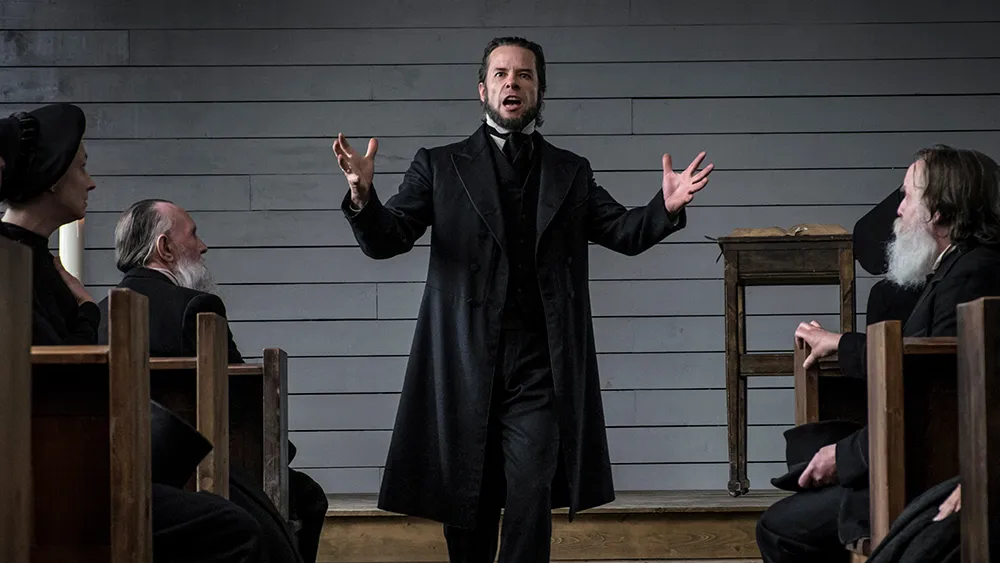
The emotional core of the ending depends on understanding who Liz really is and what the Reverend has taken from her over the course of decades. Liz, played by Fanning, is actually Joanna, the daughter of the Reverend, played by Pearce, a fiery preacher who is also a violent, perverted hypocrite that eventually rapes Liz when she is a child.
He is responsible, directly or indirectly, for the deaths of practically everyone Liz has ever loved, from her mother, who he shames into suicide, to the outlaw Samuel, played by Harington, who the Reverend kills after Samuel tries to save her. Every escape Liz manages only delays the inevitable confrontation, since the Reverend continues finding her no matter how far she runs.
Years later, the Reverend tracks her down again, killing her husband, stepson, and father in law. That cycle of loss is what gives the film’s final act its stakes, because by the time the Reverend catches up with Liz one last time, he has already destroyed nearly every relationship she has built.
Variety’s review of the film frames the character in similarly stark terms, noting that the movie stars Pearce as a Dutch immigrant preacher from hell and Fanning as his daughter, whom he explicitly wants to marry, believing it to be God’s will and citing the biblical story of Lot and his daughters to justify it. That justification is central to understanding why the character behaves the way he does across every chapter of the film.
Liz’s Final Confrontation and What It Means
The climax of ‘Brimstone’ arrives when the Reverend finally corners Liz for what is meant to be the last time. He says he plans to rape his granddaughter while Liz watches and then kill her, but Liz gets free, sets him on fire, and shoots him, blasting him out a window to his death.
That moment functions as the culmination of everything the reverse timeline has been building toward, since audiences now understand the full scope of what the Reverend has done to earn that fate. The violence of the ending mirrors the violence he inflicted throughout Liz’s life, giving the sequence a sense of grim symmetry rather than gratuitous shock.
The film closes with her daughter Sam narrating about the strength of her mother, expressing hope that her mother’s sacrifices would make Sam strong in turn. That narration turns the ending into something generational in the opposite direction of the Reverend’s cruelty, passing resilience forward instead of trauma.
Although ‘Brimstone’ is not based on a specific true story, it draws heavily from the historical realities of the nineteenth century, particularly the oppressive treatment of women under extreme religious and patriarchal systems, using its biblical symbolism to reflect a broader moral struggle between faith and corruption. That grounding is part of why the ending resonates as commentary rather than pure shock value.
How Critics and Audiences Responded to the Ending
‘Brimstone’ has always split opinion, and its ending is often cited as the moment that determines whether a viewer walks away impressed or exhausted. Critics have described the film as walking a fine line between horror and voyeurism, gripping audiences while forcing them to avert their eyes, turning cruelty into spectacle without ever fully tipping into pure exploitation.
Variety’s own assessment of the film captured that tension directly, noting that the film has gruesomely effective moments, and one at times gets caught up in the gears of its big interlocked narrative, but it also has serious longueurs, since a hifalutin exploitation picture like ‘Brimstone’ has too much and not enough on its mind, according to Variety.
Time Out’s review similarly noted that religious hypocrisy looms large in the film, describing it as a revisionist western in which a glowering Guy Pearce embodies a depraved clergyman way beyond salvation. The film was selected to compete for the Golden Lion at the 73rd Venice International Film Festival, where it caused controversy.
It premiered in the Netherlands on 12 January 2017, where it was very well received, as in the rest of Europe, and was released on 10 March in the United States, where it received mixed reviews from critics. That divide in reception has followed the film ever since, with the ending in particular remaining the scene most viewers cite when explaining why ‘Brimstone’ left such a lasting impression on them.
Given how much of the film’s power depends on piecing together Liz’s story in reverse, it seems fair to ask which chapter of ‘Brimstone’ hit hardest once you finally understood where it was leading.