Netflix’s ‘Unabomber’ Reopens the Question of How Many People Ted Kaczynski Really Killed and Injured


Ted Kaczynski’s name resurfaced across search trends this week following the premiere of Netflix’s ‘Unabomber,’ a dramatized account of the mathematician turned domestic terrorist whose bombing campaign gripped the country for nearly two decades. The film has renewed public curiosity about the actual scale of his violence, separate from the fictionalized version now streaming.
The Netflix movie takes a familiar true crime story and focuses on a less commonly explored part of Kaczynski’s life, and the true crime drama premiered on September 25, 2026. Before diving into the production itself, it is worth answering the question driving much of the renewed interest, which is exactly how many victims Kaczynski left behind.
Ted Kaczynski’s Real Death Toll Behind ‘Unabomber’
Ted Kaczynski carried out a bombing campaign that killed three people and injured 23 others between 1978 and 1995. Those attacks were spread across nearly two decades, targeting universities, airlines and other institutions he associated with technological progress.
The FBI’s pursuit became the longest and most expensive manhunt in American law enforcement history before Kaczynski was finally identified and arrested. That drawn out investigation is part of why the case still generates fascination decades later, and why Netflix chose to revisit it now.
Netflix describes the film as being inspired by true events rather than a direct historical recreation, which means some details are dramatized even though the core death toll cited throughout marketing and reviews stays consistent with the historical record. That distinction matters for viewers trying to separate the based on a true story framing from a literal documentary retelling.
Inside Netflix’s ‘Unabomber’ Cast and Story
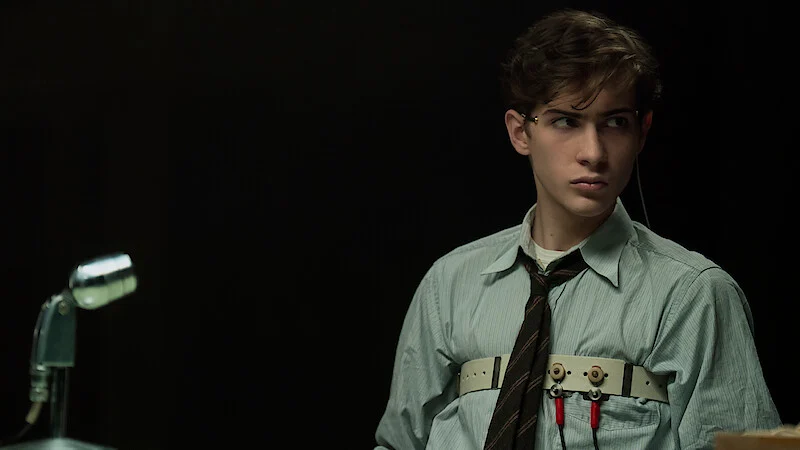
Jacob Tremblay plays the young Kaczynski, while Russell Crowe and Shailene Woodley lead the rest of the main cast. Annabelle Wallis, Alexander Ludwig, Steven Ogg and Marc Menchaca round out the supporting roles.
The film alternates between two timelines, Kaczynski’s time attending Harvard University and his prolonged manhunt decades later. One timeline follows Kaczynski as a young mathematical prodigy at Harvard, while the other tracks the federal investigation that eventually closed in on him.
Crowe plays Professor Henry Murray, who subjected Kaczynski to controversial psychological experiments, and Woodley plays FBI agent Joanne Miller, whose manhunt brings Kaczynski’s troubled past back to the surface. Director Janus Metz described the approach to Tudum by saying ‘Unabomber’ is a story about a young man who feels increasingly disenfranchised by society and decides to take up violence as a means of revenge, a framing he shared with Tudum.
Janus Metz directed the film, with Sam Chalsen and Nelson Greaves writing the screenplay, and Metz previously directed films including Borg vs McEnroe and All the Old Knives. Tremblay is known for films including Room, Wonder and Sovereign, and the director has said Tremblay’s work in that last role helped shape his casting decision.
How the FBI Manhunt Finally Caught the Unabomber
The investigation into Kaczynski stretched across multiple decades before agents connected the mail bombings to a single suspect. His eventual capture came only after his own writings, later published as a manifesto, gave investigators the linguistic clues they needed to identify him.
Kaczynski was subjected to controversial psychological experiments by Professor Henry Murray during his time at Harvard, an experience the film treats as formative to his later radicalization. That thread runs alongside the parallel manhunt storyline rather than existing as a separate flashback structure.
Netflix says the story explores the consequences of ambition and isolation while focusing on the investigation into his bombing campaign. The film uses both timelines to draw a direct line between the young student at Harvard and the man later identified as the Unabomber.
Separating Fact From Dramatization in the New Film
Not every Kaczynski related title on Netflix tells the same kind of story, and the platform already has more than one entry on the subject. ‘Unabomber’ should not be confused with ‘Unabomber, In His Own Words,’ the documentary series already streaming on Netflix, since the new film is a scripted drama rather than an archival documentary.
That earlier documentary series traces Kaczynski’s path from young intellectual to one of the most feared people in American history, relying on interviews and archival footage rather than actors. Viewers looking for a straightforward factual account may still prefer that format over the new dramatization.
Critical response to the scripted film has been mixed so far, with some reviewers questioning how the story frames Kaczynski’s psychology. IndieWire’s review of the film argued that the production leans into a specific interpretation of his mental state rather than presenting a neutral account, a point that has fueled some of the early discussion around the release.
Despite being a dramatization rather than a documentary, reviewers have noted the film stays closer to the facts than many other true crime productions. That balance between dramatized character study and historical accuracy appears to be the central tension critics keep returning to as more responses roll in.
With the real numbers now circulating alongside the film’s release, viewers who just watched Tremblay and Crowe bring this story to the screen are left weighing how much of Kaczynski’s radicalization the movie actually explains, and whether Netflix’s psychological framing changes how they understand the three deaths and 23 injuries that defined his campaign.