Sauron’s Tear at Celebrimbor’s Death Still Divides the Creators of ‘The Rings of Power’


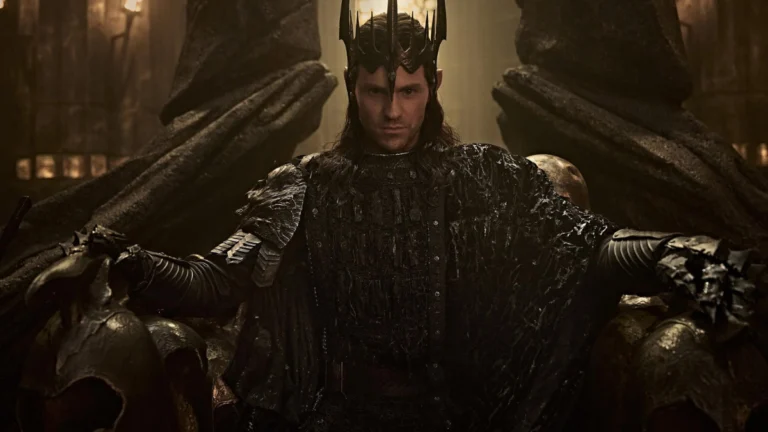
When Sauron shed a tear after the death of Celebrimbor in the second season finale of ‘The Rings of Power’, it stunned viewers who had never seen the Dark Lord show vulnerability. A single tear rolled down his cheek as the elven smith breathed his last.
The question of Sauron’s tear after Celebrimbor’s death has stayed with fans ever since, and the people who made the series have not settled on one answer. The cast and the showrunners have each offered their own reading, and together they say a good deal about how this version of Sauron is built.
Why Sauron Cried When Celebrimbor Died
Celebrimbor, played by Charles Edwards, was the elven smith of Eregion whom Sauron deceived into forging the rings of power. By the finale, Sauron needed the rings that Celebrimbor had hidden, yet the elf preferred to die rather than reveal where they were.
One analysis describes Celebrimbor as a brilliant artist who wanted to preserve Middle-earth, and notes that Sauron turned that ambition into a tool for domination. His death follows Sauron’s torture of him over the whereabouts of the Nine Rings. TV Insider notes that the end of his story was a direct adaptation of J.R.R. Tolkien’s writings.
The Mary Sue reads the moment as Celebrimbor’s parting words touching something in Sauron, which is what brings the tear. That reading points toward what Celebrimbor actually said before he died, which matters as much as the killing itself.
Celebrimbor’s Death and the Words That Landed
Before he was killed, Celebrimbor delivered a prophecy that angered Sauron, telling him that he did not command the rings and was instead their prisoner. The line is one of the sharpest rebukes the character receives in the entire series.
Inverse describes how Sauron insists he is the master of the rings, only for Celebrimbor to counter that he is their prisoner. Once Celebrimbor is gone, Sauron appears worried that the man who helped him make the rings may have been right.
The same piece argues that the exchange challenges the idea that the rings were simply the manifestation of Sauron’s dream. If that is true, the tear may be less about the elf than about what Sauron glimpsed in himself.
Charlie Vickers Explains Sauron’s Emotion
The actor behind the tear has been refreshingly candid. In an interview with Nerdist, Charlie Vickers said he did not know why Sauron cried and that it simply happened in the moment.
Vickers added that he does not think Sauron meant to kill Celebrimbor at that point, but lost control, which he called very Sauron. He suggested the tear may reflect Sauron’s view of himself, what he has become, and his history with Morgoth.
Speaking to CinemaBlend, Vickers explained that he later found a justification in Sauron losing a creative partner after searching for hundreds of years for the breakthrough Celebrimbor made possible. He also pointed to rage and frustration, since Sauron had lost control, and control is central to who he is.
Morfydd Clark, who plays Galadriel, told the same outlet that the tear showed Sauron had underestimated Celebrimbor in every way, and was a final sign that the elf had affected him. Another report on Vickers’s comments likewise stresses Sauron’s anger at Celebrimbor choosing death over giving up the rings.
Showrunner Interpretations of Sauron’s Grief
Showrunners Patrick McKay and J.D. Payne do not share a single explanation for the moment, and McKay said openly that their reasons differ. McKay believes the idea of Sauron having some kind of moment was scripted, though the result grew out of Vickers’s performance.
For McKay, Sauron’s narcissism had been punctured because he was beaten, and he could not face his own defeat. That reading treats the tear as wounded pride more than sorrow, a crack in a villain who is rarely denied.
Payne leans toward regret, describing Sauron as a poisonous snake whose venom destroys anyone he gets close to, and whose partnership with Celebrimbor was ultimately parasitic. In his view, Sauron destroyed the great artist who made the thing he had waited thousands of years for, and a measure of loathing and sadness comes with that. Payne also spoke of a pattern in which everything Sauron touches eventually turns to ashes.
CinemaBlend’s writer concluded that the different views combine into a mosaic built around loathing and regret. Whether the tear marks wounded narcissism, mourning for a lost partner, or the first flicker of recognition that the rings may own him, which of those readings feels truest to you for the tear Sauron shed over Celebrimbor in ‘The Rings of Power’.