‘The Shards’ Trawler Mystery Explained: Who The Serial Killer Really Is In Ryan Murphy And Bret Easton Ellis’ FX Series

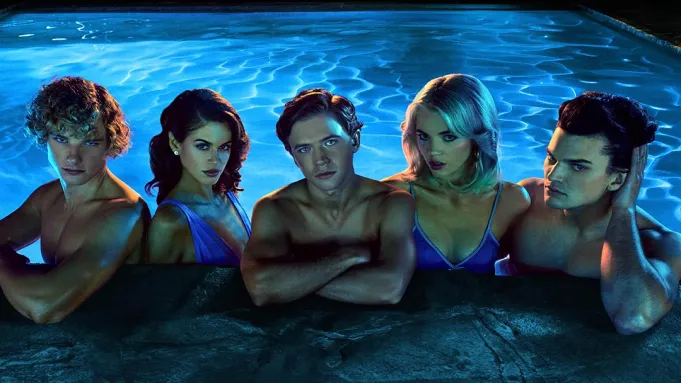

Ryan Murphy’s newest FX collaboration with novelist Bret Easton Ellis has pulled viewers into a fog of paranoia, and the central question hovering over every episode is simple. Who is the Trawler, the masked figure terrorizing a circle of wealthy Los Angeles prep school seniors in 1981.
‘The Shards’ follows 17 year old Bret Easton Ellis and his privileged circle of friends as they navigate their senior year at an elite Los Angeles prep school in 1981, only to find themselves increasingly targeted by a serial killer known as the Trawler. The show has quickly become one of the more discussed genre entries of the year, largely because its central mystery refuses to resolve itself in any conventional way.
The Trawler Killings And The Shadow Over Buckley School
The early part of Hulu’s ‘The Shards’ built dread around the Trawler’s escalating crimes, showcasing a pattern of silent phone calls, rearranged belongings, abductions, and grotesque display of victims. The violence is not framed as random. It creeps closer to Bret and his social circle with each episode, turning what begins as background news into a direct and personal threat.
The two episode premiere ends with the murder of Matt Kellner, played by Owen Painter, whom the unreliable narrator and protagonist Bret Easton Ellis was secretly in a physical relationship with. The episode closes with Bret listening to a tape left on his door detailing the final moments of Matt and his torture by the Trawler, who had earlier only targeted girls and young women. That shift in victim pattern is part of what makes the killer feel unpredictable rather than methodical.
The premiere also closes on an ominous note, with Bret answering a phone call filled with static, heavy breathing, and a boy’s voice begging for help before the screen cuts to black. These moments are staged less like traditional slasher beats and more like intrusions into Bret’s already fragile sense of reality, which is part of the show’s larger design.
Robert Mallory And Bret’s Growing Suspicion
Bret became obsessed with the idea that Robert is the Trawler, mainly because Robert’s arrival coincides with the murders. The stranger, Robert Mallory, is a new student who arrives at Bret’s school more than a year after Bret first sees him during a screening of ‘The Shining,’ and Bret recognizes him immediately while Robert claims they have never met.
Episode one does not reveal whether Robert is the killer, since that would be far too easy, and instead makes Robert suspicious enough to justify Bret’s fear while making Bret obsessive enough to question everything he tells the audience. The cast surrounding that central tension includes Kaia Gerber as Susan Reynolds, Homer Gere as Robert Mallory, Hayes Warner as Debbie Schaffer, and Graham Campbell as Thom Wright.
Robert is charming but also very reserved, and before long he becomes the prime suspect in Bret’s growing obsession about figuring out who the Trawler really is. Wes Bentley also appears as Terry Shaffer, Debbie’s father, whose role grows more significant as the investigation unfolds. Whether Robert is genuinely dangerous or simply a convenient target for Bret’s paranoia remains an open question through the early episodes.
What The Book Reveals About The Trawler’s True Identity
Anyone hoping the series will hand over a clean answer may want to adjust expectations. In Ellis’ book that the show is based on, the identity of the Trawler killer was never fully revealed.
Fans and readers had long debated the ending, with theories clustering around a few main possibilities. Some suggested that Bret himself was the Trawler, since he was an unreliable narrator in the novel due to his drug addiction and his compulsive need to narrate events with a certain dramatic flair, possibly fabricating the story to elevate himself as both a hero and a victim. His detailed knowledge of certain murder scenes and his direct involvement in Robert’s death make him a prime suspect in that reading. Others argued the title itself is a metaphor for fragments of Bret’s already fractured psyche, while another theory points to a completely separate individual with no direct connection to Bret’s circle, someone who operated independently and simply became obsessed with Robert Mallory.
A different prevailing theory holds that the Trawler killings are not fully real in the way Bret presents them, with some readers arguing Bret invented or exaggerated the serial killer narrative to heighten drama or craft a more enticing story. When ‘The Shards’ was originally released as a novel, Ellis himself explained that the entire serial killer thriller subplot involving the Trawler, along with the related appearance of Robert Mallory, was a fictional invention layered onto an otherwise autobiographical framework.
How Ryan Murphy’s Adaptation Might Handle The Answer
Since ‘The Shards’ is co-created by Ryan Murphy and Bret Easton Ellis himself, fidelity to the book’s ambiguity is plausible, especially considering Murphy’s track record with unresolved thrillers. So far, the first two episodes have mirrored the novel closely, anchored by Bret’s growing suspicion of Robert and the establishment of the Trawler’s sinister presence.
Critical reception out of the gate has been divided, with some reviewers praising the show’s mood and soundtrack while others have found the characters thin and the tone more style than substance. That split mirrors much of the original discourse around Ellis’ novel, which similarly divided readers over whether its refusal to name a killer was a strength or a frustration.
The first season of ‘The Shards’ contains nine episodes and comes to an end with its season finale in September, releasing new episodes on Wednesdays on both FX and Hulu. Whether the show ultimately breaks from the book’s ambiguity or embraces it fully will likely define how the season is remembered once the finale airs.
For now, the Trawler’s identity remains the show’s central unanswered question, and given how closely the adaptation has tracked the novel’s structure, viewers may be watching a mystery designed never to fully resolve. What theory are you leaning toward as Bret’s suspicion of Robert keeps building each week?