‘The Social Reckoning’ Review: A Familiar Villain Returns, But Who Gets the Last Word?


Sixteen years after ‘The Social Network’ turned Facebook’s origin story into a crackling thriller, Aaron Sorkin steps back into that world with ‘The Social Reckoning’. This time he writes and directs, and Sony releases the film in theaters on October 9. It is pitched as a companion piece rather than a straight sequel, which tells you he knows exactly how big the shadow is.
The setting has moved on from dorm room ambition to the fallout of the 2021 Facebook Files. Mikey Madison plays Frances Haugen, an engineer on the company’s Civic Integrity team who still believes in the mission but grows uneasy about what the feeds are pushing at people. Jeremy Allen White plays Wall Street Journal reporter Jeff Horwitz, who has to work hard to get her to hand over the proof.
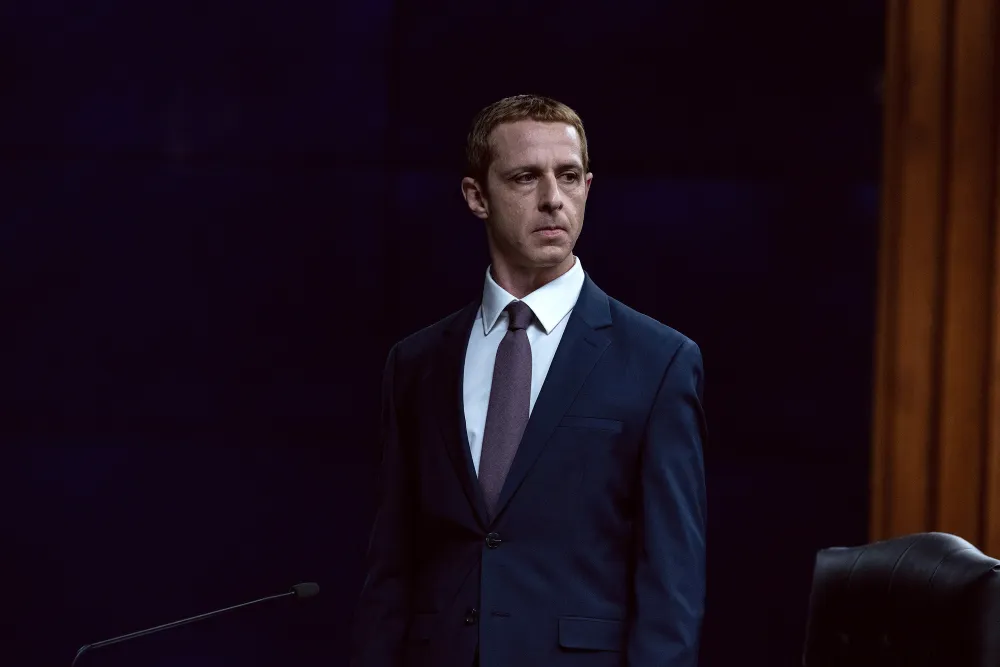
Cutting through that story are scenes set on January 6, 2021, when Jeremy Strong’s Mark Zuckerberg prepares for a Senate hearing and argues about free speech with a former associate played by Bill Burr. The film has the ingredients of a gripping legal and journalistic drama, and the cast is a big reason it mostly holds together. It is just that the filmmaking around them never quite matches the quality of the talent on screen.
Madison and White are the heartbeat here. Their meetings are full of sparring and wary trust, and the film is at its best when the two of them are simply talking across a table. Madison gives Haugen real conviction without turning her into a saint, and White plays the reporter with a dry patience that lets her do the heavy lifting.
Strong’s Zuckerberg is trickier to assess. He plays the billionaire with a stiff, imperious chill that sometimes tips into caricature, yet it is hard to look away from him. I wanted more of him, especially opposite Burr, whose scenes carry the sharpest dialogue in the film. Betty Gilpin, Billy Magnussen and Wunmi Mosaku round out a supporting cast that Sorkin’s rhythms clearly suit.
The trouble is how it all looks and sounds. The visuals are clean and efficient but flat, closer to polished television than to anything that lingers in the memory. Alexandre Desplat’s score, stepping in for the Trent Reznor and Atticus Ross sound that defined the original, leans on the drama a little too hard. The January 6 sequence also feels smaller than the weight of the day demands.
Sorkin’s script is smart and timely, and the free speech debate at its center refuses to settle into easy answers. Still, he plainly casts Zuckerberg as the wrongdoer, and the story resolves more neatly than the real world ever has. That tidiness softens a film that wants to hit as a reckoning, even if the talk itself stays lively from start to finish.
I left ‘The Social Reckoning’ impressed by its performances and a little frustrated by its restraint. It is not the equal of the film it follows, but it has enough sharp writing, strong acting and relevance to earn its place. I give it 7 out of 10.
Did Sorkin’s return to Facebook’s story land for you, or should he have left Zuckerberg alone after ‘The Social Network’? Tell me in the comments whether you agree with my verdict.