


20 Thrilling Page-Turners for Cozy Fall Evenings



When the air turns crisp and evenings draw in, a tense story can keep you turning pages long after the kettle cools. This list gathers twisty mysteries, psychological shocks, legal tangles, and high stakes chases that suit a quiet night in with a blanket and a warm cup.
You will find books set in small towns, big cities, and isolated places where secrets thrive. Each pick includes quick details on plot, setting, and what makes the structure tick, so you can spot the ones that fit your reading mood without any guesswork.
Gone Girl – Gillian Flynn

‘Gone Girl’ follows Nick and Amy Dunne after Amy disappears on the morning of their fifth wedding anniversary. The story uses alternating points of view from Nick in the present and Amy’s diary entries, which creates a timeline that slowly closes the gap between two conflicting versions of the marriage.
Published in 2012, ‘Gone Girl’ is set in North Carthage in Missouri and also New York City during earlier chapters. It explores unreliable narration, media scrutiny, and the gap between public image and private behavior through precise clues that shift meaning as new chapters arrive.
The Girl with the Dragon Tattoo – Stieg Larsson

‘The Girl with the Dragon Tattoo’ pairs journalist Mikael Blomkvist with hacker Lisbeth Salander as they investigate the decades old disappearance of Harriet Vanger. The case leads them through family archives, corporate fraud, and a remote Swedish island during a locked room style period.
First released in 2005 in Sweden, ‘The Girl with the Dragon Tattoo’ opens the Millennium trilogy and blends financial crime with a cold case puzzle. The novel includes inserted documents, articles, and research notes that support the procedural work and help track the many Vanger family ties.
The Silent Patient – Alex Michaelides

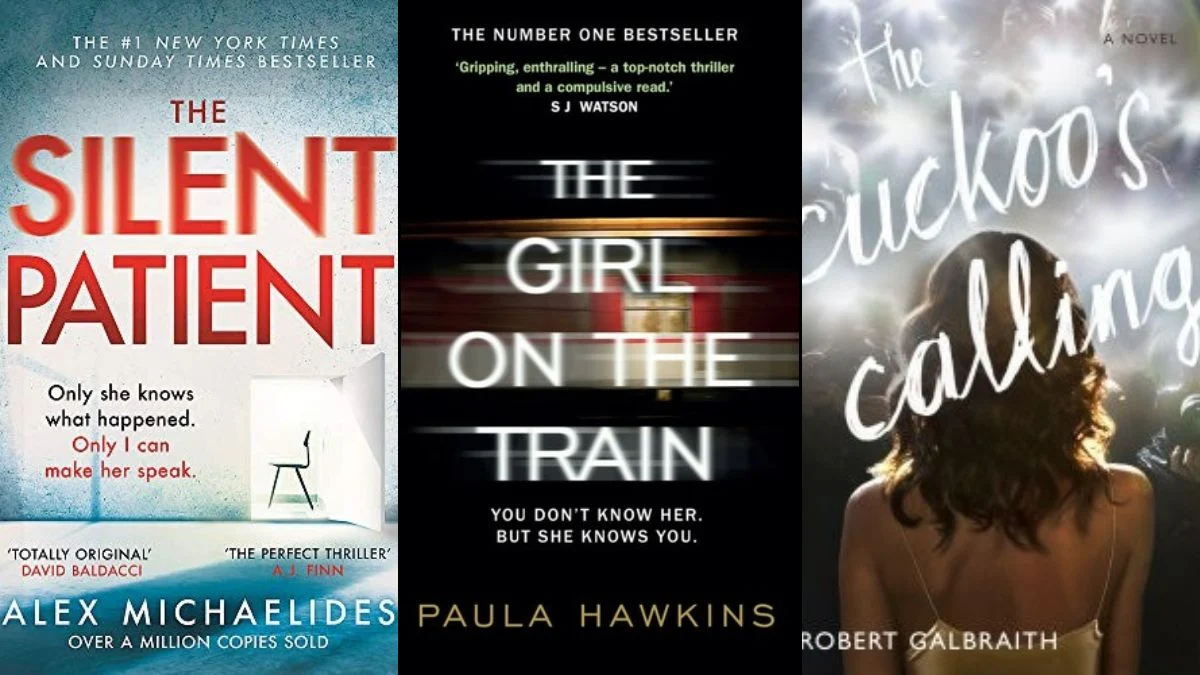
‘The Silent Patient’ centers on Alicia Berenson, a painter who stops speaking after being charged with murdering her husband. Psychotherapist Theo Faber secures a job at the secure facility where Alicia lives and tries to decode her silence using therapy sessions and personal research.
Published in 2019, ‘The Silent Patient’ unfolds in London and uses Alicia’s cryptic art as a clue trail. The book relies on clinical records, diary excerpts, and a tight first person frame that controls the flow of information about motive and identity.
The Girl on the Train – Paula Hawkins
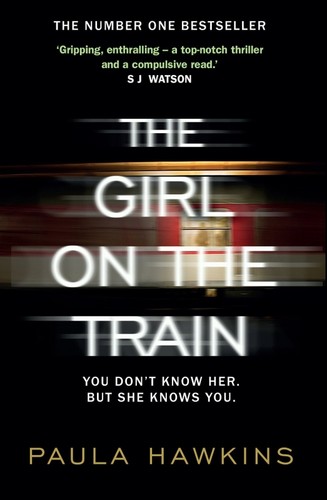
‘The Girl on the Train’ follows Rachel Watson, who observes a couple from her commuter train and later becomes involved in a missing person investigation. The narrative alternates among three women and marks chapters by date and time to map where each person was during key events.
Released in 2015 and set around London, ‘The Girl on the Train’ focuses on memory gaps and witness reliability. Police interviews, neighborhood geography, and the train timetable act as structural tools that help readers reconstruct the night in question.
The Da Vinci Code – Dan Brown
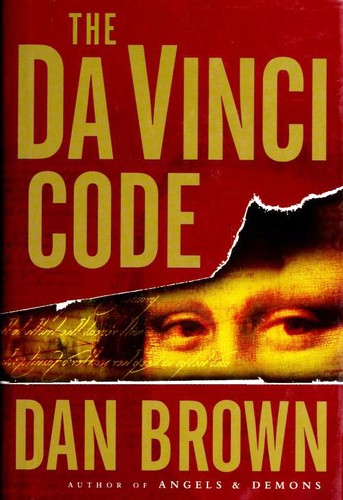
‘The Da Vinci Code’ opens with a murder in the Louvre and sends symbologist Robert Langdon and cryptologist Sophie Neveu across Paris and beyond. The plot uses ciphers, anagrams, and artworks to connect clues that point toward a secret hidden by a historical society.
First published in 2003, ‘The Da Vinci Code’ moves at the pace of a chase while incorporating art history and religious symbolism. Short chapters, frequent reveals, and puzzle based progressions create a clear breadcrumb path through museums, churches, and archives.
Shutter Island – Dennis Lehane

‘Shutter Island’ follows U.S. Marshal Teddy Daniels as he arrives at Ashecliffe Hospital to locate a missing patient. A storm isolates the island and disrupts power, which traps investigators and staff together while medical records and patient files go missing.
Published in 2003, ‘Shutter Island’ takes place in 1954 and layers psychological evaluation over noir investigation. The setting uses ward maps, treatment logs, and intake forms to shape the mystery while the timeline narrows toward a final diagnostic interview.
The Snowman – Jo Nesbø

‘The Snowman’ features Oslo detective Harry Hole as he tracks a serial killer who leaves snowmen at crime scenes. The investigation spans multiple winters and connects disappearances that were never linked before.
First released in English in 2010, ‘The Snowman’ includes forensic details from cold environments and uses weather patterns to explain evidence loss. Police reports, national databases, and case reconstructions build a procedural framework that supports the search.
The Woman in the Window – A. J. Finn
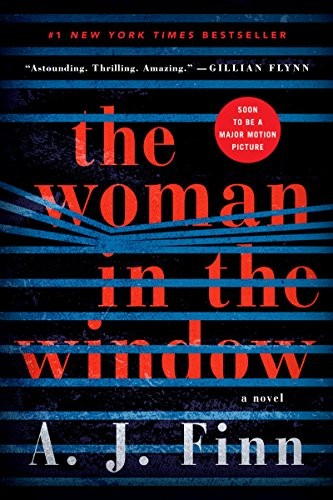
‘The Woman in the Window’ centers on Anna Fox, an agoraphobic woman who believes she witnesses a crime in the house across the street. The story includes online forums, therapy notes, and classic film references that mirror Anna’s isolated routine.
Published in 2018 and set in New York City, ‘The Woman in the Window’ uses a single location to heighten the focus on sight lines, camera angles, and what can be observed from a townhouse window. The timeline marks medication intake and weather to test the accuracy of each observation.
The Lincoln Lawyer – Michael Connelly

‘The Lincoln Lawyer’ introduces defense attorney Mickey Haller, who runs his practice from the back of a chauffeured sedan. He takes on a high profile client accused of assault and begins to connect the case to a past client through discovery materials.
Released in 2005, ‘The Lincoln Lawyer’ is the first book in the Mickey Haller series and provides a clear view of plea deals, jury selection, and the mechanics of a criminal defense. Motions, transcripts, and investigator notes create a legal paper trail that guides the plot.
The Firm – John Grisham

‘The Firm’ follows Mitch McDeere, a new associate at a small Memphis firm that pays unusually well. As he notices irregular billing and secretive client lists, he becomes entangled with federal agents who need inside evidence.
First published in 1991, ‘The Firm’ explains how offshore accounts, numbered files, and confidentiality policies can shield criminal enterprises. The story tracks covert photocopying, coded ledgers, and surveillance countermeasures that show the practical steps in exposing financial crime.
And Then There Were None – Agatha Christie

‘And Then There Were None’ gathers ten guests on a private island and accuses each of a past crime. A poem and a set of figurines act as a countdown device as guests are eliminated one by one according to the rhyme.
Originally published in 1939, ‘And Then There Were None’ uses an isolated setting with no working communication lines to frame the investigation. The novel presents inventories, guest lists, and room searches that allow readers to test theories about opportunity and means.
The Cuckoo’s Calling – Robert Galbraith
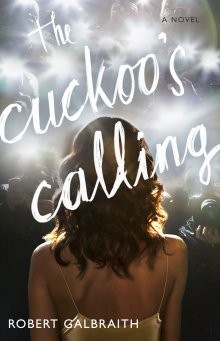
‘The Cuckoo’s Calling’ introduces private investigator Cormoran Strike, who is hired to look into the death of supermodel Lula Landry. The case leads through London’s fashion and media worlds as Strike and his assistant Robin Ellacott interview witnesses and analyze schedules.
Published in 2013, ‘The Cuckoo’s Calling’ structures the inquiry around alibis, timelines, and the layout of a Mayfair building. Phone records, security logs, and agency contracts help separate rumor from verifiable fact as the case progresses.
Before I Go to Sleep – S. J. Watson

‘Before I Go to Sleep’ follows Christine Lucas, who wakes each day without long term memory and must rebuild her understanding of her life. She keeps a secret journal that documents new discoveries and warns her about past contradictions.
Released in 2011 and set in London, ‘Before I Go to Sleep’ uses the journal entries as a narrative device that resets the stage for each day. Medical appointments, photographs, and voicemail messages act as external proof that either confirm or challenge what Christine is told.
The Silence of the Lambs – Thomas Harris

‘The Silence of the Lambs’ pairs FBI trainee Clarice Starling with imprisoned psychiatrist Hannibal Lecter, who provides insights on a killer known as Buffalo Bill. The investigation moves through case files, autopsy reports, and behavioral analysis techniques.
Published in 1988, ‘The Silence of the Lambs’ demonstrates how profiling, victimology, and evidence classification inform fieldwork. The book includes precise operational details for interagency coordination and the preparation that leads into a final rescue.
The Chain – Adrian McKinty

‘The Chain’ presents a kidnapping scheme in which parents must abduct another child to free their own. The plot follows Rachel as she receives instructions by phone and online while she works to locate the origin of the network.
First published in 2019, ‘The Chain’ covers digital security practices, burner accounts, and cash handling that allow a criminal chain to operate. Timelines, call logs, and threat assessments provide structure as Rachel gathers data points that reveal the system’s creators.
Behind Closed Doors – B. A. Paris
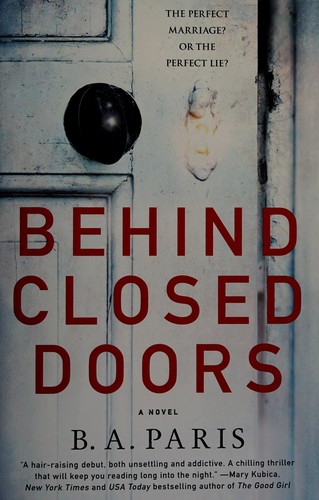
‘Behind Closed Doors’ portrays a marriage that appears perfect in public while concealing strict control at home. The story alternates between past and present to show how small choices led to a dangerous situation.
Released in 2016, ‘Behind Closed Doors’ explains legal and logistical barriers that victims face when trying to leave. Bank access, property deeds, and social schedules become tools for control, and the plot follows the steps required to build a safe exit plan.
The Reversal – Michael Connelly

‘The Reversal’ teams defense attorney Mickey Haller with prosecutor Rachel Walling for a high profile retrial, while detective Harry Bosch handles the investigation side. The case involves new forensic interpretations that challenge an old conviction.
Published in 2010, ‘The Reversal’ alternates between courtroom strategy and fieldwork. Chain of custody, jury instructions, and expert testimony are presented in clear stages that show how evidence can gain or lose weight during a retrial.
The Alienist – Caleb Carr

‘The Alienist’ is set in 1896 New York City and follows Dr. Laszlo Kreizler, an early psychologist, as he profiles a killer targeting children. The team includes a reporter and the first woman to work at the police department in a clerical role who brings access to records.
First published in 1994, ‘The Alienist’ uses period accurate research methods such as fingerprint experiments and map overlays of elevated train routes. Historical figures appear in supporting roles, and the book provides detail on how a modern investigative approach took shape.
I Am Watching You – Teresa Driscoll

‘I Am Watching You’ begins when a witness notices two men chatting with teenage girls on a train and later learns that one of the girls has vanished. The narrative rotates among the witness, the missing girl’s father, and the investigator to cover different angles.
Released in 2017, ‘I Am Watching You’ uses letters, hotline tips, and neighborhood canvassing to expand the pool of information. The structure timestamps statements and sightings to test which reports hold up when cross checked against travel time and phone activity.
Killing Floor – Lee Child

‘Killing Floor’ introduces Jack Reacher as he arrives in the small town of Margrave in Georgia and is arrested for a murder he did not commit. The investigation uncovers a counterfeiting operation that ties into federal jurisdiction.
First published in 1997, ‘Killing Floor’ explains how cash distribution, printing plates, and transport schedules can sustain large scale forgery. The book tracks interviews, warehouse searches, and cooperation between local and federal agencies as the case expands.
Share your favorite fall page turners in the comments so other readers can find their next thriller.