


Top 15 Creatures from Greek Mythology



Greek myth teems with unforgettable creatures—some born from divine rivalries, others shaped by curses, and many set against heroes whose stories still echo today. These beings guarded the thresholds of the underworld, haunted perilous seas, and challenged the bravest mortals with riddles, claws, and enchanted song. Below are fifteen of the most iconic, with where they come from, what they did, and which myths made them famous.
Medusa

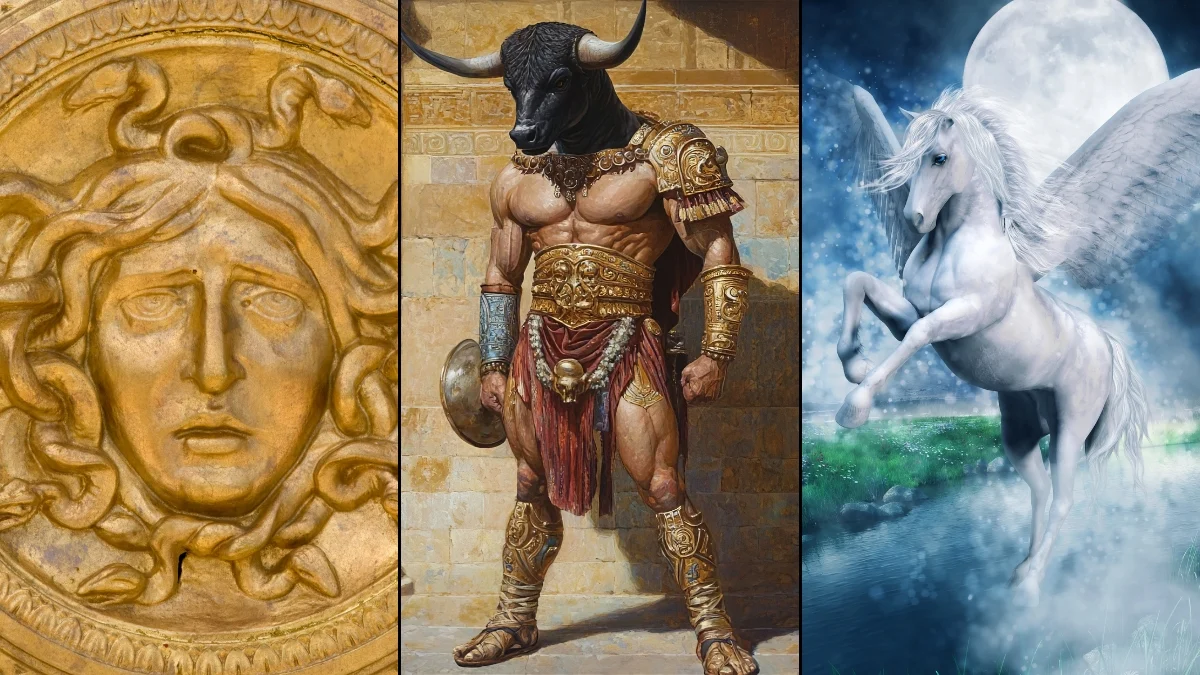
Medusa is the mortal Gorgon whose gaze turned onlookers to stone. Beheaded by Perseus, she is said to have birthed Pegasus and Chrysaor when her blood struck the ground. Ancient sources describe her as once beautiful before being transformed, and her severed head became a protective emblem on shields and armor.
Minotaur

The Minotaur—half man, half bull—was confined in the Labyrinth built by Daedalus on Crete. Born from Pasiphaë and the Cretan bull, it fed on sacrificial youths until Theseus slew it. The creature’s story intertwines with political tribute, architectural ingenuity, and the founding legends of Athens.
Lernaean Hydra

The Hydra was a multi-headed serpent from the marshes of Lerna, with heads that regrew—two for every one cut off. Heracles defeated it in his second labor by cauterizing the necks with help from Iolaus, and he buried the immortal head. Its poisonous blood later played a fatal role in Heracles’ own story.
Cerberus

Cerberus is the many-headed hound guarding the gates of Hades to prevent the dead from leaving. Often depicted with three heads and a serpent’s tail, he is a child of Typhon and Echidna. Heracles captured him alive in his twelfth labor, demonstrating mastery over death’s threshold.
Chimera

The Chimera is a fire-breathing hybrid—typically lion in front, goat along the back, and serpent for a tail. Often called a child of Typhon and Echidna, it ravaged Lycia until Bellerophon killed it, aided by Pegasus. Some accounts say he used a lead-tipped spear that melted in its flames, suffocating the beast.
Pegasus

Pegasus is the winged horse that sprang from the blood of Medusa at her death. Tamed by Bellerophon with a bridle given by Athena, Pegasus helped him defeat the Chimera and perform daring feats. Later tradition places the horse in Zeus’s service, associated with thunder and the sky.
Cyclopes

The Cyclopes appear in two main traditions: the divine smiths (Brontes, Steropes, and Arges) who forged Zeus’s thunderbolts, and the pastoral giants like Polyphemus encountered by Odysseus. The smiths are linked with subterranean forges and volcanic fire. Polyphemus’s episode highlights their solitary, lawless way of life.
Sirens

Sirens were enchantresses of the sea whose songs lured sailors to destruction. Early Greek art depicts them as bird-bodied with human heads, dwelling near rocky islands such as Anthemoessa. Odysseus escaped them by stopping his crew’s ears with wax, while Jason’s Argonauts were saved by Orpheus’s counter-song. Their myth underscores the peril of irresistible knowledge and sound.
Harpies

Harpies are storm spirits known as “snatchers,” associated with sudden disappearances and the winds. Named figures include Aello, Ocypete, and Celaeno. They tormented the seer Phineus by defiling his food until the Boreads drove them away during the Argonauts’ voyage.
Sphinx

The Greek Sphinx is a female monster with a woman’s head, lion’s body, and wings, sent to plague Thebes. She posed a riddle and devoured those who failed to answer; Oedipus’s correct reply led to her death. Traditions often name her parents as Typhon and Echidna, tying her to other monstrous lineages.
Nemean Lion

The Nemean Lion terrorized the region with a hide that no weapon could pierce. Heracles strangled it in his first labor and skinned it using its own claw, thereafter wearing the pelt as armor. The lion’s defeat marked the beginning of Heracles’s cycle of labors.
Scylla

Scylla is a sea monster lurking opposite Charybdis, often set in the Strait of Messina. Once a nymph, she was transformed—variously through jealousy—into a creature with multiple heads that plucked sailors from ships. Odysseus chose to pass near her rather than risk total destruction by the whirlpool.
Charybdis

Charybdis is a monstrous whirlpool that swallowed vast quantities of seawater and belched it out again. Positioned across from Scylla, she forced mariners into a deadly choice. Some traditions name her a daughter of Poseidon and Gaia, reflecting the ocean’s raw, tectonic power.
Centaurs

Centaurs are beings with a human torso and a horse’s body, associated with the highlands of Thessaly. They are central to the mythic battle with the Lapiths at King Pirithous’s wedding. The wise centaur Chiron stands apart as a cultured teacher of heroes, including Achilles and Asclepius.
Satyrs

Satyrs are woodland spirits linked with Dionysus, revelry, and the untamed countryside. In early Greek art they often have horse-like tails and ears, while Roman adaptations shift toward goat-features and are commonly called fauns. They appear alongside nymphs and Silenus, embodying fertility, music, and the comic side of mythic narratives. Their presence in satyr plays connects them to Athenian theater and ritual.
Share your favorite Greek myth creature—or one we missed—in the comments!