What Happens to Odysseus at the End of Christopher Nolan’s ‘The Odyssey’

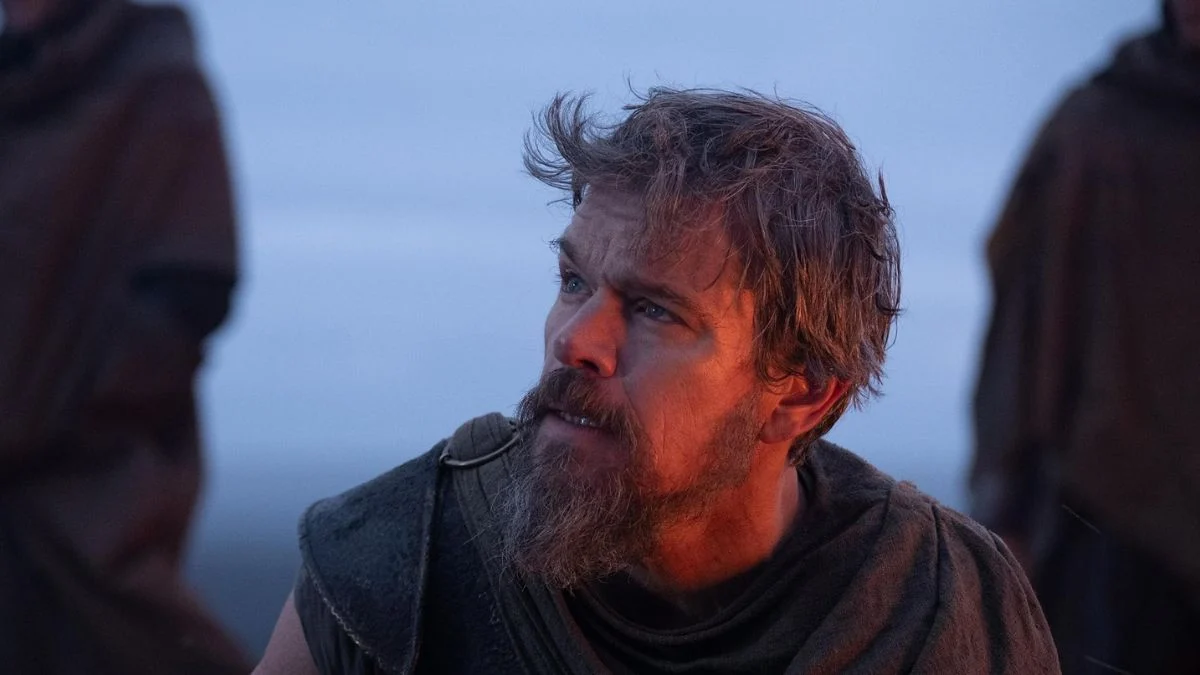

Christopher Nolan’s adaptation of Homer’s ancient poem has become one of the year’s defining theatrical events, and much of the conversation since its release has centered on how the filmmaker chose to end the story. Matt Damon plays the title role in ‘The Odyssey,’ a king who spends a decade fighting the Trojan War before enduring another ten years of trials on his way home to Ithaca.
Fans who know the source material well have been asking a specific question since the film’s premiere, wondering whether Nolan’s version reveals how Odysseus ultimately dies. The one big question the film doesn’t answer is Odysseus’s ultimate fate, a detail fans have continued asking about since the movie opened. That ambiguity has become one of the more talked about choices in Nolan’s retelling of the epic.
Odysseus’s Return to Ithaca and the Fate of the Suitors
The film follows the broad shape of Homer’s narrative while adding its own texture along the way. After constructing the Trojan horse and taking Troy, Odysseus and his men choose a less traveled route home, a decision that proves disastrous for the crew. His men are picked off one by one through encounters with a Cyclops, the songs of the Sirens, and the anger of a god after the crew eats his sacred cattle, an act that leads to their ship being torn apart.
Odysseus survives the wreck but pays a steep price for his solitude. He washes up alone and spends nearly seven years with Calypso, played by Charlize Theron, before finally finding his way back to Ithaca. Once home, the film follows the poem’s climax fairly closely in its broad strokes.
Back in Ithaca, Odysseus challenges and kills the suitors who had been circling his household, then reunites with his family and reclaims his throne. That confrontation, one of the most famous sequences in the original text, plays out as the emotional and narrative peak of the film’s back half.
The cast surrounding Damon during this stretch of the story includes some of Nolan’s frequent collaborators. Anne Hathaway plays Penelope, Odysseus’s wife, whose patience and cunning are central to the household drama that unfolds while her husband is away.
Nolan’s Ending Twist and the Fate of Odysseus
Where Nolan departs most sharply from Homer is in what happens after the suitors are dealt with. Rather than closing on a note of restored order, Nolan reimagines the aftermath of Odysseus’s homecoming after ten years fighting in Troy and another ten years trying to return to his kingdom.
The ending Nolan lands on is bittersweet for both Odysseus and Penelope, since after murdering the suitors who had been courting her, Odysseus is exiled from Ithaca rather than allowed to simply resume his reign. He and Penelope then leave their son Telemachus, played by Tom Holland, behind and sail west toward the setting sun, fulfilling a vision Penelope had described when news of the Trojan War first broke out.
That choice reframes the film’s title in a literal sense, since Odysseus’s odyssey does not conclude with his arrival home. Nolan’s script also leans into a broader historical idea that colors how audiences read the final stretch of the film.
Did you like the ending to 'The Odyssey?'
Several characters throughout the film reference a mysterious seafaring group known as the people from the sea, who have been raiding settlements and palaces, and by the film’s end Odysseus admits to Penelope that he and his fellow Greeks are in fact that very group. This plot thread draws on a real historical mystery involving groups of seafarers who arrived in the eastern Mediterranean toward the end of the Bronze Age. Because the film stops short of depicting Odysseus’s death, the question of how the character eventually dies remains something audiences are left to speculate about beyond what appears onscreen.
Critical and Box Office Reception
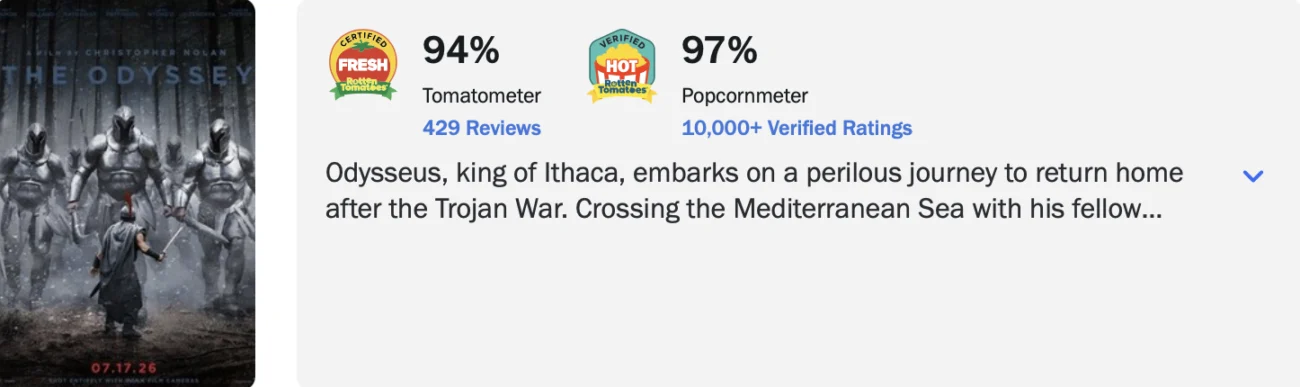
The response from critics has been notably strong even by Nolan’s standards. The Odyssey earned a 95 percent score from critics, making it Nolan’s highest rated film and surpassing both ‘The Dark Knight’ and ‘Memento.’ Audiences responded even more enthusiastically, giving the film a 97 percent score on Rotten Tomatoes’ Popcornmeter, a new high for a Nolan release.
The box office numbers have matched the critical enthusiasm. The film opened to 124.5 million dollars domestically across roughly 3,900 North American screens, marking the year’s biggest live action debut at that point. Globally, the film had already brought in 282.1 million dollars against its 250 million dollar production budget within its first several days.
Reviews from major outlets have generally praised the film’s scope while noting the challenges of adapting such a sprawling source text. In his review for The Hollywood Reporter, chief film critic David Rooney described the movie as a meditative action film both immense and intimate, while noting its flow is occasionally impeded by the episodic nature of its nonlinear structure. That mix of praise and measured critique has been echoed across much of the critical conversation surrounding the release.
The Cast and Nolan’s Adaptation of Homer’s Epic
Beyond Damon, Hathaway, and Holland, the film assembles one of the largest ensembles of Nolan’s career. The cast includes Zendaya, Lupita Nyong’o, Robert Pattinson, Charlize Theron, Jon Bernthal, Benny Safdie, Elliot Page, Himesh Patel, Bill Irwin, and Samantha Morton. Several of these actors, including Damon, Hathaway, and Pattinson, have worked with Nolan before on films such as ‘Interstellar,’ ‘Oppenheimer,’ and ‘Tenet.’
The production reflects Nolan’s long standing commitment to large format filmmaking. Universal scheduled the film for a global IMAX rollout, continuing the director’s preference for high quality large format projection previously seen in films like ‘Dunkirk’ and ‘Tenet.’ The story itself follows Odysseus as he faces a dangerous voyage back to Ithaca, encountering figures like the Cyclops Polyphemus, the Sirens, and the sorceress Circe along the way.
For a filmmaker who built his reputation on original screenplays and time bending structures, adapting a text as old and as widely known as Homer’s poem represented a distinct kind of challenge. The finished film suggests Nolan found room within that ancient framework to tell a story that still feels distinctly his own, even as it leaves Odysseus’s ultimate fate unresolved.
Given how firmly Nolan’s ending departs from the version most readers grew up with, it’s worth asking how audiences who know ‘The Odyssey’ well feel about sending Odysseus back out to sea instead of letting him finally rest in Ithaca.