


What Kind of Mark Does Gandalf Put on Bilbo’s Door? Difference Between the Book & the Movie Explained




In this article, I am going to give you a description of the symbols that Gandalf marked on Bilbo’s door, both in the book and in the movie. You’re going to find out where they came from, what they look like, and what they mean. I’ve done quite a little study for you, so stick around until the end!
In The Hobbit, what does Gandalf draw on Bilbo’s door?
In the first chapter of The Hobbit, we find out that Gandalf writes a symbol on Bilbo’s “beautiful green door”. We do not actually know what that symbol looks like, as Tolkien himself never described it:
“After a while he stepped up, and with the spike of his staff scratched a queer sign on the hobbit’s beautiful green front-door.”
– The Hobbit, Chapter I, “An Unexpected Party”
The symbol (or rather, the symbols) were put on the door so that the invited Dwarves, led by Thorin Oakenshield, knew which house they had to come to. It was, as Glóin said on one occasion, a standard practice in the trade. Glóin also describes the three symbols, defining their meaning:
“Yes, yes, but that was long ago,” said Glóin. “I was talking about you. And I assure you there is a mark on this door-the usual one in the trade, or used to be. Burglar wants a good job, plenty of Excitement and reasonable Reward, that’s how it is usually read. You can say Expert Treasure-hunter instead of Burglar if you like. Some of them do. It’s all the same to us. Gandalf told us that there was a man of the sort in these parts looking for a Job at once, and that he had arranged for a meeting here this Wednesday tea-time.”
– The Hobbit, Chapter I, “An Unexpected Party”
And while Glóin does tell us what the symbols represent and confirms that they have been used as an in-trade symbol of identification, he doesn’t really tell us what they look like. Luckily for us, Tolkien himself made an illustration that allows us to roughly identify the symbols (on the right is the symbol drawn in the movie):
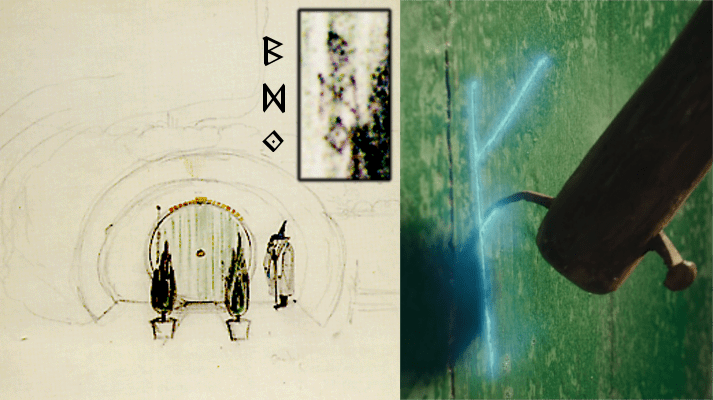
So, we see that the first symbol (a “B” in Anglo-Saxon and a “B” or an “M” in Cirth) represents the Burglar; the second symbol (a “D” in Anglo-Saxon or a group – either “nd” or “nj” – in Cirth) represents Danger; while the third symbol (a diamond which does not correspond to any letter) represents a Reward. So, by interpreting Tolkien’s drawing and his writing, we have come to the conclusion that the symbols were a sign of identification for the Dwarves, and that they meant: “Burglar wants a good job, plenty of Excitement and reasonable Reward”.
This clears up the dilemma as far as the books are concerned.
In the movies, what does Gandalf draw on Bilbo’s door?
Now, the situation in the movie is completely different, as Gandalf never wrote anything even remotely similar to what he wrote in the books. He wrote just one simple symbol (the one on the right, see the picture above) and while it did have the same purpose – identifying Bilbo’s house as the meeting place for the Dwarves – it certainly never conveyed the same meaning, nor did it represent any kind of meaningful message as it did in the book. It was just a symbol of identification.
So, what does that symbol even mean? Well, it’s rather unclear as neither Jackson nor the screenwriters have ever confirmed whether they used Cirth or Anglo-Saxon and, sadly, this symbol appears in both scriptures.
In Cirth, this symbol represents the letter “G” and there is a theory that Gandalf actually referenced his own name with that symbol, which is also confirmed by The Hobbit merchandise. And while this does seem to be the correct theory, after all, the fact that Jackson inconsistently used these scriptures – for example, in The Lord of the Rings, he uses Anglo-Saxon – still confuses fans, who think that it might be the Anglo-Saxon symbol for the letter “F”.
So, while the inconsistency remains, we might be able to provide an explanation that satisfies both parties. While writing The Hobbit, Tolkien himself used Anglo-Saxon runes on the maps and that is the predominant scripture in Tolkien’s first major work.
Later on, Tolkien invented Cirth and that is the scripture consistently used in The Lord of the Rings. In that way, as it turns out, Tolkien himself combined the scripts and was inconsistent in using them throughout his works.
So, why would Jackson have to be consistent? Sure, he switched the order and he did have the time to make a consistent system, but if Tolkien himself did it, we cannot really blame Jackson, despite not being sure that it was his intention to do it like that.
But it is a plausible explanation and an explanation that does satisfies both sides of the argument, so if it makes you feel better, we’ll be glad to hear that you decided to adapt it for yourselves!