Why Calypso Traps Odysseus for Seven Years in Christopher Nolan’s ‘The Odyssey’

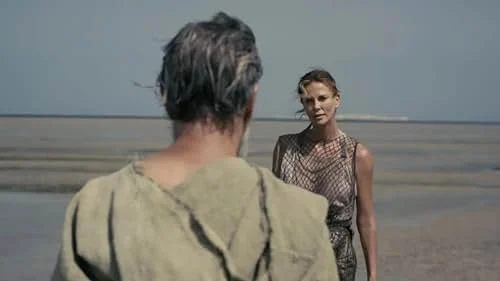

Among the many detours in Christopher Nolan’s adaptation of Homer’s ancient poem, one stop has become a particular point of curiosity for audiences leaving theaters. Odysseus does not simply choose to linger on the island of Ogygia, and understanding why he ends up stranded there for so long requires looking at both the mythology Nolan is drawing from and the choices his film makes with that source material.
In ‘The Odyssey,’ Charlize Theron plays Calypso, the immortal nymph whose island becomes an unplanned and prolonged stopover in Odysseus’s journey home. The character has existed in Homer’s text for nearly three thousand years, but Nolan’s film reshapes her motivations in ways that have sparked discussion among viewers familiar with the original poem.
The Mythology Behind Calypso’s Island
According to Variety’s breakdown of the film, Odysseus washes up on Calypso’s island after being shipwrecked, and he ends up spending seven years there. The outlet notes that Calypso herself had been banished to live on the island of Ogygia after the Olympians defeated the Titans long ago, which means she is a captive of the island in her own right well before Odysseus ever arrives.
The Hollywood Reporter’s cast breakdown describes Calypso as the immortal sea nymph who lives on the mythical island of Ogygia, and after Odysseus becomes stranded there, she keeps him captive for seven years, delaying his return to Ithaca. That detail, the seven year span, lines up with the version of the myth most readers of Homer would recognize, even as the film changes the emotional texture of what happens during that time.
A separate report from The Tab digs into the discrepancy between the poem and the movie, noting that in Homer’s epic, Calypso is the nymph who keeps Odysseus trapped on her island for seven years after the Trojan War, promising him immortality and eternal youth if he stays with her forever, while all he wants is to make it back home. In the source material, her hold over him is framed less as guidance and more as a prolonged, one sided captivity.
Calypso’s Role in Odysseus’s Trauma
Where Nolan’s film departs most noticeably from Homer is in how it explains Odysseus staying so long. Variety reports that once he arrives on Ogygia, Calypso feeds him lotus flowers that make him forget about his wife Penelope and his son Telemachus, sending his mind into a peaceful state. That detail borrows imagery from the Lotus Eaters episode elsewhere in the poem and folds it into the Calypso sequence, giving the island a dreamlike, memory suppressing quality rather than a straightforward prison.
The same report explains that the turning point comes when Odysseus finally confronts his trauma and the real reason he didn’t want to return home, after which Calypso helps guide him back to Ithaca. Rather than being freed through trickery or divine intervention alone, the film’s Odysseus has to reckon with something psychological before he can leave.
The Tab’s analysis of the change is direct about what this means for the character. It argues that the result is a version of Calypso who feels far more morally ambiguous than Nolan’s adaptation, where she’s portrayed as someone trying to help a traumatized man rather than keep him imprisoned indefinitely. The outlet adds that instead of portraying Calypso as an obsessive captor, Nolan’s version leans into a more compassionate interpretation. For a director known for restructuring narratives around memory and trauma, folding that theme into ‘The Odyssey’ fits a familiar pattern in his filmography.
How Odysseus Finally Leaves Ogygia
Getting off the island is not instantaneous even after the emotional turning point. Variety’s timeline notes that Calypso tells Odysseus he must submit to the will of the gods, something he had been reluctant to do up to that point, which reframes his departure as an act of surrender rather than escape. He then builds a raft to leave Ogygia, letting the ocean carry him until it deposits him on land.
The sequence closes with a moment of clarity rather than triumph. Per Variety, Athena appears to Odysseus and reveals that he has finally arrived back in Ithaca, and the film notes that he returns twenty years after his initial departure, disguised as a beggar. The scale of that time gap, a decade for the Trojan War and roughly another decade to get home, underscores just how much of Odysseus’s absence the Calypso section alone accounts for.
Theron’s casting in the role also carries some behind the scenes context. The Hollywood Reporter notes that while ‘The Odyssey’ marks Theron’s first collaboration with Nolan, it reunites her with Matt Damon twenty six years after they starred together in ‘The Legend of Bagger Vance.’
Critical and Audience Reaction to the Film
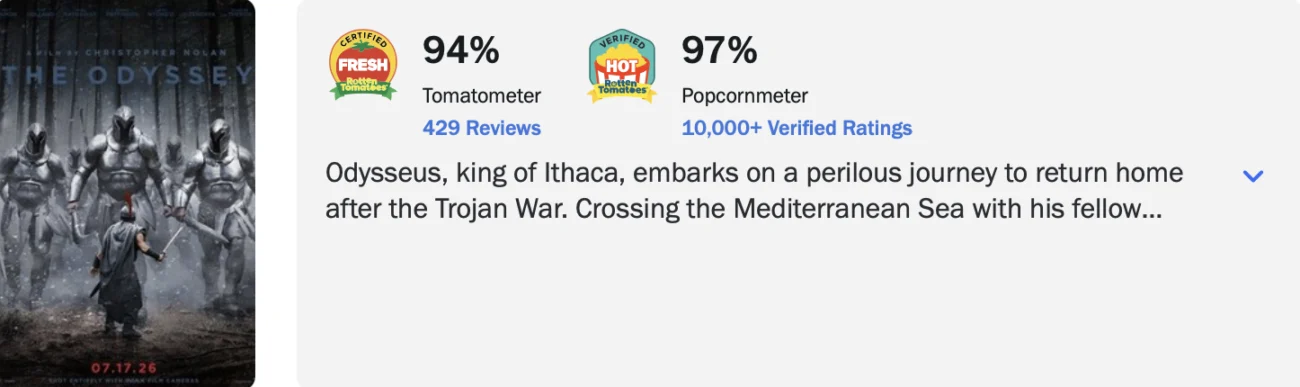
The Calypso sequence arrives inside a film that has performed strongly with both critics and audiences since its release. According to Rotten Tomatoes, the film holds 95 percent approval on the Tomatometer, the highest of Nolan’s career, placing it alongside Memento, Insomnia, The Dark Knight, Dunkirk and Oppenheimer as films at 90 percent or higher.
Forbes reported that as reviews continued to roll in, the critics’ score settled at a still stellar 94 percent fresh, tying for Nolan’s highest rated film, while audiences gave it an even higher 97 percent fresh score, a new record for the director. That audience enthusiasm translated directly into ticket sales, with Deadline reporting an opening weekend north of 124 million dollars domestically.
The film’s commercial run has continued to build on that debut. Forbes noted that through Monday, the film had earned 142.1 million dollars domestically and 140 million dollars internationally, for a worldwide total of 282.1 million dollars against a production budget of 250 million dollars. Given how central the Ogygia sequence is to the film’s middle stretch, its reception has effectively tracked with the movie’s broader critical success.
Odysseus’s time with Calypso may only be one stretch of a nearly three hour film, but it sets up much of what follows once he finally reaches Ithaca, and it raises the question of how much of his homecoming was really about geography versus what he needed to work through first. What did you make of the way Nolan’s ‘The Odyssey’ handled Calypso and the reasons behind Odysseus’s seven years on Ogygia?