

Record of Ragnarok: Who Is Anubis & How Strong Is He?



Anubis is by far one of the best-known and most popular Egyptian gods. Depicted as a human with the head of a jackal or a wolf (a canine, in general, as descriptions vary), Anubis was the Egyptian god in charge of funerary rites, protecting graves, and guiding dead souls to the Underworld. He was also responsible for the “Weighing of the Heart” ritual, through which he would determine where in the Underworld a dead soul should reside. But, alongside his rich mythological background, Anubis is also set to appear as a fighter for the Gods in Record of Ragnarok. Since he has not been officially introduced in the manga, we know nothing about him and his role in the story, but we will tell you we know.
The rest of this article will focus solely on the character of Anubis both in real-life mythology and in Record of Ragnarok, as we bring you everything you need to know about him and his actions, at least… everything that is known at this moment. We are going to tell you some information about the history of the character, as well as his role in the whole story. We will also answer a series of relevant questions about Anubis, the famous Egyptian deity of the Underworld.
Who is Anubis in Record of Ragnarok, and how strong is he?
Record of Ragnarok is an intriguing series that offers a lot for the average viewer. It teaches you a lot about the history of humankind and various mythologies, combining actual facts with an interesting fictional premise. Throughout the duels, as well as behind the scenes, a lot of various personalities have been introduced or, at least, announced. One of the latter is the famous Egyptian god, Anubis. Anubis is by far one of the best-known Egyptian deities and has often been used as a symbol for Ancient Egypt as a whole. He is the god of the Underworld in Ancient Egypt and is responsible for guiding dead souls into the Underworld.
His powers and abilities are unknown at this moment. Since he is going to appear later in the series and is introduced as the scariest fighter for the gods, we assume that he is going to be incredibly powerful and that he is going to have some powers related to the dead and will possibly be able to manipulate the soul in one way or another. But, as of yet, this is mere speculation, as we know nothing for certain.
Although we have not seen him introduced in the series, we know he will appear, so our data on him is limited. But, as Record of Ragnarok mostly sticks to the actual historical and mythological stories, we are going to bring you Anubis’ mythological story as we know it so that you can know, at least roughly, what you can expect from him as soon as he appears in the series.
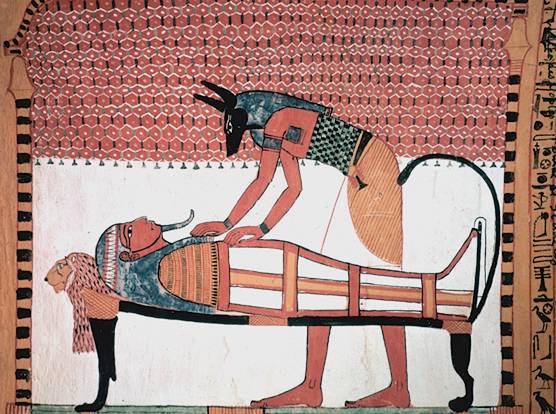
Anubis is one of the oldest deities of ancient Egypt, even before the famous Osiris, who is, interestingly, considered to be his father according to the myths. The integration of Anubis within the Osirian family (Osiris, Isis, Horus, Nephthys) proved to be complex. It was probably dictated by the need to give Osiris, the murdered god, the most effective god connected with the world of the dead.
Concerning Anubis, a few facts dominate in the funerary theme. For the sovereign, the afterlife is a domain located in the sky, and the royal person is considered as a son of Ra, the sun god – a concept which was gradually put in place from the Second Dynasty but did not culminate until under the 4th and 5th Dynasties. The rest of the Egyptian population does not have the celestial regions as their post-mortem destination: for them, the afterlife is located in the West, considered as an extension of the terrestrial necropolises.
During the first three dynasties (from 3000 to 2600 before our era), Anubis was the only funerary deity who served the king as well as individuals. From the end of the Fourth Dynasty, the West is best known for being the kingdom of Osiris, who assassinated and then resurrected the god-king. But this vision of the West is only a second step; previously, he was mostly dominated by Anubis.
Between the 1st and 4th Dynasties, the funerary religion patronized by Anubis managed to attract many non-royal followers. But this predominance of Anubis over the West was not achieved without competition from other funerary deities. The deity who guarantees food to the deceased is indeed very variable. During the 1st dynasty, the great rival of Anubis in this function is the goddess Neith, from the city of Sais. During the first half of the Fourth Dynasty, the great rulers of the pharaonic state almost all placed themselves under the protection of Anubis.
The recourse to this god appears in formulas engraved on the walls of the chapels which surmount the tombs. At the end of the 4th dynasty or the beginning of the 5th dynasty, Osiris took his place next to Anubis. During the Fifth Dynasty, Osiris supplanted Anubis as the undisputed ruler of the world beyond. However, Anubis retains a significant place in funerary beliefs as a protective deity.
Anubis assisted Isis in embalming Osiris in the Osirian myth. The Osirian myth really states that Anubis received Osiris’s organs as a gift after Seth killed him. Anubis thus became the primary patron deity of embalmers due to this association; pictures from the Book of the Dead frequently depict a priest performing mummification rituals while donning the jackal mask and supporting the mummy upright.
Anubis served as the guardian and protector of cemeteries and tombs. In Egyptian literature and inscriptions, Anubis received numerous epithets that indicate this function. Because the deceased were frequently interred on the west bank of the Nile, the name Khenty-Amentiu, which means “chief of the Westerners” and is also the name of another canine funeral god, refers to his protecting function. He adopted many names about his profession as a funeral director.
Anubis was frequently pictured in late Pharaonic art (664-332 BC) as leading people through the entrance from the world of living souls into the underworld. But cow-headed Hathor occasionally had a part to play. Similar to that, Anubis was frequently picked to play that part. The job was described as “psychopomp” by Greek authors of the Roman era of Egyptian history.
This name, which means “guide of souls” in Greek, was also a reference to their own deity, Hermes, who also played that role in Greek mythology. During this time, Osiris, who had by then taken over the position of the ruler of the Underworld from Anibus, is shown escorting men or women clothed in Greek attire to Anubis in funerary art.
Under the watchful eye of the ibis-headed Thoth, Anubis is shown moving the corpse ahead and adjusting the scales. Anubis played the roles of “keeper of the scales” and “weigher of the hearts,” among other things. The crucial moment in the Book of the Dead that represents the “weighing of the heart” shows Anubis measuring whether a person deserves to step into the afterlife (the underworld, known as the Duat). Anubis determined the destiny of souls by weighing the deceased’s heart against Ma’at (“Truth”), most commonly represented with only a single ostrich feather. Ammit would devour those souls that proved to be heavier than the feather provided, while those lighter than the feather would simply proceed.


