‘The Boys’: Is Soldier Boy a Good Guy?

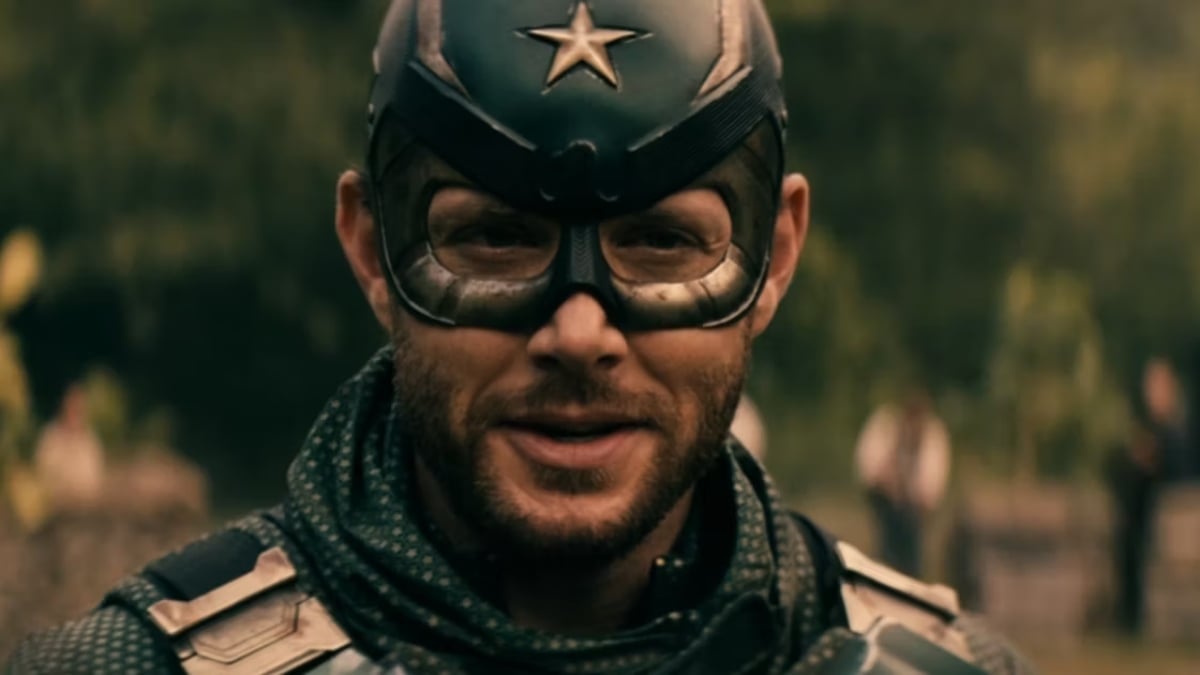

When ‘The Boys’ introduced Soldier Boy, audiences immediately understood they were dealing with something far more nuanced than a simple villain. Jensen Ackles brought the character to life with a magnetic charm that made viewers genuinely uncertain about where his loyalties and his morality truly stood. That ambiguity is precisely what makes him one of the most compelling figures in the entire series.
Soldier Boy occupies a rare space in superhero storytelling. He is neither a straightforward hero nor a cartoonish villain, and ‘The Boys’ uses that tension to explore what happens when power, trauma, and unchecked ego collide without consequences across decades.
Unpacking the Moral Complexity of Soldier Boy
At the surface level, Soldier Boy presents himself as a patriotic legend, a founding member of Payback, and the original superhero icon of the Vought era. The reality that slowly emerges is far darker, rooted in abuse, cruelty, and an entitlement that stretches back generations. His heroic image was always a manufactured product, carefully packaged to sell war bonds and corporate profits rather than genuine virtue.
What makes his moral complexity so compelling is that the show never lets him off the hook while also never denying the genuine trauma he endured. Being experimented on, betrayed by his own team, and locked away in a Soviet facility for decades is genuinely horrifying. The audience is asked to hold both truths at once, that he suffered terribly and that he was also a deeply terrible person long before that suffering began.
This layered approach to character building is one of the things that separates ‘The Boys’ from most other superhero properties. Soldier Boy is not redeemed by his pain, nor is his pain dismissed simply because he caused pain to others. The writing forces viewers to sit with that discomfort without offering an easy resolution.
The Antihero Appeal That Defines His Character
The antihero framework is where Soldier Boy feels most at home within the narrative of ‘The Boys’. He operates according to his own code, one built on ego, strength, and a warped sense of what he deserves from the world around him. His brief alliance with Butcher and Hughie is perhaps the clearest illustration of this dynamic, where three deeply flawed individuals unite around a shared enemy rather than any shared sense of justice.
His moments of unexpected vulnerability, particularly around his complicated relationship with Homelander, add emotional weight to what could have been a one-note performance. There is a version of Soldier Boy that might have chosen differently, that might have found something worth protecting in a legacy beyond corporate mythology. The show tantalizes the audience with that possibility before making clear that his fundamental nature remains unchanged.
This is the antihero trap done well. The audience roots for him in specific moments, enjoys his blunt chaos, and then gets reminded why none of that admiration should ever be fully extended. ‘The Boys’ is disciplined about never letting that line blur into genuine endorsement of who he actually is.
Superhero Redemption and Why It Never Quite Arrives
The question of superhero redemption haunts every scene Soldier Boy appears in. His story is structured in a way that invites the audience to wonder whether someone so deeply shaped by institutional violence and personal cruelty can ever genuinely change. The answer ‘The Boys’ arrives at is not quite hopeful.
He shows flickers of something real, a longing for recognition, a brief moment of connection, and what appears to be genuine hurt when he realizes how dispensable he was to everyone around him. But those moments are consistently undercut by his inability to extend any genuine empathy outward. His pain is real, but his response to that pain consistently falls back on domination and destruction.
Redemption in superhero stories is often treated as inevitable, a narrative reward for suffering. ‘The Boys’ deliberately subverts that expectation with Soldier Boy, arguing instead that survival and trauma do not automatically produce wisdom or growth. It is a colder and arguably more honest take on what prolonged violence actually does to a person over time.
Vought’s Corruption and Its Role in Soldier Boy’s Story
It would be incomplete to discuss Soldier Boy without examining the role that Vought’s corruption played in shaping him. He did not emerge from a vacuum. He was built, branded, and instrumentalized by an institution that required a certain kind of brutality from its assets while pretending publicly that those same assets embodied goodness and national courage.
This context does not excuse his behavior, but it does complicate the question of culpability in ways that ‘The Boys’ seems genuinely interested in exploring. Vought manufactured heroic myths to serve profit margins, and Soldier Boy was both a willing participant in and a victim of that system. His belief in his own legend was partly a psychological defense mechanism constructed around the lies he was told and the lies he told himself.
The show draws a direct line between institutional corruption and individual moral failure. By examining how power structures enable and even reward the worst impulses in people, ‘The Boys’ uses Soldier Boy as a pointed critique of hero worship culture and the industries built around it.
What Soldier Boy Ultimately Reveals About ‘The Boys’
Soldier Boy functions as a mirror held up to the entire world of ‘The Boys’. He reflects back the question that the show asks again and again, which is whether heroism is something people can actually embody or whether it has always been a story that powerful institutions tell about useful individuals.
He is not a good guy. He is not quite a traditional villain either. He is something more uncomfortable, a man who had every structural advantage, who experienced genuine horror, and who emerged from both experiences without becoming better. ‘The Boys’ is interested in that specific kind of failure because it mirrors something true about how power and mythology interact in the broader world.
Soldier Boy remains one of the most debated characters in recent superhero television precisely because the show refuses to settle the question for the audience. Viewers are left to make their own moral accounting, and that lingering uncertainty is entirely intentional.