‘Ramayana: Part 1’ Makes Box Office History as North America’s Biggest Indian Film Ever


Few Indian films have arrived with the kind of hype that surrounded Nitesh Tiwari’s mythological epic, and ‘Ramayana: Part 1’ has spent the past few weeks proving the buzz was justified. The Ranbir Kapoor and Yash-led spectacle has been steadily rewriting box office records since its release, both at home and abroad.
Released internationally as ‘Ramayana: Rise of a Legend’, the film opened in Indian theaters on November 5 and reached North American screens a day earlier. Its trailer alone racked up more than 350 million digital views in its first 2 days, a sign of just how eager audiences were for this adaptation.
Now the film has claimed one of the most coveted overseas records of all. ‘Ramayana: Part 1’ has officially become the highest-grossing Indian film of all time in North America, crossing the $29 million mark in the United States and Canada.
In doing so, it dethroned Ranveer Singh’s ‘Dhurandhar: The Revenge’, also known as ‘Dhurandhar 2’, which had finished its North American run with around $28 million. That film was released in March and held the record for several months.
Remarkably, ‘Ramayana’ took the top spot within just 20 days of its North American release. The epic is now setting its sights on the $30 million milestone, and trade analysts expect it to finish its run above $32 million.
‘Ramayana: Part 1’ has become the highest-grossing Indian film of all time in North America. https://t.co/mff4RJGKkx
— Pop Base (@PopBase) November 25, 2026
The new record puts the mythological drama ahead of some of the biggest Indian blockbusters ever to play in the region. The original ‘Dhurandhar’ sits at $20.69 million, while Shah Rukh Khan hits ‘Pathaan’ and ‘Jawan’ trail with $17.49 million and $15.23 million, respectively.
The film’s overseas strength extends beyond North America too. It has already surpassed the international earnings of ‘Dhurandhar 2’, ‘Pathaan’ and ‘RRR’, underlining its appeal with global audiences.
An epic journey unlike anything you’ve seen before. Watch the exclusive official trailer for #Ramayana, coming to theaters worldwide November 5. Tickets are on sale now at Fandango – https://t.co/BBgWkxokVO https://t.co/FrCFmnGSFd
— Fandango (@Fandango) October 15, 2026
At the worldwide box office, the numbers have been just as staggering. ‘Ramayana: Part 1’ grossed more than ₹100 crore worldwide on its first day, crossed ₹1,000 crore within 8 days and has since surged past ₹1,500 crore globally.
It also became only the second Bollywood film of the year to hit the ₹1,000 crore milestone worldwide, following ‘Dhurandhar: The Revenge’. Its post-Diwali momentum has been fueled by extraordinary audience turnout alongside substantial business from international markets. The scale of the release played a part as well. The producers had planned to launch the film across an unprecedented 59,000 screens worldwide.
Backed by Namit Malhotra’s Prime Focus Studios and Yash’s Monster Mind Creations, the film boasts one of Indian cinema’s most ambitious ensembles. Ranbir Kapoor plays Lord Rama in a double role that also sees him portray Parshurama, while Sai Pallavi stars as Sita and Yash takes on Ravana.
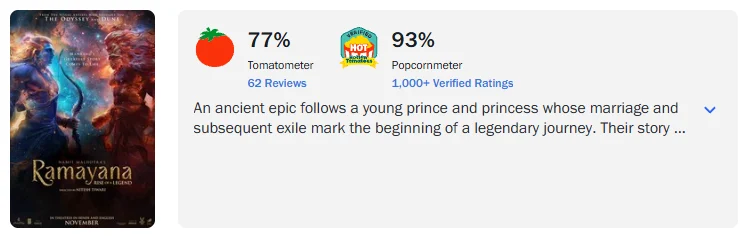
The cast also includes Ravie Dubey as Lakshman and Sunny Deol as Hanuman, alongside Arun Govil, Anupam Kher and Lara Dutta. Yash’s intense transformation as Ravana has become one of the film’s biggest talking points. Interestingly, the record comes despite a mixed reception in India. In North America, however, the response has been strong enough to push the film into uncharted territory.
With the first chapter still going strong in theaters, the story is far from over. A second installment is already planned, giving fans plenty to look forward to as the saga continues. If its current pace holds, ‘Ramayana: Part 1’ could set a North American benchmark that future Indian releases will struggle to reach for some time.
Do you think ‘Ramayana: Part 1’ can hold onto its record as North America's highest-grossing Indian film and surpass $30 million?
Have something to add? Let us know in the comments!