

Hell’s Paradise: How Is Kotaku Dividied? Geography Explained!




And while the recently-premiered anime adaptation of Hell’s Paradise promises to be a big hit, fans have, naturally, begun to ask questions about the series’ characters. But, the series has also introduced us to some important aspects that are not related to the characters themselves; one of them will be the topic of this article. Namely, Kotaku, as the primary setting of the series, is exceptionally important, and this strange island has a very specific geographical structure, as Hōko explained to Gabimaru and the others. In this article, we will tell you what Hōko said, i.e., how Kotaku is structured and divided in the world of Hell’s Paradise. The structure of the island is important for understanding how certain things work, which is why we have decided to dedicate a whole article to it.
Kotaku, also known as Shinsenkyō, is an island in the southwest seas far beyond the Ryukyu Kingdom. The island is divided into three regions: Eishū, the outer region of the island where the Sōshin live (it is largely a forest); Hōjō, the middle region of the island, where the Sōshin nest (it is a valley with several settlements); and the Hōrai, the inner and central region, where the Tensen live (it contains many temples).
The rest of this article will focus on the layout of Kotaku Island in the lore of Hell’s Paradise, as well as how the layout is important for the story of the manga. Kotaku is the principal location featured in the series and is the center of all its happenings, so we will tell you everything you need to know. Be careful, though, as the article will be filled with spoilers.
Kotaku is divided into three major regions
Fans of Hell’s Paradise will know that the manga plot mostly takes place on an island known under the name Kotaku; the more common name for the island is Shinsenkyō. The island itself is located somewhere in the southwest seas that is far beyond the Ryukyu Kingdom. It is not that difficult to reach, but as a rule, it is impossible to leave once a person reaches it, at least not in the same condition as when one arrived there.
The island is covered by thick fog, and many sea-dwelling monsters protect the seas around the island, attacking and sinking any ship that wants to leave. There is a way to leave the island, but the one leaving must come through the Hōrai’s floodgates for the sea monsters to let it pass.
Now, when Gabimaru and the others first arrived on the island, they were unaware that the island had a fixed layout as it did because the layout is not really reflected in the geography of the island itself, as the borders between the regions are quite fluid (save for the central region, which is guarded by gates, but that is an architectural thing, not a geographical one; were there no gates, you couldn’t really tell). This is why no one really knows where they are, and for an outsider, it is basically impossible to tell the difference.
After facing off against Rokurōta and killing him, when our heroes reached Hōjō village and observed it above a cliff, Gabimaru first sensed that someone was staring at them. The spy was Mei, and after catching up with her, Gabimaru and the others were taken to the village by Hōko and Mei. Hōko and Mei proved to be friendly and offered to guide them to the village, and while Yuzuriha believed it was a trap, they all persuaded her to join them.
Aside from being friendly, the two of them proved to be an invaluable source of information. Namely, Hōko provided Gabimaru and the others with information about the island and its geography. They also revealed some valuable information about the monsters on the island, themselves, and their future enemies.
Now that we have provided you with this introduction, we can confirm that the island of Kotaku was divided into three major regions:
- Eishū
- Hōjō
- Hōrai
What follows is a proper introduction to each of the three regions.
Eishū

Eishū is the first and outer region of Kotaku. When one arrives on the island, the first of the three circular regions one steps foot into is Eishū. The region is quite simple: it encompasses the beach where the ships land and the surrounding forest that serves as a form of protection for the inner regions of the island. It is rich with plant and animal life, and most of the lower-ranked monsters on the island inhabit this region, and they attack any intruders that step on the island. In terms of its scenery and landscape, it is a truly beautiful region, but it is quite dangerous.
Hōjō


Hōjō is the name of the second region of Kotaku, the middle circle in its specific circular structure. Hōjō is a large valley located underneath the cliffs of the Eishū. The geography of Hōjō is more varied and less rich in flora and fauna, but it is known that some of the lower-ranked monsters nest in this region. The region consists, more precisely, of six rocky valleys, which give it the appearance of a six-petaled flower, especially with the Hōrai as its center. Unlike the first region, some settlements are present in Hōjō, and Hōko Village is located there; the settlements are now uninhabited but were quite lively 1,000 years ago.
Hōrai
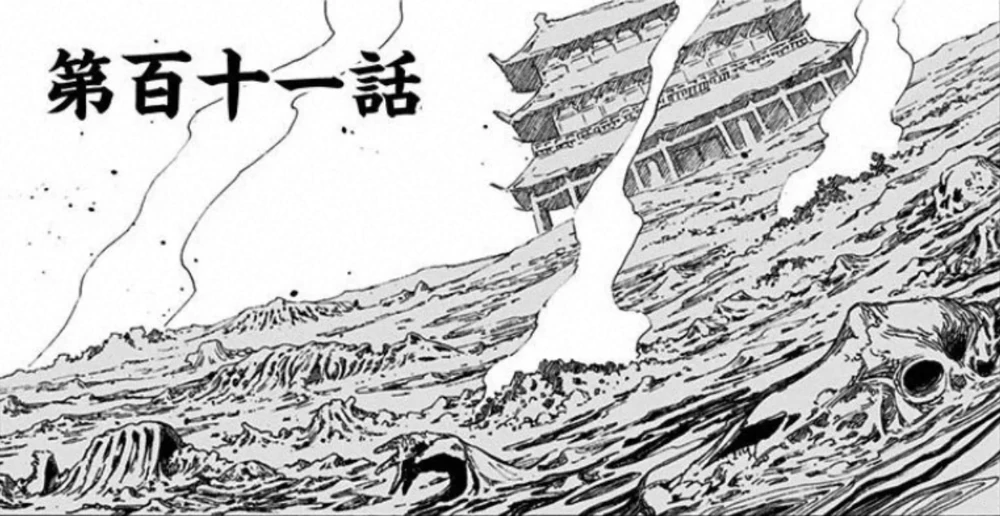
Hōrai is the central and most important region of Kotaku. It is also the smallest region of the island and is located in its center, surrounded and protected by the other two regions. It is exceptionally difficult to enter, as it is protected by gates, which are, in turn, guarded by the Tensesn, who serve as the gate guardians of the Hōrai. As stated, the Tensen live in Hōrai, as do their students and pupils; the Dōshi, a group of higher-ranked monsters permitted to enter the Hōrai; the other monsters are strictly forbidden from entering this region.
The Hōrai is a very large, palace-like fortress modeled after China’s famous Epang Palace. Because the basic structure is that of a traditional Oriental palace was divided between a large inner castle and several outer structures. The Tensen live inside the Hōrai, where they also train and conduct their experiments, each having a palace of their own. The Banko is also located within the Hōrai.
The inner part of the palace consists of the Bōchū Jutsu Temple, the Taisoku Temple, the Dō’in Temple, the Shu’itsu Temple, the Shūten Temple, the Rentan Temple, and the Main Temple, which contains a special section that houses the Basin. A new training area was also constructed at some point in the past, and we also have the underground floodgate, which is, as we have mentioned above, the only safe and proper way for an outsider to leave the island.
2.3.7 Main Temple