How ‘The End of Oak Street’ Resolves Its Time-Displaced Dinosaur Nightmare

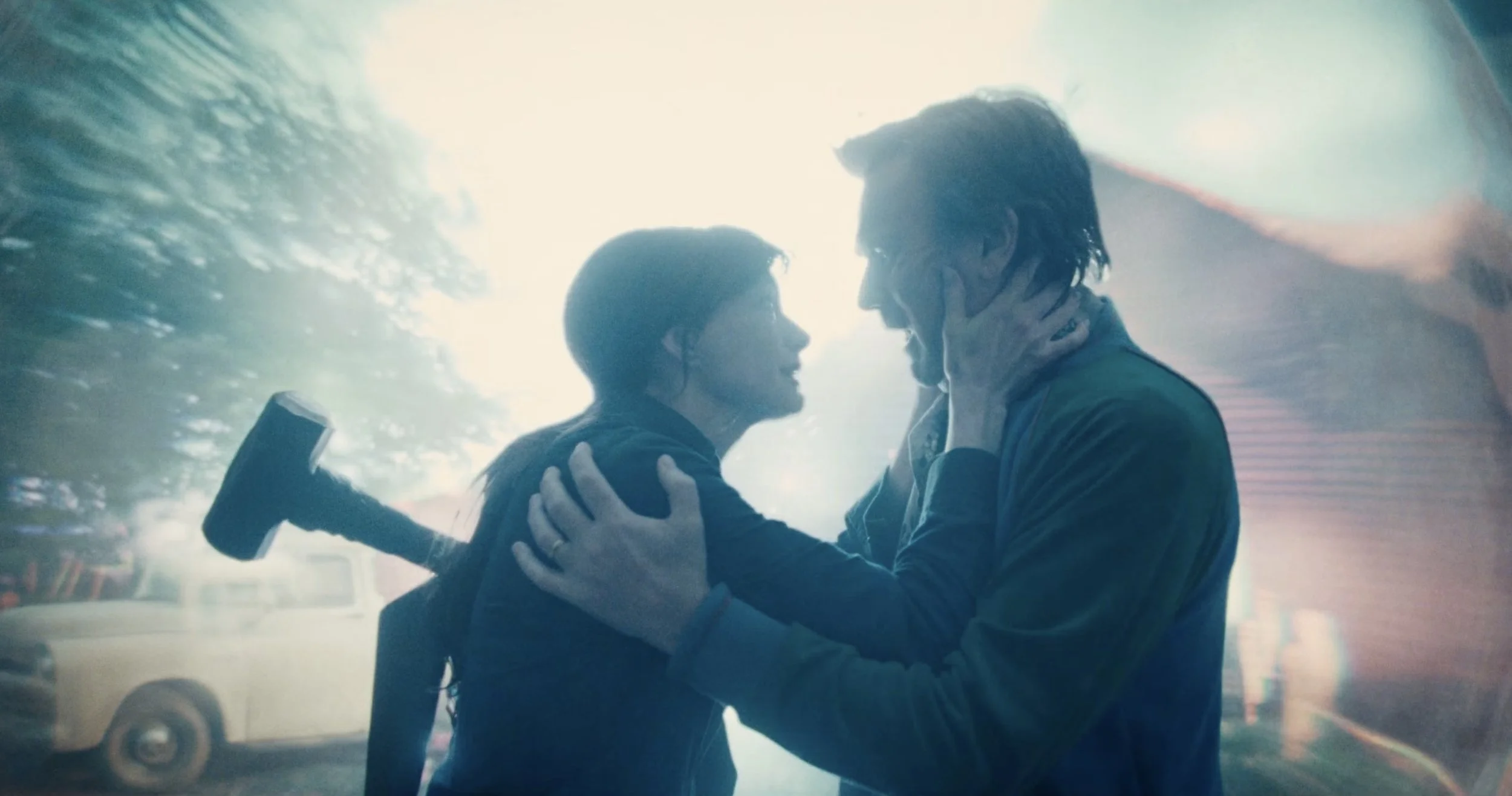

Warner Bros. has spent the back half of summer betting on an unlikely genre mashup, and audiences are now getting their answer. The story follows the Platt family in 1982 when a cosmic vortex sends their suburban neighborhood millions of years back, and to return home, Denise, Greg, and their young children must negotiate an ancient world full of terrible dinosaurs.
‘The End of Oak Street’ has generated plenty of questions since its release, particularly around how the family gets out of the prehistoric mess they land in and what the film’s closing minutes actually mean for its characters. Below is a full breakdown of the plot, the ending, and what critics and box office analysts are saying about the film’s early performance.
The Oak Street Recap Sets Up a Prehistoric Nightmare
A wormhole opens over a two mile stretch of suburban Michigan in 1982 and swaps the street with a slab of the prehistoric past. The Platt family soon discovers that their survival depends on sticking together as they navigate their now unrecognizable surroundings.
Greg Platt wants to go back in time to the days before his marriage soured, back when he still had a full time job and his comfortably middle class Michigan family looked like the picture of 1980s suburban Americana, while his wife Denise wants him to face the reality that their family is being confronted by a genuine crisis. Those domestic tensions are still simmering when the vortex hits, and the film uses them as connective tissue between its horror setpieces.
As the survivors try to make sense of what happened, one of the teenagers theorizes that some type of tremor in the universe created a time portal that sent their neighborhood back in time, while possibly transporting prehistoric creatures to the future in the process. The film never dwells on the science for long, choosing instead to keep the family moving from one threat to the next.
The movie offers no explanation for why or how the wormholes are opening up, and in the end it does not really matter, since the time displacement gives the family both a way out and a way to undo a devastating loss. That restraint becomes a defining trait of the film’s back half.
‘The End of Oak Street’ Ending Explained
Greg Platt does not make it. Ewan McGregor’s father figure is caught by an Allosaurus while shielding his wife, and the film does not soften the moment. The dinosaur tosses him into the air and slams him into the ground before devouring him in front of a stunned Denise.
After the attack claims Greg’s life, the remaining family members locate a temporal anomaly to escape the carnage, ultimately jumping through a fluctuating wormhole that transports them back to 1982, minutes before the original event. The portal flashes rather than staying open, meaning the group has to time their jumps precisely to pass through.
That timing detail matters because it gives Denise a second chance most disaster movies never grant their characters. Denise uses a payphone to order a pizza, which effectively saves the past version of Greg from ever being swept up in the original wormhole event. It is a small, almost mundane gesture that ends up rewriting the family’s fate.
The family embraces once Greg arrives to deliver that pizza, and they share a kiss before watching from a hill as their street travels through time and is replaced by prehistoric creatures. Denise was able to warn some of her neighbors ahead of time and save them as well.
How the Platt Family Survives the Wormhole
Mrs. Valcourt sacrifices herself to kill a dinosaur so the survivors can reach the roof, and in the climax, Denise, Brian, Audrey, and the family dog Starbuck run into the glowing portal with seconds to spare, leaving the ancient world behind. The survivors arrive back in 1982 inside a cement swimming pool after crossing the time divide.
Jeannette, the family’s teenage neighbor, voluntarily goes back into the vortex in hopes of finding her own parents. That choice sets up the film’s emotional epilogue as much as its literal one.
A news report shown on a television screen two years later reveals that Denise became an author and wrote about her experience in a book titled ‘The End of Oak Street,’ while footage of the U.S. military protecting citizens from the dinosaurs shows that her warnings allowed authorities to be prepared. The leap forward also confirms that the government captured or killed the dinosaurs that were sent to the present, and that the Platts managed to save several of their neighbors in the process.
A closing news broadcast still describes the event as a tragedy, which is the film’s way of telling audiences the warning worked partially and not completely. There is no mid credits scene and no post credits scene, so viewers can leave once the crawl starts, though the dedication card is worth staying for.
Critical Reception and Box Office for The End of Oak Street
Director David Robert Mitchell, best known for ‘It Follows,’ is back with his first film in nearly eight years, and ‘The End of Oak Street’ arrives as part of a crowded summer dinosaur showdown alongside ‘Paw Patrol: The Dino Movie.’ Warner Bros. released the film in roughly 3,400 North American theaters, with the studio projecting an opening weekend in the range of eighteen million to twenty three million dollars against an eighty million dollar production budget.
Reviews have been notably stronger than the film’s modest box office projections suggested they might be. With 95 reviews counted, the film sits at 84 percent on Rotten Tomatoes and a more middling 67 out of 100 on Metacritic, with the Rotten Tomatoes score outperforming any entry in the ‘Jurassic World’ franchise.
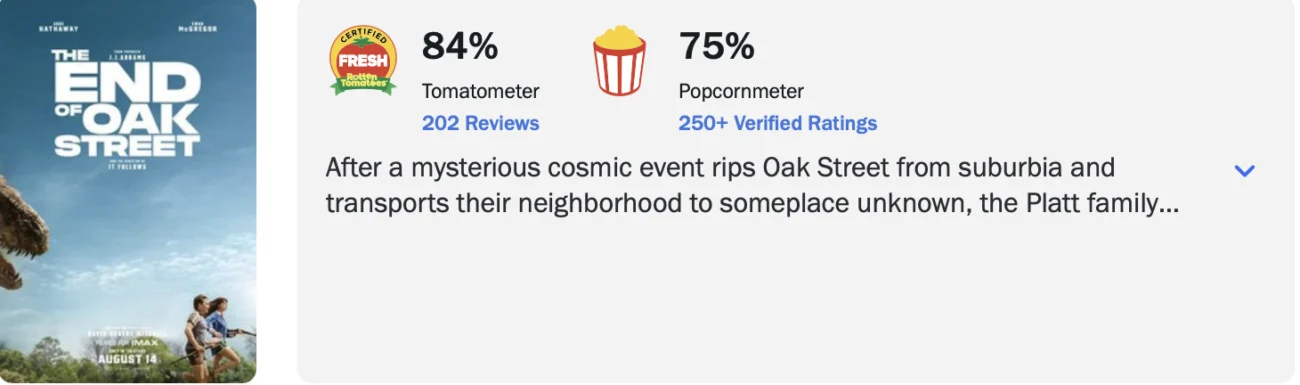
Early reactions ranged from calling it one of the biggest surprises of 2026 and one of the best blockbusters of the summer to praising it as one of the most delightful movies of the season. Not every critic was as enthusiastic, with some pointing to shaky thematic underpinnings and screenwriting shortcuts beneath the spectacle.
NPR’s review argued that this shouldn’t be controversial to say, but dinosaur movies should be fun, and called ‘The End of Oak Street’ silly, scary, and over the top all at once, a description that captures how the film balances horror instincts with popcorn entertainment. Critics have generally praised the film for balancing its ‘Jurassic Park’-inspired plot with ruthless kills, dark humor, and a surprising amount of heart.
Denise’s book, her neighbors’ partial survival, and the government’s cleanup all suggest there is room for the story to continue if Warner Bros. wants to revisit Oak Street. Given how divided critics remain on whether Mitchell fully capitalized on his premise, it feels fair to ask longtime fans of his earlier work what they made of this pivot into big budget dinosaur spectacle.