Is the Mountain in ‘Fall 2: Deadpoint’ Real? Here’s the True Story Behind the Sequel’s Deadly Climb

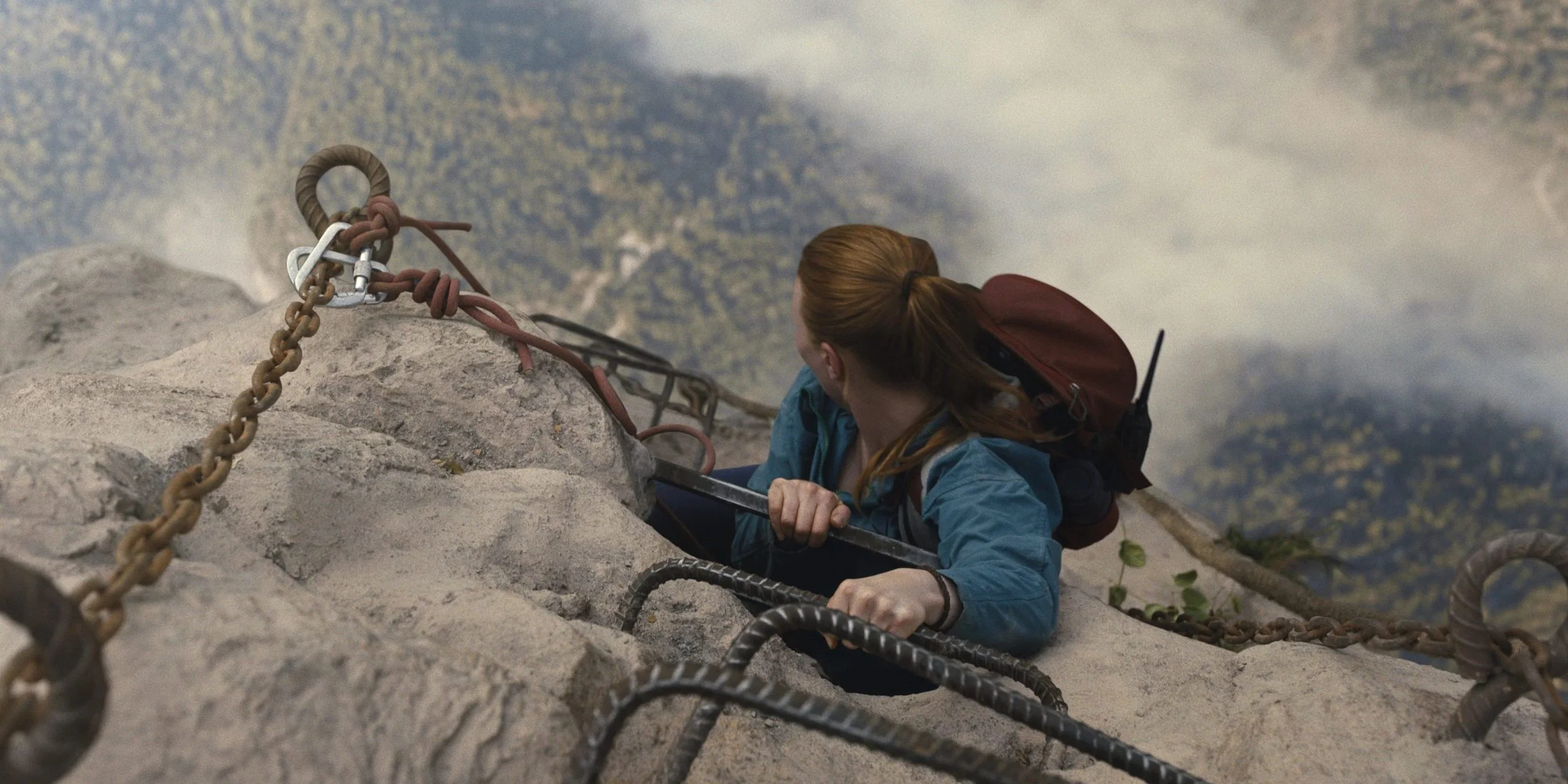

Anyone who watched the trailer for ‘Fall 2: Deadpoint’ and felt their stomach drop is asking a fair question. The sequel to the surprise 2022 survival hit trades a rusted radio tower for a sheer rock face, and the vertigo the footage produces has viewers wondering whether the mountain at the center of the story actually exists.
The short answer is that it does not, at least not under the name the film uses. The film’s official synopsis places two climbers thousands of feet above the ground on Thailand’s fictional Mount Kwan, where the heights and impossible conditions push the story forward. That said, the production drew heavily on a real and genuinely dangerous hiking route to make the peril feel grounded.
Is Mount Kwan in ‘Fall 2: Deadpoint’ a Real Mountain
Mount Kwan does not appear on any map. In the film, Luce convinces Jax to join her on a plank walk on Mount Kwan in Thailand, hoping to reach a statue of a dragon said to consume a climber’s fears. The two secure access through a local guide named Jon, who warns them upfront that the mountain has been closed off for years due to earthquakes, rockslides, and heavy rain, a detail that signals early on how the climb will go wrong.
Fan sites tracking the production have been careful to note the gap between story and reality. Mount Kwan should be treated as a narrative location unless an official source confirms the production actually filmed at a real mountain carrying that name. The confirmed material places the sequel’s setting in Thailand with Mount Kwan as the climb’s destination, but it does not establish a verified list of real-world peaks, studios, or climbing areas used behind the scenes.
Critics who have already seen the finished film have pointed out that the mountain’s artificial origins are visible on screen. Part of what makes it hard to suspend disbelief is that the mountain itself is so clearly the product of digital visual effects, which makes it difficult to feel genuine fear of something that obviously is not really there. That observation lines up with what location trackers have found, since no confirmed physical mountain has been tied to the shoot.
The Real Hike That Inspired the Film’s Deadly Plank Walk
While Mount Kwan is invented, the plank walk the characters attempt is not pulled from nowhere. The hike that actually inspired the film is the Huashan Plank Trail in Shaanxi, China, which in reality is far better equipped with safety features than what appears on screen, even if that would make for a far less tense movie. The route is one of the most talked about hiking trails in the world for a reason.
Coverage of the trailer confirmed the same connection. Although Mount Kwan itself is fictional, the narrow planked walkway suspended over a deep mountain pass shown in the trailer is based directly on the Huashan Plank Trail, often described as one of the world’s most dangerous hikes. That real trail consists of wooden boards bolted into a cliff face, and it has built a reputation among thrill seeking hikers for decades.
By borrowing the visual language of an actual extreme trail and relocating it to a fictional Thai peak, the filmmakers gave the sequel a foundation that feels plausible even though the specific mountain and situation are made up. It is a common approach for survival thrillers, which often need a setting extreme enough to justify the plot while avoiding the legal and logistical complications of naming a real, currently accessible location.
How the Original ‘Fall’ Grounded Its Fictional Tower in Reality
The first film used a similar trick, and it is worth revisiting given how directly it shaped the sequel’s approach. While the story in ‘Fall’ is fictional, the television tower that Becky and Hunter climb is based on a real structure, which gave the film a grounded sense of danger. The production found its inspiration in the KXTV Tower in Walnut Grove, California, and used it to shape the film’s central setting.
Director Scott Mann has spoken about how the location came together. He explained that the team looked at buildings, mountains, and other structures across California before settling on the towers, noting that their consistent height of 2,000 feet and above was what ultimately excited the production. A set resembling the tower was then built on the upper portion of a nearby mountain, and thanks to careful camera work, the actors genuinely appeared to be thousands of feet in the air even though they were filming on a controlled structure rather than an actual broadcast tower.
That original film became a bigger success than its modest scale suggested it would. ‘Fall’ grossed 21.8 million dollars worldwide against a 3 million dollar budget, with 7.2 million coming from the United States and Canada and the rest from international markets. Its strong word of mouth performance is the direct reason ‘Fall 2: Deadpoint’ exists at all.
Cast, Production, and What Comes Next
The sequel keeps some familiar faces while introducing new ones for its expanded story. Grace Caroline Currey and Virginia Gardner return in their original roles, though this time their characters’ skills are tested atop the tower from the first film rather than the new mountain setting, while Harriet Slater plays Jax Hunter and Arsema Thomas plays Luce, with Tom Brittney rounding out the principal cast. Behind the camera, directing duties shifted for this installment.
Production also moved to a new part of the world for the follow up. By September 2025 it was confirmed that the project had commenced principal photography earlier that year on location in Thailand, with production completed by that point. The Spierig brothers stepped in to direct from a script credited to Jonathan Frank and Scott Mann, with Mann continuing on as a producer alongside the returning creative team.
For a movie built entirely around the fear of falling, ‘Fall 2: Deadpoint’ leans on a real and well known trail to sell its most terrifying moments even while inventing the mountain itself. Given how much of the tension depends on that blurred line between fact and fabrication, it seems worth asking how much viewers actually want their survival thrillers rooted in reality, and whether knowing Mount Kwan isn’t real changes how frightening the climb feels once the credits roll.