

‘Naruto’: Who Is Jashin? Everything You Need to Know




The world of Kishimoto’s Naruto series is a fascinating one, and unlike One Piece and like in Bleach, deities are heavily featured in the story and were, more or less, very important in the series. Kishimoto has not portrayed any classical religion here, but traditional beliefs and various theological concepts are, in that aspect, an essential part of the lore (even though Boruto has shifted more towards science). One of these deities is Jashin, and in this article, we will give you a detailed overview of just who Jashin is and what his role in the story is.
Jashin is the principal deity of the Jashinism denomination in Naruto. The name itself means either “evil heart” or “evil god” (since it’s written in katakana, it is impossible to tell what “shin” refers to, as usual, the difference is seen when writing in Kanji). The symbol of Jashin and the whole system is an upside-down triangle that is surrounded by a simple black circle. Jashin is a mysterious figure in the series.
As you might have deduced, the article will be dedicated solely to Jashin and his role in the story. You’re going to find out about his history and his appearances, as well as some of the main aspects of his story and his role in the story as well. We plan to give you a full guide to the deity so you can enjoy it without searching elsewhere. The article will contain spoilers, of course, so be careful how you approach it.
Jashin is the principal deity of Jashinism, but not much is known about him
As we have said, religion and mythology play a large role in Kishimoto’s lore, but until now, we haven’t had the chance to talk a lot about that aspect of the lore. This is why we have decided to discuss one such concept in this article, in which you will find out all you need to know about Jashinism.
So, in the world of Kishimoto’s Naruto series, Jashism is the name of a sect of Buddhism. Jashin is Old Japanese and means “evil god” (as opposed to Jasshin, which means devil) or potentially “evil heart,” depending on the Kanji.
In Naruto, the name is spelled using katakana (ジャシン), which makes it impossible to determine the meaning of the word “shin,” as it could mean either god (if written in Kanji as 神) or heart (if written in Kanji as 心). Since we don’t know the kanji, the distinction is impossible to make. And that is why, as we have said, the phrase cannot be translated properly in the series.
What distinguishes the Jashinist from any other devout believer is that he never gives in, no matter what the price, which is a trademark of the religion, so it seems. But, since the only known Jashinist is Hidan, we cannot really state whether it is just Hidan’s thing because of his powers and abilities, as well as his personality, or a trademark of every other Jashinist as well.
Sadly, Kishimoto has not provided us with enough data in that aspect, so there is not much that we can do there. But if Hidan is Hidan because of his beliefs, we wouldn’t want to meet the other guys, either. (Okay, you can count Ameyuki there, but he is not part of the original canon.)

Jashinists sacrifice their opponents or their blood to their god Jashin. The symbol for Jashin is a circle with an inverted triangle inside. The triangle touches the inner edge of the circle with each corner. There are no sources for such a symbol, so we don’t really know how it came to be.
However, it is known that an inverted triangle was a symbol of aberration in ancient Egypt. It is not the size of the symbol that matters but the correctness of the lines. With a lot of math, one can see that area A, B, and C add up to 1 1/2 times the size of area D. It’s not clear if this is supposed to have any deeper meaning, but when it comes to religious matters, researchers and analysts are always contentious. The best example: the painting “The Last Supper” by Leonardo Da Vinci.
Also known about this symbol is that Hidan uses it for his ceremony. It is similar to the alchemical symbol for Water and to symbols used in Western paganism. Hidan also wears a necklace with the Jashin symbol around his neck. It is not known whether it is an obligation for a Jashinist or just Hidan’s choice.
The Jashinist is a very religious person. Since there is only one known Jashinist, one can only do theses about the character and attitude to life of a Jashinist, as we have said above. But the goal in life is always the same: to sacrifice as many people as possible for Jashin.
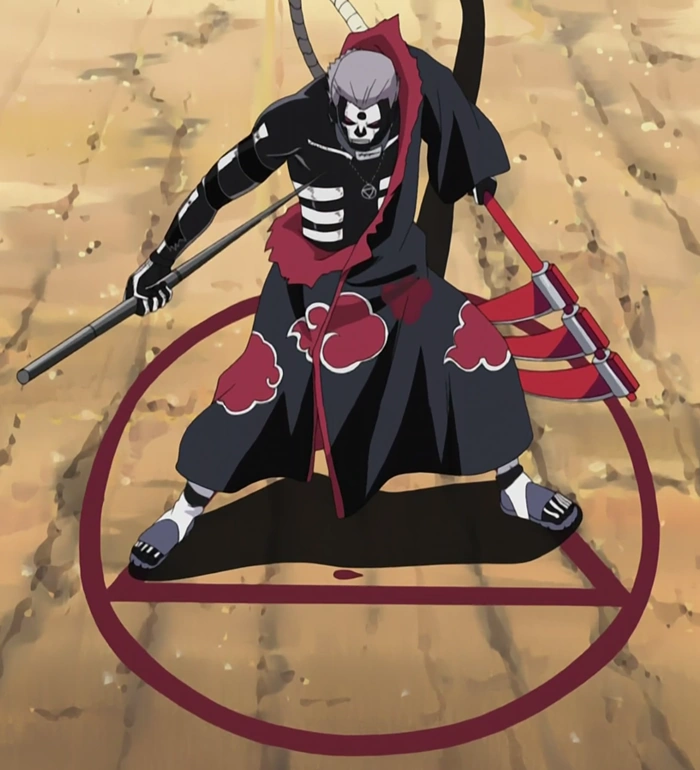
Jashinist combat is one of the most brutal fighting styles and, at the same time, a sacrifice for Jashin. He begins with a short prayer. It reads: “Please give me strength so that you will have many sacrifices.”
After that, Hidan kisses his necklace. When one joins Jashin, one attains a special technique called Kami no Sabaki, which grants one absolute immortality. In order to be able to execute this technique, you need the opponent’s blood, which Hidan gets with his scythe. The blood has to be swallowed.
The moment it is swallowed, Kami no Sabaki (Lord’s Judgment) begins, turning the user’s skin black and white. This looks like a skeleton. Now another technique must be applied.
This reads “Jujutsu: Shijihyouketsu”. It allows the user to transfer all of their pain to their opponent. Now the real fight begins: The Jashinist can now inflict as much pain on himself as he wants. He will survive it through the Kami no Sabaki, even if his head is severed.
What is important in the Jashinistic struggle is that one must win the struggle because defeat is viewed as a sin. When the battle is over, the Jashinist still has to perform an approximately 30-minute ritual. After that, Jujutsu: Shijihyouketsu will stop working, and the caster’s skin color will return to normal.