Rhaenyra Targaryen’s Dark Turn Draws Deliberate Daenerys Comparisons in ‘House of the Dragon’

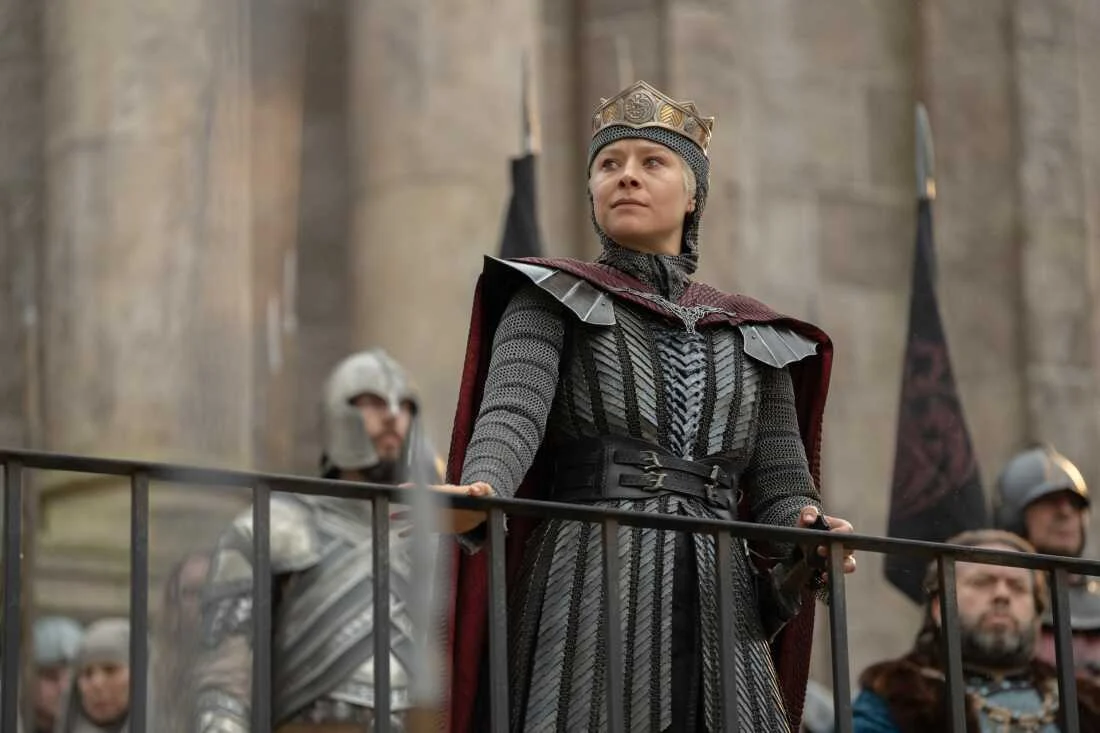

The ‘House of the Dragon’ Season 3 finale gave viewers a version of Rhaenyra Targaryen that many fans immediately recognized from another queen’s downfall. Queen Rhaenyra Targaryen’s cold, calculated choices in the season finale have fans and critics drawing a straight line to Daenerys Targaryen’s infamous heel turn in ‘Game of Thrones’, and the resemblance struck viewers as unmistakable once they noticed it.
What sets this moment apart from years of casual fan theorizing is that the people who made the show are now addressing the connection directly. With showrunner Ryan Condal and star Emma D’Arcy weighing in on the connection, the parallels between the two Targaryen queens are no longer confined to fan theory territory, and are now part of the show’s own narrative fabric.
The Family Tie Behind the Rhaenyra and Daenerys Parallel
The connection between these two characters is not simply a thematic coincidence dreamed up by frustrated viewers. Rhaenyra and Daenerys are distant relatives, living roughly two hundred years and about eight generations apart, according to the Targaryen family tree George R.R. Martin laid out in his work.
That bloodline matters because both women are fighting for the same prize under strikingly similar circumstances. According to analysis comparing the two, they are both female claimants to a throne sat by a male relative, both were named Princess of Dragonstone by a previous king, and both had a stillbirth where their child showed draconic malformation. Both are also dragon riders who were pushed into arranged marriages, underscoring how closely their circumstances echo one another across two centuries of Targaryen history.
Not every comparison holds up under scrutiny, however. Some longtime readers of the source material have pointed out that Rhaenyra was named Princess of Dragonstone by a sitting king with recognized authority, while Daenerys was named by a pretender from an overthrown dynasty that no one else recognized as king, a distinction that complicates any tidy one-to-one comparison between their journeys.
Ryan Condal Addresses the Rhaenyra Daenerys Comparison Directly
Ryan Condal, the co-creator of ‘House of the Dragon,’ has stopped short of treating the Daenerys comparisons as an accident. Speaking to Business Insider, Condal said Rhaenyra and Daenerys are on parallel tracks, and confirmed that the echoes of Daenerys’s self-righteous rise to power and her tragic downfall in Rhaenyra’s story were intentional.
At a press conference following the finale, Condal welcomed the comparisons rather than deflecting them. He told reporters that he thinks it is wonderful if people draw parallels between the two series, adding that there will certainly be mirroring, echoes, and reflections across both stories, some intentional and some subliminal. He framed the connection as something larger than a simple callback, tying it instead to a theme that runs through the entire franchise.
Condal was also careful to draw distinctions between the two queens, even as he acknowledged the overlap. He explained that Daenerys only reached the Iron Throne at the very end, after she had already destroyed the city, while Rhaenyra’s story is about actually holding the throne and being slowly altered by the experience of trying to keep it. In his own words, “Daenerys only got to the Iron Throne at the very end, after she had destroyed the city,” while “Rhaenyra goes through this experience of having the throne, trying to hold it and being, in a way, turned and changed by it, altered by the experience.”
Still, Condal was clear that the underlying scaffolding of both arcs comes from the same place. He said the parallels call to the greater themes of the ‘A Song of Ice and Fire’ universe, namely pride and power, and how power corrupts and how far it corrupts.
Emma D’Arcy on Rhaenyra’s Descent and What It Means for the Show
Emma D’Arcy, who plays the adult Rhaenyra, has offered their own perspective on why audiences keep landing on Daenerys as the obvious reference point. D’Arcy told reporters that the parallels tie back to the greater themes of the franchise, namely pride and power, and how power corrupts and how far that corruption can travel, turning good people into corrupted people and corrupted people into real villains, while for others it simply destroys them.
The season’s darker choices were not subtle. Rhaenyra’s arc included ordering the execution of the High Septon and having a captive Helaena force fed, choices that read as a direct callback to the ruthlessness that defined Daenerys’s final chapter on ‘Game of Thrones.’ D’Arcy has been notably candid about how deliberate this shift was meant to feel, explaining that Rhaenyra’s harder edges this season track with how grief disrupts her ability to empathize, particularly following her son Jace’s death.
That grief, according to reporting on the finale, is central to understanding why Rhaenyra crosses the line she does. Rhaenyra reached a point of no return in the season finale, pushed there by grief, a determination to reject the realm’s insistence that a woman cannot rule, and a desperate need to give her grief meaning. That combination of motives gives her turn a different emotional texture than Daenerys’s, even as the visual and narrative echoes remain deliberate.
How the Two Queens’ Legacies Diverge
Despite the mounting similarities, longtime fans of the franchise have long noted that the two characters started from very different places. One widely shared comparison of their personalities points out that Daenerys was a quiet, shy girl until she became the Khaleesi, while Rhaenyra was always the center of attention, and Daenerys tends to be a deeper, more logical thinker while Rhaenyra lives very much in the moment and lets her emotions guide her.
Their records as rulers also diverge sharply, at least in the earlier chapters of their stories. According to one comparison of the two queens, Daenerys freed hundreds of thousands of people from slavery and united several countries under her rule before her downfall, a legacy of liberation that gives her fall from grace a different weight than whatever awaits Rhaenyra.
Other longtime readers of Martin’s work argue the resemblance is looser than the show’s marketing suggests. The thing that defines Daenerys most is that she cares deeply about others and puts their interests above her own desires, whereas Rhaenyra cares mainly about herself, even if it means trampling common people in the process, evidenced by Dany’s willingness to marry a man she did not want in order to bring peace to Mereen, compared to Rhaenyra’s blunt rejection of Corlys Velaryon’s suggestions for ending the war peacefully. That contrast suggests the two women may be united more by the corrupting pull of the Iron Throne than by shared temperament.
With ‘House of the Dragon’ now heading into its final season, the show has made clear that the Daenerys comparisons are not incidental, and viewers who have watched Rhaenyra’s arc unfold will likely be debating for months whether her story ends up mirroring Daenerys’s tragedy or finding its own distinct shape entirely. What do you think the finale’s Daenerys echoes mean for how Rhaenyra’s story wraps up in Season 4.