‘The Christophers’ Ending Explained and the Surprising Real Meaning Behind Its Title

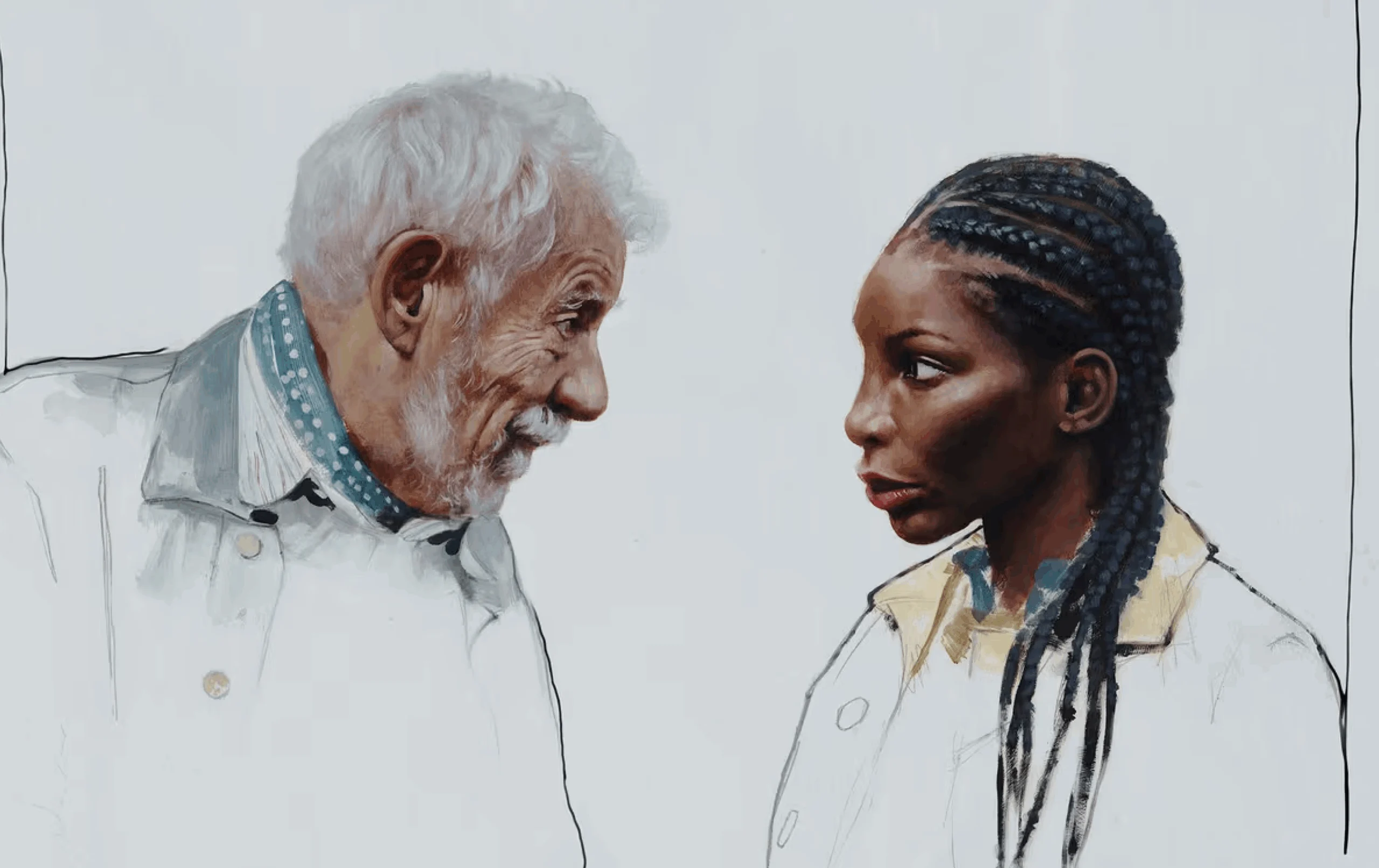

Steven Soderbergh’s latest black comedy has given audiences plenty to unpack, and much of that conversation centers on how ‘The Christophers’ closes out its story of art, deception, and legacy. The film was directed by Steven Soderbergh and written by Ed Solomon, with a cast led by Ian McKellen, Michaela Coel, James Corden, and Jessica Gunning. The premise sounds like a straightforward con movie at first, but the ending pulls the film in a far more personal direction.
At the center of the story is Julian Sklar, a once celebrated London painter who has not produced important new work in decades, and Lori Butler, a younger painter, art restorer, and sometime forger who is recruited under false pretenses to enter his house. What follows is less a heist and more a quiet reckoning between two artists who see each other more clearly than anyone else in their lives.
Julian Sklar’s Unfinished Paintings and the Forgery Scheme
Julian’s estranged children want Lori to locate and secretly finish a cache of uncompleted paintings known as the Christophers, so those works can later be discovered and sold for a fortune after Julian’s death. The plot follows Lori Butler, an artist and forger hired by the estranged, greedy children of the legendary painter Julian Sklar, with Barnaby and Sallie Sklar intending for Lori to secretly complete their father’s unfinished Christopher series so they can sell them for millions after his passing.
The scheme complicates itself almost immediately once Julian realizes what is happening in his own home. The scheme takes a sharp turn when Julian discovers the plot, and after Julian burns the sketches, Lori recreates the paintings as a tribute, turning a mercenary heist into a creative love and legacy preservation.
That reversal is the emotional hinge of the entire film. Several reviews stress that the ending intentionally avoids a conventional con movie payoff, with the finale turning on Julian’s refusal to let his unfinished work become an inheritance product and Lori’s shift from hired imitator into something closer to a steward of his legacy.
What Happens in ‘The Christophers’ Ending
The climax reveals that while the physical sketches were destroyed by the artist himself to spite his children, the essence of the work survived through Lori. The ending highlights a shift from greed to authenticity, as the act of forging becomes a way to honor the creative impulse rather than just a way to cash in on a dying man’s name.
There is also a more intimate final gesture involving the two lead characters. Lori receives a package that Julian’s masseuse brings to her, and as she opens it, she finds an incomplete self portrait of Julian that he had been painting for her, believing she is the only one who would truly appreciate his art.
The film does not tie everything up neatly, and that appears to be intentional. After Julian’s death, Lori forges a letter in his name granting ownership of the paintings to his muse, and the muse later presents the works at a public exhibition, which restores Julian’s standing in the art world. At that same exhibition, Lori quietly debuts her own modern art installation built from clips of Julian’s Cameo videos, a gesture that seems to honor him while exposing the private man behind the public persona he curated for so long.
Critics have generally read this as the emotional payoff the film was building toward all along. Critics have generally framed the story as beginning with forgery and ending as an intimate meditation on art, with the relationship between the two leads evolving into an uneasy but lasting connection rather than a clean resolution.
The Real Story Behind the Title
The title itself carries more weight than it initially seems to, and that is the detail many first time viewers miss. The title gains extra weight by the finale, since Christopher is revealed to be a real person who mattered deeply to Julian and hurt him, which explains why the paintings sat unfinished for so long and why his first instinct was to bury them.
That backstory reframes everything that came before it in the film. The title refers to a series of paintings that Julian had left incomplete for mysterious reasons, and Lori is the one tasked to forge them to be sold after his death. Once the identity behind the name is revealed, the destroyed sketches read less like a business decision and more like a wound Julian was never able to close.
By the film’s final stretch, that emotional throughline is what critics point to as the real accomplishment of the ending. By the end, Julian fully recognizes Lori’s insight into his work, and that mutual recognition is what the film has been building toward the entire time.
Critical Reception of Soderbergh’s Latest Film
The response to ‘The Christophers’ has been notably strong, particularly for a film built almost entirely around two performances. The film currently holds a Tomatometer score in the mid nineties across dozens of reviews, with critics praising it as a sly caper carried off with Soderbergh’s characteristic panache and calling it a superb two hander featuring McKellen and Coel at their very best.
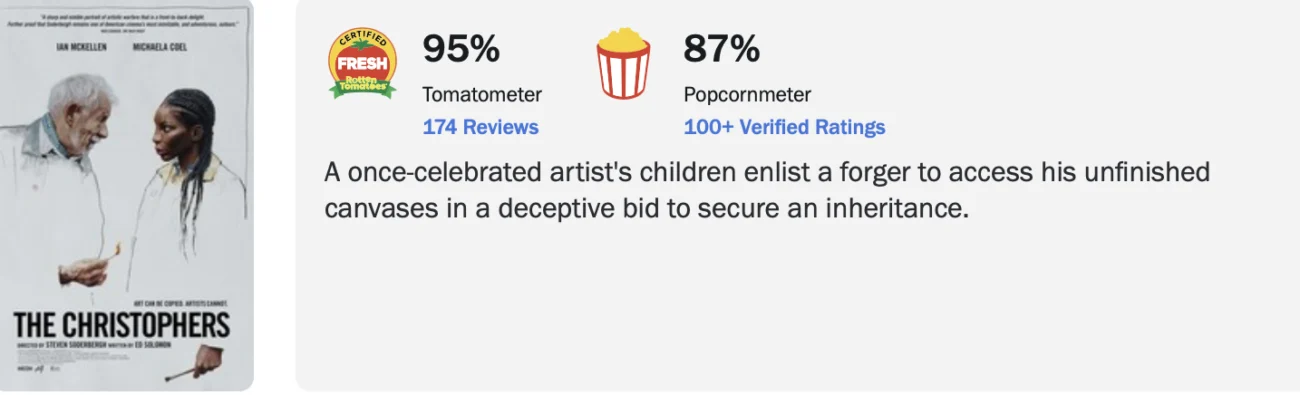
Individual reviews have echoed that same enthusiasm for the central pairing. Alissa Wilkinson of the New York Times wrote that she rarely enjoyed watching two actors’ rapport the way she loved watching McKellen and Coel, adding it could have gone on forever and not been long enough. Rachel Labonte of ScreenRant wrote that the film trusts its two leads and their characters to guide the audience to its desired conclusion, calling watching it unfurl a rewarding experience.
The film’s box office run has been modest compared to its critical reception. The film received a limited theatrical release in the United States on April 10, 2026, through Neon, and in the United Kingdom on May 15, 2026, through Picturehouse Entertainment. That gap between acclaim and audience turnout has become part of the broader conversation around the film, especially given how deliberately paced and dialogue driven the ending turns out to be.
For a film this quiet about its biggest reveal, the finale still manages to land with real emotional force, so which of the two, Julian or Lori, do you think actually walked away with the truer legacy once the paintings finally left that house.