Why Steven Spielberg and David Koepp Chose to Honor Classic Alien Mythology in ‘Disclosure Day’

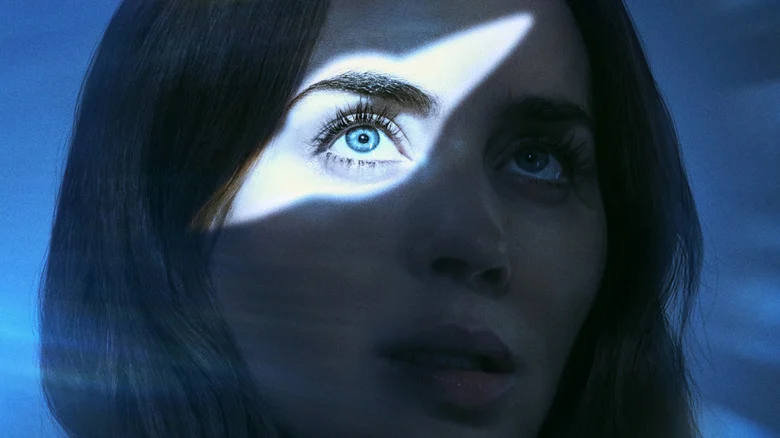

Few filmmakers have spent more time staring at the sky than Steven Spielberg. From the wonder-soaked encounters of his early career to a lifetime of reported personal fascination with the UFO phenomenon, the director has always seemed magnetically drawn to the question of what might be out there. With ‘Disclosure Day,’ he returns to that obsession more than half a century after helping establish the pop-culture language around alien contact, this time imagining a world in which humanity receives definitive proof that we are not alone and powerful forces have long worked to keep that fact buried.
The film, written by David Koepp from a story by Spielberg and distributed by Universal Pictures, stars Emily Blunt and Josh O’Connor as two individuals seeking the truth about alien visitation, with Colin Firth playing a grim government operative determined to silence them. The ensemble also includes Colman Domingo, Eve Hewson, Wyatt Russell, and Elizabeth Marvel, with a score composed by John Williams. It marks yet another collaboration between Spielberg and Koepp, who have previously worked together on ‘Jurassic Park,’ ‘The Lost World,’ ‘War of the Worlds,’ and ‘Indiana Jones and the Kingdom of the Crystal Skull.’
At the center of the film’s mythology is a deliberate creative choice that Koepp has now publicly explained. Rather than reimagining what extraterrestrials might look like, the filmmakers leaned directly into the image most people already carry in their minds. When the aliens in ‘Disclosure Day’ appear in their true form, they present the classic extraterrestrial silhouette, complete with large heads, black eyes, gray skin, long thin fingers, and an overall humanoid shape, and are shown to vary significantly in size across the film.
In an exclusive interview with ScreenRant’s Liam Crowley, Koepp revealed that this was a conscious and deeply considered decision shared by both writer and director. As quoted in the screenshot shared by ScreenRant, Koepp explained that Spielberg had been clear from the start: “I want to respect the lore that’s out there. There’s a cultural memory of how things are and what might have happened. And I don’t want to fly in the face of that.” That philosophy extended to the screenplay itself, with Koepp noting the two set out to find “a unified theory of the UAP phenomenon,” choosing to include as much of the existing mythology as possible rather than debunking or filtering it.
The film mines roughly 70 years of UFO mythology, referencing touchstones like the 1947 Roswell crash and even more obscure folklore, such as a supposed incident in which President Nixon showed actor Jackie Gleason the bodies of recovered aliens. The approach reflects Spielberg’s own lifelong investment in the subject, one he described to Empire magazine as “seven solid decades of a vast personal interest in what lies beyond our atmosphere.”
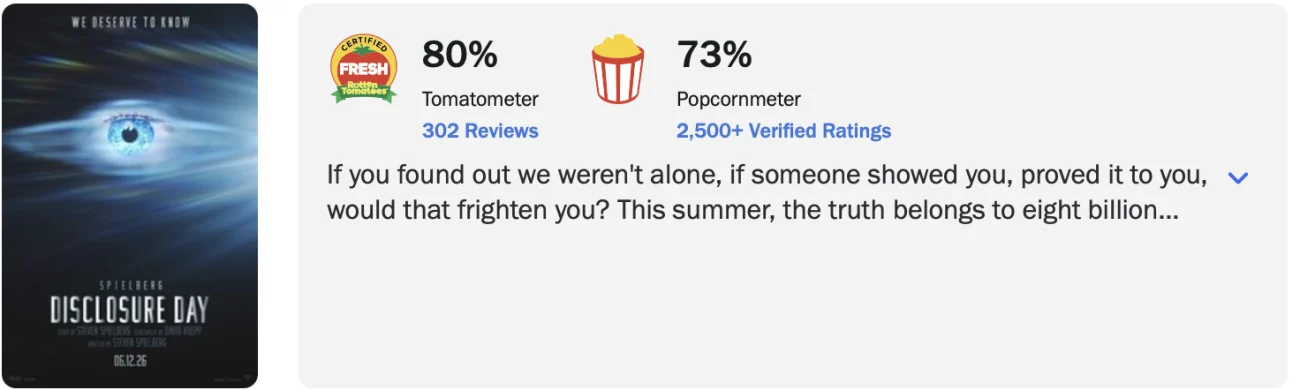
Audiences have responded warmly to the film’s grounded reverence for the mythology. ‘Disclosure Day’ opened to roughly 44 million dollars domestically across 3,824 North American theaters, landing at number one at the box office in its debut weekend. That figure also makes it Spielberg’s highest opening weekend for any project based on an original screenplay, surpassing the domestic starts of both ‘Minority Report’ and ‘Saving Private Ryan.’ Critics have been largely supportive as well, with the film earning an 82 percent score on Rotten Tomatoes and a Metacritic score of 75.
With a filmmaker of Spielberg’s stature deliberately choosing to honor rather than subvert what audiences already believe about alien life, ‘Disclosure Day’ arrives as something rarer than most blockbusters: a film that trusts its audience’s imagination. Whether that gamble sustains the film through its theatrical run remains to be seen, but after decades of science fiction movies trying to reinvent the extraterrestrial wheel, there is something genuinely refreshing about the choice to say that the cultural memory was right all along. Does the decision to embrace the classic alien image make the creatures in ‘Disclosure Day’ more unsettling for you, or would you have preferred Spielberg take the design somewhere entirely new?