Documentaries As a Quiet Form of Loud Conversation Inside the Cinema World


Documentary filmmaker Katerina Diakova Spector chooses the path of inner silence and ethical precision in her work, speaking about complex, breathtaking topics in the modern world.
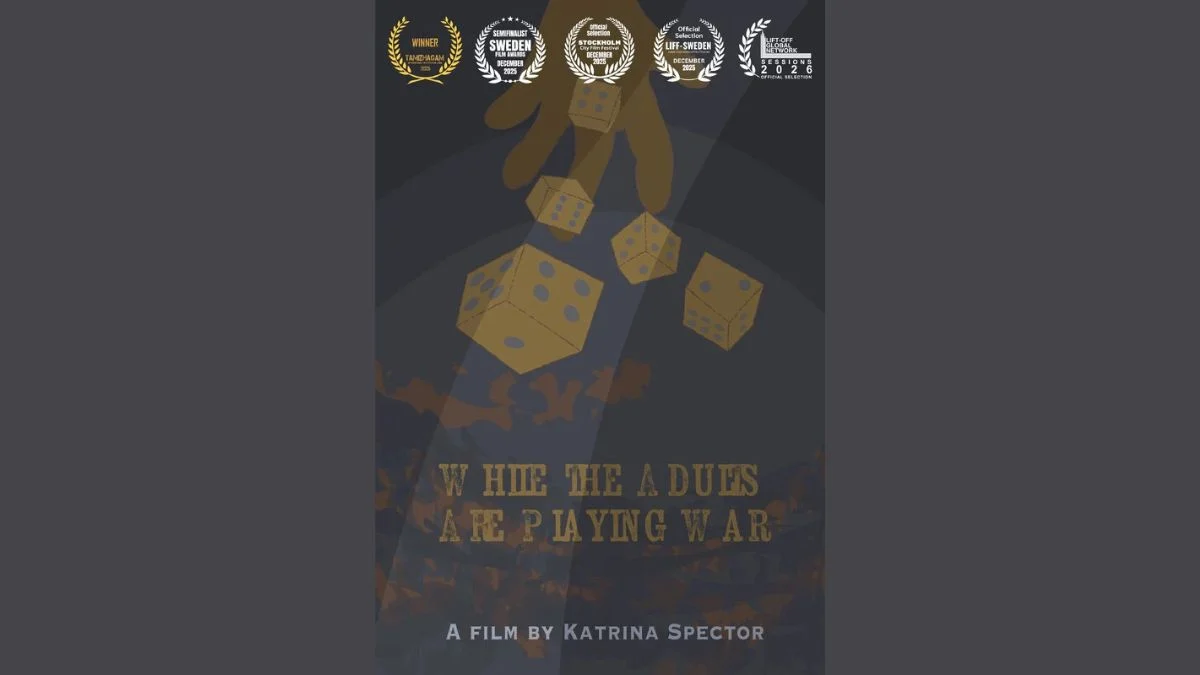
Now at international film festivals, more and more attention has been paid to films that are not built around an interesting plot, but can construct a deep dialogue with the audience on sometimes painful topics. Katerina Diakova Spector, a documentary filmmaker and editor from Tel Aviv, works in a similar field – war and its consequences, internal emigration, memory, political pressure, and human vulnerability. Her short film “While the Adults Are Playing War” (2025), about a young Ukrainian refugee undergoing art therapy after the war, has become one of the most notable directorial works of recent years.

This movie began with one simple observation: children understand more than they can articulate, especially in times of war. This work is about a simple and understandable, but such an important experience of a child – fear. For the last year, the film won the Best War Theme Film award at the Berlin Indie Film Festival, as well as the Best Documentary Short Film award at the Tamizhagam International Film Festival. In addition, the movie was included in the official programs of the Stockholm City Film Festival and the Lift-Off Global Network and was awarded as a semi-finalist at the Swedish Film Awards. Such a festival dynamic shows that the work, built on delicate ethics and internal drama, resonates with an international audience nowadays.
Being a member of the Israeli Directors Guild and laureate of international festivals, Katerina creates films about children who survived the war, about people in a state of social and political instability, about trauma, family memory, and the right to an inner voice. Using her own methods of building a dialogue with the actors and forming a picture, she creates strong short films for a caring audience. Against the global trend towards humane documentaries, her works do not follow fashion, but a consistent professional position on how to touch the viewer’s soul.
Ethics as a form of director’s statement
One of the main problems of modern documentary filmmaking is the conflict between truth and invasion. The camera is able not only to capture reality, but also to destroy it, turning a person into an object of observation.
Katerina Diakova Spector’s method is based on the rejection of aggressive exposure. She works with partial shots, pauses, voice-overs, fragmentation, and a deliberate lack of full visual disclosure. In her films, the hero is not obliged to give out everything – he retains the right to the border.
“I often work in conditions of limited visibility — partial framing, off-screen presence, closed or indirect viewing points, allowing me to build a plot using voice, gestures, silence, and emotional tension, rather than full visual impact. This method creates a sense of truth that arises gradually, from within the situation being filmed, rather than being imposed from the outside,” Katerina shares.
The focus is not on revealing everything, but on allowing the audience to enter into the inner world of the film, capture character while maintaining dignity and boundaries. An important aspect of Katerina’s work is the observance of ethical standards in relations with the people she films. The characters are fully aware of their right to demand that certain moments, words, or actions not be included in the final version of the film, and the director always respects such requests.
“This constant dialogue between the author and the hero shapes the structure of the film and raises questions about the ethics of documentary filmmaking – how much can be revealed, where the boundary lies, and who ultimately controls the image,” Katerina comments. This approach is especially important in trauma-related projects. Instead of emotional pressure, the director builds trust. Instead of an effect, it is a process. As a result, there is a space where the truth is born not from confrontation, but from a gradual rapprochement.
Documentaries in a tense society
Now the director’s work is unfolding in the context of a complex social and political reality, so Katerina Diakova Spector’s approach is largely dictated by the modern viewer. Her current full-length project, “The Last Typewriter”, explores changes in the social atmosphere, pressure on writers and intellectuals, and the gradual narrowing of the space for critical expression in Israel.
The themes she works with require not only artistic precision but also inner courage. Such projects often face difficulties with institutional support, precisely because they raise sensitive issues. “Because the film deals openly with sensitive political issues, many broadcasting bodies are unwilling to invest in or support the project, despite its artistic and cultural value”, Katerina shares.
International festivals are increasingly awarding films that show things that are scary to talk about: the viewer does not demand sensationalism, but depth, respect for the hero, and a complex artistic language. That is why creating the current film for Katerina is both a challenge and a personal responsibility at the same time. Recently, at the Sundance Film Festival, the Audience Award in the documentary category was awarded to the film “One in a Million”, a long-term observation of a Syrian girl who survived the war and forced resettlement. “Documentaries are now becoming one of the most influential forms of public expression. A personal story turns into a universal conversation about trauma, memories, and growing up in conflict,” Katerina comments.
In these circumstances, her method becomes not so much an aesthetic choice as a strategy for professional sustainability. Hybrid forms – a combination of documentary material with animation and non-literary visual layers – allow us to talk about complex processes without destroying the personal space of the hero and without turning the film into a straightforward manifesto. International interest in films about war, memory, and personal freedom – from Sundance to European festivals – confirms that this form of conversation is in demand today.
When cinema resonates around the world
Despite the difficulties with supporting the current film, which many directors face, Katerina’s work has not gone unnoticed. Besides the successful short film “While the Adults Are Playing War”, Katerina’s earlier full-length film “Stains”, exploring family history, trauma, and political memory, received festival recognition in the Family Film Project Festival in Portugal back in 2017. This is a fairly well-known and unusual international film festival, held annually in Porto, focused on archival, ethnographic, and experimental films exploring the themes of family, memory, and identity. This award marks the uniqueness and relevance of the film in terms of the importance of the values raised in the film. This project was a turning point: the author’s language of the director was finally formed in it – a combination of personal and historical without direct declarativeness, which later became her main principle of work.
The recognition also touched upon her work as an editor. At the beginning of her career, her editing was marked by a special mention at one of the leading Israeli documentary festivals. In 2020–2021, Katerina served as Lead Editor on the documentary series #AMiNORMAL, an 8-episode documentary format that combines documentary storytelling with a distinctive visual language such as GIF animation. It is a comedy digital series about the human effort to define normal and the desire to fit in. This series premiered at the International Documentary Film Festival Amsterdam and was broadcast on ARTE in France and Germany, as well as on the Israeli Public Broadcasting Corporation. Since then, projects with Katerina’s participation have been regularly selected for international programs, from European to global documentary forums.
The experience of Katerina Diakova Spector allowed her to understand and feel the passage of time and her audience. Modern documentary filmmaking requires not only artistic talent but also inner resilience. Working with war, trauma, memory, and freedom of expression, she chooses a form in which the hero retains the right to a boundary, and the viewer retains a space for reflection.
In an era when the world is increasingly turning to personal stories as a way of understanding big processes, the power of documentary films is not in volume, but in depth. And it is precisely this depth that becomes the main professional result of a successful director.