AI Doesn’t Solve the Main Problem in GameDev. People Simply Change the Processes Behind the Scenes

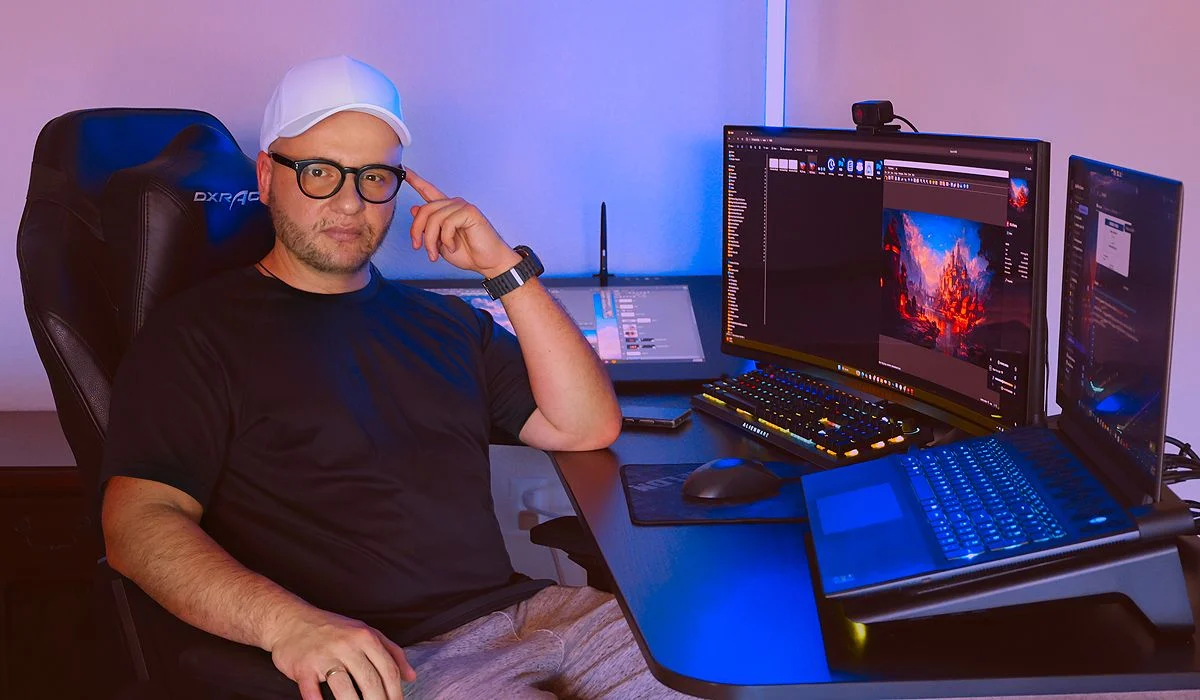
Using the example of Senior Art Director with 20+ years of experience across the game industry, Dmytrii Yeremenko, we explore why the future of GameDev depends not so much on generative AI as on the ability to build effective processes.
Over the past few weeks, the topic of artificial intelligence has once again become one of the most discussed in the gaming industry. Laura Miele, EA’s president of enterprise development, stated that AI helps free teams from routine work and accelerates the creative process. At the same time, CD Projekt Red’s leadership acknowledges that fully generated games will eventually emerge, but doubts that this approach represents the future. Capcom has taken a more cautious line, telling investors earlier this year that it will use generative AI to improve efficiency but not to replace the final artistic content in its games.
At first glance, it seems that the main question today is whether or not to use AI in game development. In practice, however, the industry has long been discussing a different problem: how to speed up work and maintain project quality when development costs are constantly rising, teams consist of hundreds of specialists, and the production cycle takes years. That is why the focus is increasingly shifting from individual technologies to the organization of the production process itself.
Dmytrii Yeremenko, Art Director at SpinPlay Games, is among the professionals who view this issue not as a passing trend, but through the lens of his own experience building large-scale production systems. Over more than 20 years, he has risen from 3D artist to the head of art departments numbering in the hundreds, and he arrived there the long way around: through PC and console game development, film and TV post-production, visual effects, and some of the largest mobile games on the market.
From film VFX to a game inside a supermarket chain
He started in PC game development,building environments for investigation-focused gameplay, where every street and interior had to stay believable under a player’s close scrutiny. From games he moved into film, joining the visual-effects studio Postmodern, where he contributed to the 2013 miniseries Inseparable. The project received two nominations at the 2014 Visual Effects Society Awards for which Dmytrii was personally named among the nominated artists.
The years that followed placed him at the center of some very large productions. At Plarium, the studio behind Vikings: War of Clans and RAID: Shadow Legends, he helped build the art function for its Kyiv office and worked on Terminator Genisys: Future War, an official mobile title made with Skydance on the Terminator license. Plarium’s games have since drawn more than 380 million players, and in 2024 the studio changed hands for as much as $820 million. At GSN Games, he directed art for casino titles built on well-known American brands, among them Wheel of Fortune slots and the long-running social game Bingo Bash, with its audience of more than 70 million. At Whaleapp, he took charge of a department that eventually grew to 200 artists and art leads and helped deliver crossovers with Nickelodeon’s SpongeBob SquarePants and the BBC’s Doctor Who. And at Playrix, one of the four largest mobile game companies in the world, he worked on Fishdom, a match-3 hit downloaded well over a hundred million times. Taken together, his projects span mobile, PC and console games, casino, film VFX and loyalty gamification, a range few art directors cover in a single career.
His most recent chapter began at Loyalty Games, where in 2024-2025 he led an art team of up to 20 specialists. The key project was Chroma Legends, a mobile PvP game created for Ukraine’s Silpo retail chain that ties an in-app world to physical collectible cards and the chain’s loyalty program. Dmytrii shaped the unified visual style, from characters and environments to interfaces, animation and the collectible materials. He also reorganized how the art team worked, building the communication between specialists and the quality standards that carried the project from an early prototype to a commercial launch in 2025. The campaign ran in more than 300 Silpo stores, and the project won Best Use of Gamification within a Loyalty Program or Initiative at the European Loyalty Awards.
Since September 2025, Dmytrii has been Art Director at SpinPlay Games, a US studio that develops online slots with complex game mechanics. There his focus is on turning layered mechanics into visual solutions players read at a glance, and on keeping artists, game designers and engineers working as one team.
When scale becomes the main problem
A decade ago, team growth was considered a sign of a successful project. Today, it is increasingly becoming a source of new challenges. When dozens of artists work on a game at the same time, maintaining a consistent visual style is relatively straightforward, but when hundreds of specialists are involved, entirely different challenges arise: consistent quality standards, documentation, asset libraries, approval processes, and the transfer of knowledge between teams.
While working at Whaleapp, Dmytrii led an art department that brought together as many as 200 artists and art leads. Instead of constantly expanding the staff, the team focused on standardizing production, implementing unified pipelines, asset-reuse systems, leadership development programs, and new principles for organizing the work.
“At some point, I realized that an art director’s success isn’t just about personal taste or the ability to draw. It’s the ability to help others produce strong work. Art direction is teamwork. Essentially, an art director can be compared to a conductor who sets the rhythm for an entire orchestra of professional musicians,” Dmytrii said.
By applying this philosophy, his team managed to reduce art production costs by roughly 25 to 30 percent. Such results grow more relevant every year in an industry where the cost of creating content keeps rising faster than teams gain productivity, and they are the reason an art director’s job now rests on building a system that lets hundreds of specialists work as one, rather than on the sheer number of concepts one person can produce.
AI has proven to be most useful where it was least expected
However, standardization alone does not speed up development. Even in well-organized teams, a huge portion of time is still taken up by repetitive tasks: preparing references, searching for visual solutions, creating initial concepts, and working through dozens of intermediate iterations. It is in this area that AI tools have begun to see active use in recent years.
Dmytrii Yeremenko views AI primarily as a tool for production preparation: exploring visual directions, creating references, generating quick concept variations, prototyping interfaces, and automating repetitive tasks. “I don’t see AI as a replacement for artists. For me, it’s purely a tool that helps speed up the search for ideas,” he noted. According to him, at certain stages this approach has made it possible to reduce task completion time by up to 70 percent, leaving artists with more room for the creative parts of the work.
This largely aligns with what the major game companies are discussing today. Even advocates of actively implementing AI emphasize that the technology’s value lies in accelerating the preliminary stages of development rather than in creating finished art. This points to the real limit of the technology: AI speeds up an artist’s work, but it does not answer the question that decides a project, namely how many resources that project will actually need.
Long before the first drawing
If a team cannot estimate the scope of work, timelines, and staffing requirements in advance, even double-digit gains at individual stages can be lost. That is why many managers begin the optimization process by first reviewing how a project is planned, before reaching for any image-generation tool. In the early stages, teams need to assess the scope of work, deadlines, the number of specialists, production costs, and the interdependencies between different areas of development. Mistakes made at this stage can follow a project for months.
Faced with this challenge in his day-to-day work as an art director, Dmytrii Yeremenko developed a free web tool called Project Tool Estimator. The service helps production teams calculate project scope, the number of specialists required, deadlines, working hours, and budget, so that everyone involved uses the same approach to production estimation.
“I built it as a tool for professionals: producers and art directors who need to plan production on solid numbers, not on gut feeling. When teams estimate work in the same way, projects are planned more honestly and resources go where they are really needed. In the end, that means better games. I’d like this approach to become standard across the industry, so that fewer teams discover halfway through a project that they need more time or more people than planned,” Dmytrii shared.
The tool is free and requires no registration, and nothing a user enters is sent to a server. Such tools grow more useful as game projects become more complex, when even a minor error in planning can lead to a sharp increase in the budget.
What decides the outcome
Dmytrii Yeremenko is candid that he did not always work this way. Early in his career, he found it easier to fix a problem himself than to hand it to someone else, and for a while that instinct kept the quality bar high. Over time, though, it became clear that the approach does not scale: on a large team, doing everything yourself becomes a bottleneck, and holding on too tightly keeps the people around you from growing. Managing art production, he concluded, is far more a matter of organizing a process than of personal skill, and so he put his energy into developing his art leads, building a culture of clear, specific feedback that helps artists understand not only what needs to change, but why it matters for the project, and setting quality standards clear enough that the system keeps working no matter who happens to be doing the job.
That is more or less where the current argument about AI lands, once the loudest claims are set aside. The debate tends to circle whether the technology can replace artists and run production on its own, but the experience of the larger studios points somewhere quieter. A studio’s real advantage is not that it can use AI, since by now almost anyone can; the advantage is whether it can fit AI into a process that already works, so that production moves faster, quality holds, and the part of the work only people can do stays in human hands. What will decide the next few years of the games industry is how well studios rebuild the entire production cycle that leads up to the final image, and it is there, in the unglamorous work of organizing how a game gets made, that the line now runs between a studio that is experimenting with AI and one that has actually learned to use it.