‘Avatar Aang: The Last Airbender’ Confirmed Canon Within the Franchise Timeline

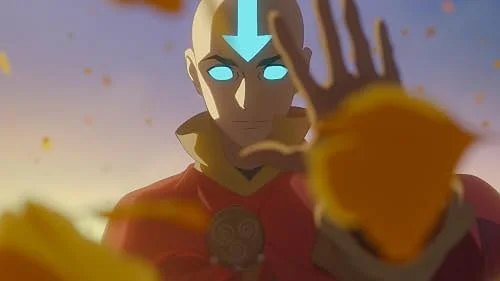

Fans who spent years wondering what happened to Team Avatar after the war with the Fire Nation finally have a definitive answer, and it comes with an equally clear verdict on where the story fits in the larger mythology. ‘Avatar Aang: The Last Airbender’ has arrived as the first animated feature from Avatar Studios, and the question of whether it counts as official canon has been settled by the people who built the original show.
The film picks up more than a decade after the events fans grew up watching, following Aang, Katara, Sokka, Toph and Zuko as adults navigating a world still recovering from the Hundred Year War. That timeline placement, combined with direct involvement from the franchise’s creators, is central to how the movie is being received by longtime viewers of ‘Avatar the last airbender canon’ discussions online.
Avatar Studios Confirms Canon Status
The short answer to whether this new movie counts is yes, and the reasoning comes down to who made it. The film is directed by Lauren Montgomery and written by Tim Hedrick and Christopher Yost, based on a story credited to Bryan Konietzko, Michael Dante DiMartino, Hedrick, and Kenneth Lin.
Konietzko and DiMartino are the original creators of ‘Avatar: The Last Airbender,’ and their direct involvement is a major reason the movie is treated as canon rather than a side story. That distinction matters to fans who have watched other spinoff material get dismissed as non essential over the years.
Nickelodeon rekindled its relationship with Konietzko and DiMartino, which eventually led ViacomCBS to announce the formation of Avatar Studios during its investor day in February 2021. The studio was built specifically to keep expanding the animated universe under the guidance of the people who created it in the first place.
Critics have also weighed in on the canon question directly, with one review noting that despite comparisons to non canon anime spinoffs, ‘Avatar Aang: The Last Airbender’ is still very much part of the broader franchise. That kind of framing from outlets covering the release reinforces what the production credits already suggest.
The Gaang’s Story After the Hundred Year War
The film’s official logline describes Aang, the world’s last Airbender, learning of an ancient power that could save his culture from extinction, prompting him and his friends to embark on a global quest before it falls into the wrong hands. That quest threatens to unravel the peace the group sacrificed everything to secure years earlier.
Thirteen years have passed since the defeat of Fire Lord Ozai, and Aang remains unhappy and lonesome despite the peace that followed, still carrying the weight of being the last of his people after the Air Nomads were wiped out during his time in hibernation. A new antagonist group called the Denied complicates the search for the staff Aang is chasing.
The story eventually reveals that the film’s villain was secretly funded by a coalition within the Earth Kingdom nobility, planting the seeds of corruption that later leads to the Earth Queen’s tyranny. The movie closes with the birth of Tenzin, Aang and Katara’s youngest son, symbolizing the restoration of the Air Nation.
Because the characters have aged, Avatar Studios assembled a new cast of Asian and Indigenous talent to portray the adult Gaang, one of the more discussed aspects of the production. The voice cast includes Eric Nam, Jessica Matten, Roman Zaragoza, Dionne Quan, Steven Yeun, Dee Bradley Baker, Taika Waititi, Ronny Chieng, Freida Pinto, Geraldine Viswanathan, Ken Jeong, Ke Huy Quan, and Dave Bautista.
Critical Reception and the Streaming Debate
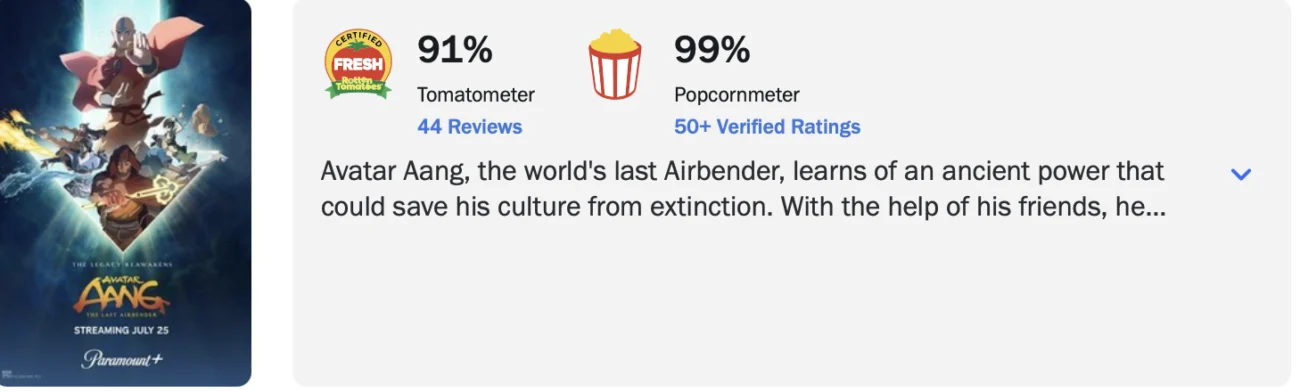
The film currently holds a 91 percent fresh rating on Rotten Tomatoes, though that figure is based on a relatively small sample of 11 reviews at the time of reporting. That early positivity arrived under unusual circumstances for the franchise.
The entire film leaked online a couple of months before its official release, becoming available through social media and piracy sites, which was a significant blow to a franchise already working to maintain relevance at Paramount. The movie was originally intended for a theatrical release before being shifted to Paramount+ years later, only for Paramount to eventually announce a limited theatrical run following backlash over the streaming only plan.
Reviews have been largely favorable but not uniformly glowing. Rotten Tomatoes aggregated reactions include praise for the film’s ability to pack a lot of story into a compressed runtime, alongside more measured takes calling it an action packed entry that falls short of Aang’s greatest moments.
Variety described the movie as delivering gorgeous visuals and thoughtful worldbuilding that would have benefited from a wider theatrical release, noting the movie was set for only a limited, awards qualifying run in New York and Los Angeles before heading to streaming. RogerEbert.com went further, arguing that the film proves earlier abridged adaptations, including the ongoing Netflix series and the widely panned M. Night Shyamalan version, pale in comparison to this new effort.
What Seven Havens Means for the Franchise Timeline
The canon confirmation for ‘Avatar Aang: The Last Airbender’ is not an isolated event within the franchise. Avatar Studios is already working on Avatar Seven Havens, which is currently in production as the third animated series in the Avatar universe and will introduce a brand new Avatar as its protagonist.
Reports indicate the new series will use 2D animation similar to its predecessors, and it is expected to arrive on Nickelodeon, the same network that aired the original two shows. That continuity of format suggests Avatar Studios wants Seven Havens to feel connected to the shows longtime fans already know.
With Tenzin’s birth closing out the film and Earth Kingdom corruption planted as a seed for future stories, ‘Avatar Aang: The Last Airbender’ positions itself as connective tissue between the original series and ‘The Legend of Korra.’ That framing suggests Avatar Studios is building a single connected timeline rather than treating each project as a standalone effort.
Between the confirmed canon status of the new film and a new series already in production, Avatar Studios appears committed to a long term expansion of the mythology rather than a one off nostalgia play. For a fandom that has debated canon and continuity for years, this level of clarity from the creators themselves is notable, and it raises the question of how audiences feel about where the Gaang’s story goes from here as Tenzin’s generation prepares to inherit it.