How Christopher Nolan’s ‘The Odyssey’ Reimagines Homer’s Men From the Sea


Christopher Nolan’s new adaptation of Homer’s epic poem gives audiences an unexpected answer to an old historical mystery, tying the wandering crew of Odysseus to the shadowy raiders history remembers as the Sea Peoples. The film’s most provocative historical invention links the wandering Greeks with the mysterious raiders later remembered as the Sea Peoples, turning Odysseus’s voyage into an origin story for the Late Bronze Age collapse.
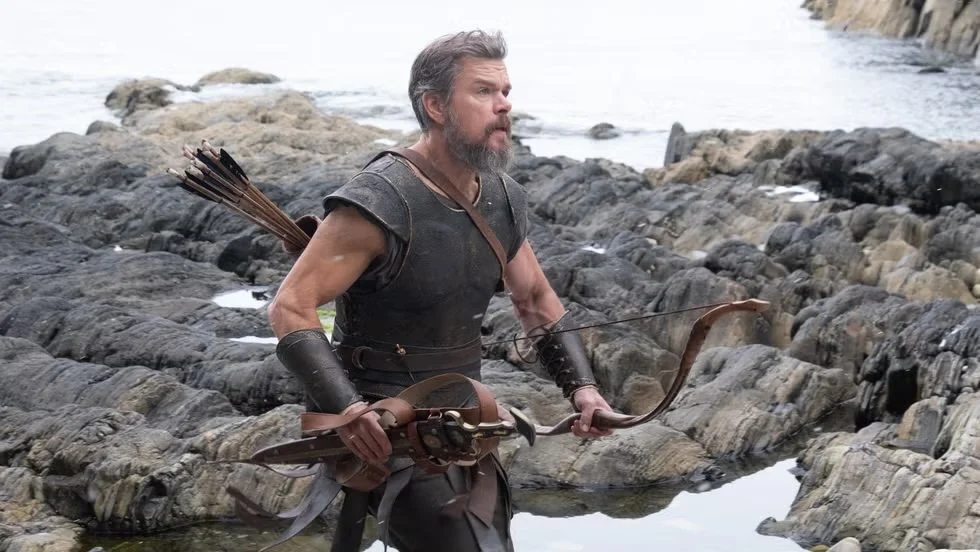
‘The Odyssey’ follows Matt Damon’s Odysseus as he leads his men across the Mediterranean in the years after the fall of Troy, alongside a cast that includes Anne Hathaway as Penelope and Tom Holland as their son Telemachus. Matt Damon plays the film’s lead hero Odysseus, Anne Hathaway plays his wife Penelope, and Tom Holland plays their son Telemachus. By the time the story reaches its final act, the film suggests that the very men trying to sail home may have become the thing other kingdoms fear most.
The Sea Peoples Enter Homer’s Story
In Nolan’s script, the Sea Peoples exist first as rumor, described in the film as an existential threat spreading from the Aegean and Ionian seas toward Ithaca and Sparta long before anyone can name what they actually are. These apparent strangers emerging from parts unknown along the Aegean and Ionian Seas are spoken about in the movie as an existential threat greater than old King Priam of Troy could ever hope to muster.
Homer’s original poem never mentions the Sea Peoples by name, which makes their presence one of the clearest markers of how far Nolan strayed from the source text to build his version of the story. Unlike nearly everything else in Nolan’s Odyssey, the Sea People of the film appear nowhere in Homer.
The device pays off late in the film, when a weathered Odysseus offers Penelope a theory about who the Sea Peoples actually are and how they came to be. Odysseus and his men, whom Odysseus suggests accidentally became the Sea Peoples. That single narrative turn reframes everything that came before it, from the fall of Troy to the long journey home.
Reviewers have pointed to this thread as the film’s boldest storytelling choice, arguing that it recasts a ten year voyage as something closer to the beginning of a much larger civilizational unraveling. The movie around that idea resembles one of its own storms, thunderous, beautiful, disorienting, and prone to throwing entire ships worth of names, prophecies, betrayals, political anxieties, and mythological detours directly overboard.
What History Says About the Bronze Age Collapse
The Sea Peoples are not purely Nolan’s invention. Historical records dating back to roughly 1200 BCE describe them, and for decades they were blamed, at least in part, for the wider collapse of Bronze Age civilization, a subject explored in detail by The Conversation.
During that period the great palaces of Mycenae and Pylos burned, the Hittite empire that once ruled over Troy fell apart, and cities stretching from Syria to Cyprus to Canaan were destroyed within a short span of years. In Greece, the grand palaces of Mycenae and Pylos, home to the legendary kings of Homer’s Odyssey, burned down, and in modern day Turkey, the Hittite empire, overlord of Troy, fell apart.
Historians increasingly treat the Sea Peoples as one symptom among several rather than the sole cause of that collapse, pointing instead to a prolonged drought, broken trade routes, and internal unrest already reshaping the region. Historians now think a web of crises were behind this systems collapse, a 300 year megadrought caused famine, trade routes vital to the Bronze Age economy broke down, and people moved, sometimes peacefully, other times bringing conflict. Some researchers even suggest that part of the so called Sea Peoples may have been Mycenaean Greeks themselves, displaced by the same pressures and searching for new shores.
Wikipedia’s overview of the period notes that certain groups, such as the Lukka and Peleset, are well documented in ancient sources, while the origins of others remain a matter of ongoing scholarly debate. The Sea Peoples included well attested groups such as the Lukka and Peleset, as well as others such as the Weshesh whose origins are unknown.
How Odysseus and His Men Become the Threat
The film draws a direct line between the sack of Troy and the unraveling that follows, with Odysseus warning that the bonds holding the ancient world together, between hosts and guests, rulers and subjects, soldiers and commanders, are beginning to snap across the Mediterranean. The bonds between hosts and guests, rulers and subjects, soldiers and commanders have begun snapping all across the Mediterranean.
Did you like the portrayal of the Sea Peoples?
That warning becomes personal once the crew’s own actions start to echo the pattern historians associate with the Sea Peoples themselves. After the fall of the historic Troy around 1200 B.C., all the civilizations of the eastern Mediterranean collapsed, and the mysterious Sea Peoples began to raid, an arc of fire and blood sweeping across Greece, Turkey, and Syria, all the way to Egypt. Rolling Stone’s reporting notes that author Eric Cline’s research into the same period, which weighs climate change, trade collapse, and internal revolt together, appears to have shaped how Nolan approached this material.
Even the ending resists a clean resolution for its hero. After Odysseus defeats Penelope’s suitors, the killings leave behind widows, fathers, and brothers who may seek retribution, meaning Telemachus could inherit exile rather than a stable throne. Killing the suitors creates widows, fathers, brothers, and another generation of men obligated to demand blood, and Telemachus understands that inheriting the throne may now mean inheriting exile.
Critics Weigh In on Nolan’s Boldest Addition
Critical reaction to the Sea Peoples thread has been engaged if divided, with several reviewers describing it as the most intellectually ambitious choice Nolan makes in the film. At its best, The Odyssey finds a genuinely fresh angle on one of the oldest surviving stories in Western literature, at its weakest, every character sounds ready to defend a doctoral thesis on the Bronze Age collapse.
Some have praised the approach for finding new stakes in one of the oldest surviving stories in Western literature, while cautioning that the density of mythology, prophecy, and political detail can make certain stretches hard to follow. Universal Pictures has scheduled The Odyssey for release on July 17, 2026, with a global IMAX rollout, following Nolan’s long standing preference for high quality large format projection.
Taken together, the historical thread gives ‘The Odyssey’ a weight that goes beyond monsters and storms, positioning the film as much as an argument about how civilizations end as it is an adventure about one man’s journey home.
For a story this old, Nolan’s choice to tie Odysseus and his men to the Sea Peoples raises a genuinely open question about where heroism ends and the very destruction it feared begins, and that seems like exactly the kind of debate worth continuing in the comments.