The Biggest Differences Between Christopher Nolan’s ‘The Odyssey’ and Homer’s Epic Poem


Christopher Nolan has spent his career adapting complicated ideas for mainstream audiences, but his latest project asked him to reckon with a text nearly three thousand years old. Directed and written by Nolan and based on the Odyssey by Homer, the film reimagines one of the foundational stories of Western literature for a modern theatrical audience.
While the bones of Odysseus’s journey home remain intact, Nolan made a series of deliberate choices that separate his film from the source material. Some changes streamline a sprawling poem for a two and a half hour runtime, while others reflect a more contemporary sensibility about heroism, trauma and family.
The Role of the Gods Gets Scaled Back
One of the most fundamental differences in ‘The Odyssey’ is the way the Greek gods are depicted, since throughout Homer’s epic figures like Athena, Zeus, Poseidon and Hermes constantly interfere with human events, either helping Odysseus on his trip or working against him. Nolan strips much of that divine machinery away.
In Homer’s poem, the entire story kicks off with the gods meeting on Mount Olympus to argue over Odysseus’s fate, and their constant interference basically drives the plot, but Nolan almost completely ditches that angle. Characters still reference the gods, but the film never stages a scene on Olympus.
Zeus is never seen on screen and Poseidon exists only as an unseen force whose influence is felt through storms and disaster rather than a physical presence. Athena, played by Zendaya, remains the only deity with any personal connection to Odysseus, though the film leaves room to read her appearances as expressions of his conscience rather than literal divine visits.
That ambiguity fits the film’s broader interest in psychology over mythology. Nolan reframes Odysseus, played by Matt Damon, as less the cunning and manipulative hero of Homer’s poem and more a former warrior haunted by the Trojan War, someone dealing with trauma and flashbacks, favoring a more psychological reading of the character.
The Cyclops Encounter Plays Out Differently
The Cyclops sequence is one of the most recognizable set pieces in ‘The Odyssey’, and Nolan reworks its mechanics considerably. In the film, Odysseus and his crew escape by blinding the Cyclops and strapping straw to their backs so the creature cannot feel the difference between them and his sheep, while in the poem the men cling to the undersides of the sheep and are carried out upside down.
The method of blinding him changes too, since in the poem Odysseus gets the Cyclops drunk before the attack, while in the film the assault happens while the creature is asleep. The sequence also leans harder into physical spectacle, ending with Odysseus firing an arrow through the eye of the blinded Cyclops as he flees.
Nolan adds an extra beat where Odysseus fires another arrow at the Cyclops to provoke it into a greater rage, a moment absent from Homer, where the escape depends far more on cunning than confrontation.
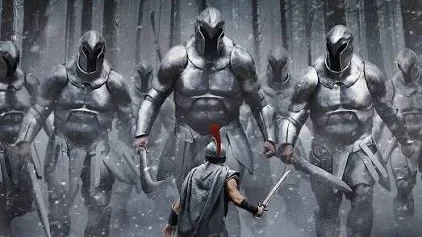
Other monsters get softened for the screen as well. The Laestrygonians, who received significant attention in the marketing thanks to their redesign, remain terrifying in the film but the cannibalism that defines them in Homer’s poem is left out entirely.
Penelope and Telemachus Get a New Dynamic
Nolan’s most pointed departure from Homer involves the relationship between Odysseus’s wife and son. In the poem, Telemachus repeatedly condescends to his mother, at one point ordering her back to her chambers and declaring that speech is the business of men, a moment widely read as reflecting the patriarchal attitudes of the period.
Nolan reverses their roles in the film, with Penelope, played by Anne Hathaway, frequently scolding Telemachus for his immaturity, even declaring that she would watch the suitors burn if it were up to her. It is a small structural swap with a large tonal effect on how the household in Ithaca reads on screen.
The film also alters how father and son reunite. In Nolan’s version, Odysseus finds Telemachus in Pylos and accompanies him into a temple dedicated to Athena alongside Telemachus’s mentor Mentor, which allows Odysseus to thwart a scheme against his son’s life, whereas in Homer’s poem Odysseus never travels to Pylos or meets Telemachus there.
A Different Fate Awaits Odysseus
The film’s ending marks perhaps its clearest break from the source material. In Homer’s poem, Odysseus returns to Ithaca disguised as a beggar, reunites with Telemachus, kills the suitors pursuing Penelope, reclaims the throne, and is only stopped from further bloodshed when Athena intervenes. In Nolan’s film, that path stays mostly the same with one major exception, since Odysseus does not retake the throne.
Instead, he and Penelope choose to leave Ithaca to honor the soldiers lost in the Trojan War, letting Telemachus take over the kingdom in their place. The poem’s more brutal conclusion, in which Penelope tests Odysseus by asking to move their marriage bed and twelve servants accused of betrayal are executed, does not carry over to the film in the same form.
The poem also ends with Odysseus reuniting with his father Laertes, a character who is absent from the film entirely, as Nolan chooses instead to keep the focus on Telemachus. Nolan also removes the Phaeacians altogether, even though it is to them that Odysseus recounts his adventures in Homer’s original structure, while still preserving a version of that storytelling through flashbacks told by different characters.
New Characters and Modern Themes
Nolan introduces figures and ideas that have no direct source in Homer’s text. The film brings in Sinon, played by Elliot Page, a character borrowed from Virgil’s ‘Aeneid’ rather than Homer’s ‘Odyssey’. The movie links Sinon to Antinous through the drawing of lots for soldiers heading to Troy, a connection that does not exist in Homer’s version.
That addition shifts the story’s focus somewhat, moving from Odysseus’s yearning for glory toward his sympathy for a loyal soldier who loses his life on his behalf, and the weight of recognizing the cost paid by others. The film also changes who succumbs to the lotus flower, since in Nolan’s version Odysseus himself struggles with the temptation to forget his past on Calypso’s island, while in Homer’s poem it is his crew who taste the plant and Odysseus who must drag them back to the ships in chains.
Nolan layers in modern anxieties absent from the ancient text as well, including references to the fear of “peoples coming from the sea,” evoking migration, expansion and the collapse of empires, even though the idea that Troy’s fall caused a broader civilizational collapse has no basis in Homer’s original.
The scale of the production matches the ambition of those changes. Universal spent $250 million to produce the film and another $125 million to market it globally. It was also shot entirely using IMAX cameras, a first for a blockbuster of this size. The film’s opening weekend brought in more than $264 million in global ticket sales, surpassing the debut of Nolan’s previous film, ‘Oppenheimer.’
That commercial strength arrived alongside strong exhibitor confidence. IMAX CEO Richard Gelfond told The Hollywood Reporter that the studio had high expectations for both the film and its own performance, and that those expectations were exceeded.
With Homer’s poem still being read and taught nearly three thousand years after it was composed, Nolan’s choices about what to keep and what to leave behind carry real weight for audiences who know the original by heart, and it’s worth hearing which of these changes to ‘The Odyssey’ felt earned and which ones you’re still turning over.