The Director Who Shaped Spielberg’s Career Just Got His Biggest Compliment Yet


When cinephiles debate the greatest influence on modern Hollywood, one name tends to surface before all others. Alfred Hitchcock’s fingerprints are everywhere in the work of the directors who followed him, but none has been more candid about that debt than Steven Spielberg. The blockbuster architect behind ‘Jaws,’ ‘Raiders of the Lost Ark,’ and ‘Schindler’s List’ has long spoken about how the Master of Suspense fundamentally shaped his creative instincts, and a new admission from Spielberg has reignited that conversation in the most direct way possible.
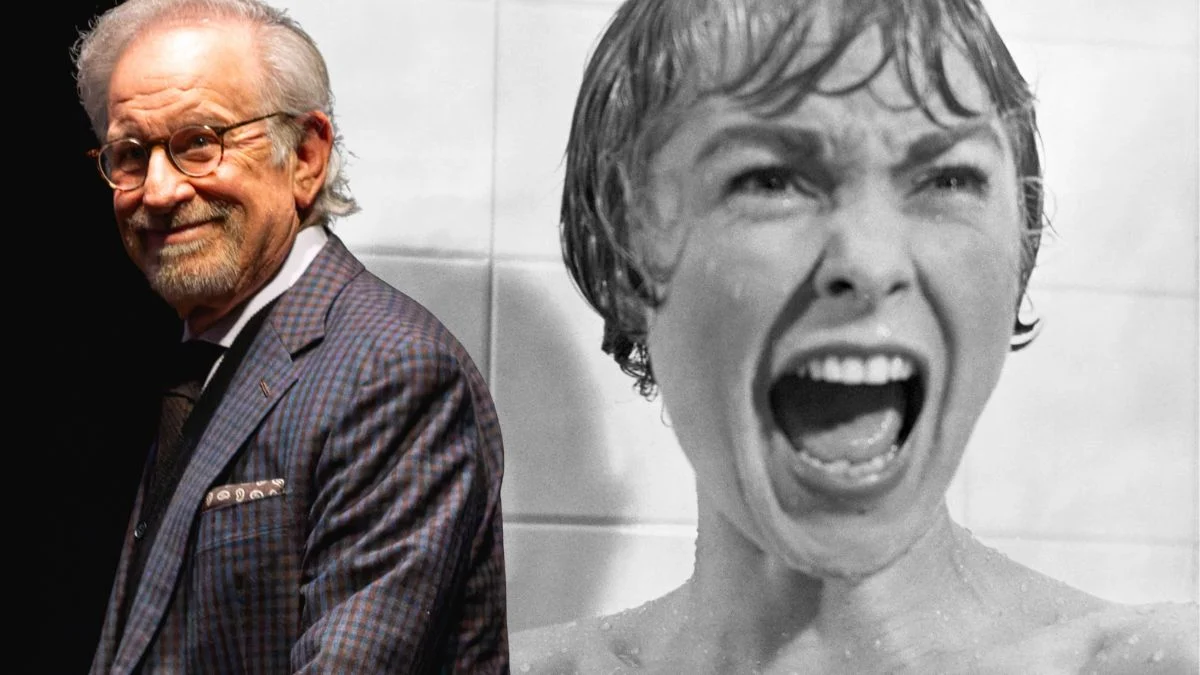
Spielberg recently revealed that ‘Psycho’ is his favorite film from Hitchcock’s catalog, describing it as “simple, but incredibly effective.” The quote, shared by @Kalshi_Film via @Francetele, has been circulating quickly among film communities, and it is easy to understand why. Coming from one of cinema’s most commercially dominant directors, it reads less like a casual preference and more like a mission statement.
Spielberg has long been open about how Hitchcock shaped his artistic sensibility, but the specific reverence for ‘Psycho’ speaks to something deeper than admiration. It reveals what Spielberg has always understood about great filmmaking: that restraint, suggestion, and economy of storytelling are often more powerful than spectacle. His choice of ‘Psycho’ over more celebrated Hitchcock entries like ‘Vertigo’ or ‘North by Northwest’ is itself telling, and it is entirely consistent with how his own career has unfolded.
During an appearance on BBC’s Desert Island Discs, Spielberg credited Hitchcock directly with helping him find success on ‘Jaws,’ reflecting that Hitchcock was a tremendous guide in the way he was able to scare audiences without showing much at all, and that the shark’s constant mechanical failures turned out to be good fortune for both himself and viewers. The infamous unreliability of the mechanical shark, affectionately nicknamed “Bruce,” forced Spielberg to adopt a more suspenseful, Hitchcock-style approach. It is a philosophy that runs directly through ‘Psycho,’ a film that manufactures dread not through excess but through implication.
‘Psycho’ has a notable legacy as Hitchcock’s most famous work and has since earned high praise from film critics as one of the highest-rated films on both Rotten Tomatoes and Metacritic. Produced for only around $800,000, it earned more than ten times that figure on its initial release and became the highest-grossing film for Paramount, a studio that initially wanted nothing to do with it. The American Film Institute later ranked it first on its list of the most thrilling films ever made, while Norman Bates landed at second place on its list of the greatest cinema villains.
Its cultural footprint is enormous, but perhaps its most lasting contribution is the permission it gave filmmakers to trust their audiences. That is exactly the lesson Spielberg appears to have internalized most deeply, and it is the thread connecting the shower scene in the Bates Motel to every terrifyingly invisible shark fin cutting through the waters off Amity Island.
Despite Spielberg’s profound admiration, the two directors never actually met. Actor Bruce Dern, who appeared in two of Hitchcock’s films, recalled trying to broker an introduction, telling Hitchcock that Spielberg simply wanted to sit with him for five minutes, only to be refused. There is something quietly poignant about one of cinema’s greatest devotional relationships existing entirely on one side, a student studying a master who never acknowledged the student at all.
For Spielberg to single out ‘Psycho’ as the crown jewel of Hitchcock’s filmography, above everything else the director ever made, is a statement worth sitting with. It is a choice that cuts straight to the philosophy both men shared, even if only one of them knew it. What do you think ‘Psycho’ represents in Hitchcock’s body of work that still resonates so deeply with filmmakers generations later?