‘Pressure’ Scores a Commanding 95% on the Rotten Tomatoes Popcornmeter as Audiences Fall for Andrew Scott’s D-Day Drama



Andrew Scott has carved out a remarkable career playing characters who operate under impossible circumstances, from tortured priests to cold-blooded con men, but his latest role may be his most grounded and most urgent yet. In ‘Pressure’, he steps into the shoes of real-life Group Captain James Stagg, the meticulous Scottish meteorologist tasked with delivering what may be the most consequential weather forecast in human history. It is the kind of story that sounds almost too tense to believe, and yet every detail of it is true.
Directed and edited by Anthony Maras and written by Maras alongside playwright David Haig, ‘Pressure’ is based on Haig’s acclaimed 2014 stage play and brings together a stellar ensemble that includes Brendan Fraser as General Dwight D. Eisenhower, Kerry Condon, Chris Messina, and Damian Lewis. The film was released in the United States on May 29, arriving in theaters just days before the 82nd anniversary of D-Day. The timing could not be more fitting for a story that hinges on the clock.
Audiences have responded with remarkable enthusiasm, awarding the film a CinemaScore of A and a Rotten Tomatoes Popcornmeter score of 95%, marking it as Verified Hot on the platform. That kind of audience alignment is a signal the industry takes seriously, and it suggests ‘Pressure’ has the word-of-mouth momentum to sustain a strong theatrical run well beyond its opening weekend. The film debuted to 5.8 million dollars domestically, finishing seventh at the box office in its opening weekend.
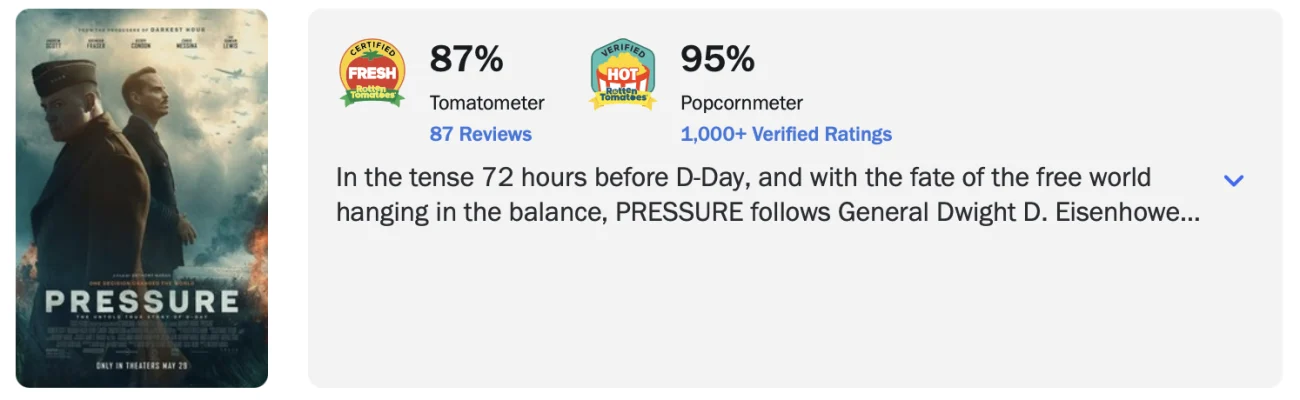
Critics, too, have found plenty to admire. On Rotten Tomatoes, 87% of critics’ reviews are positive, with the site’s consensus praising the film as a brainy war drama that derives most of its thrills from Andrew Scott’s simmering performance. The Hollywood Reporter called Scott’s work “award-worthy,” arguing that ‘Pressure’ lives up to its title through an expert ratcheting up of sustained tension. For a film largely set in drawing rooms and war offices, that is no small achievement.
Much of the film’s power comes from the central conflict between two forecasters who cannot agree on what the skies over Normandy are about to do. Stagg broke from the accepted forecast and predicted far harsher conditions than his American counterpart Irving Krick, forcing Allied commanders to debate whether to delay the invasion or push ahead into potentially disastrous weather. Scott himself spoke to the character’s appeal in an interview with People, explaining that what he loved most about Stagg was that he was “not charming” in the conventional sense, but someone who was simply committed to doing his job well and refusing to bow down to anyone.
The film is a closely wound chamber drama, with the airy confines of the stately home where Allied commanders gathered providing both grandeur and contrast to the minutiae inked out on vast maps in the small hours of the night. Director Anthony Maras keeps the adaptation of Haig’s stage play moving swiftly enough to hold the tension, with the film benefiting enormously from larger-than-life portrayals of historical figures. In a summer landscape dominated by sequels and franchise spectacle, ‘Pressure’ is making the case that a film about debates over barometric readings can be every bit as riveting as any action set piece.
Whether you think the biggest wars are fought on beaches or in briefing rooms, ‘Pressure’ seems determined to make you reconsider, and with audiences and critics both firmly on board, it would be fascinating to hear whether the film’s unconventional brand of heroism resonated with you the way it has with so many others.