How ‘The Furious’ Built One of the Year’s Most Insane Fight Finales, Scene by Brutal Scene


When the history of modern martial arts cinema gets written, a handful of films tend to define the turning points. ‘Ong-Bak’ sent shockwaves through the action genre in 2003, and for many fans it opened a door to the work of Jackie Chan, Donnie Yen, and Jet Li that has never fully closed. That hunger for a worthy successor has lingered for years, and the conversation around what film might finally satisfy it has now arrived at a clear answer.
Director Kenji Tanigaki’s Hong Kong epic ‘The Furious’ opened in American theaters via Lionsgate Films to immediate buzz, starring some of the world’s most talented martial artists fighting at relentless speed while a steady camera captures every blow with crystalline clarity. Tanigaki began his career in Hong Kong as a trained martial artist and stunt performer before transitioning to Hollywood productions, and he has collaborated with Donnie Yen for more than 30 years. That decades-long apprenticeship in the craft is visible in every frame.
The film’s fight design is built on a simple but electric philosophy. Tanigaki, speaking to Variety, explained that the electricity in his scenes comes from pairing performers with contrasting disciplines, noting that Xie Miao’s Chinese Wushu and Joe Taslim’s Judo create an inherent tension where one fighter tries to keep distance while the other closes in to grapple. Fight choreography duties were handled by Kensuke Sonomura, the action director behind the ‘Baby Assassins’ films, whose distinctive style involves unpredictable changes in rhythm and ground-level movement that here reaches a scale far beyond his previous work.
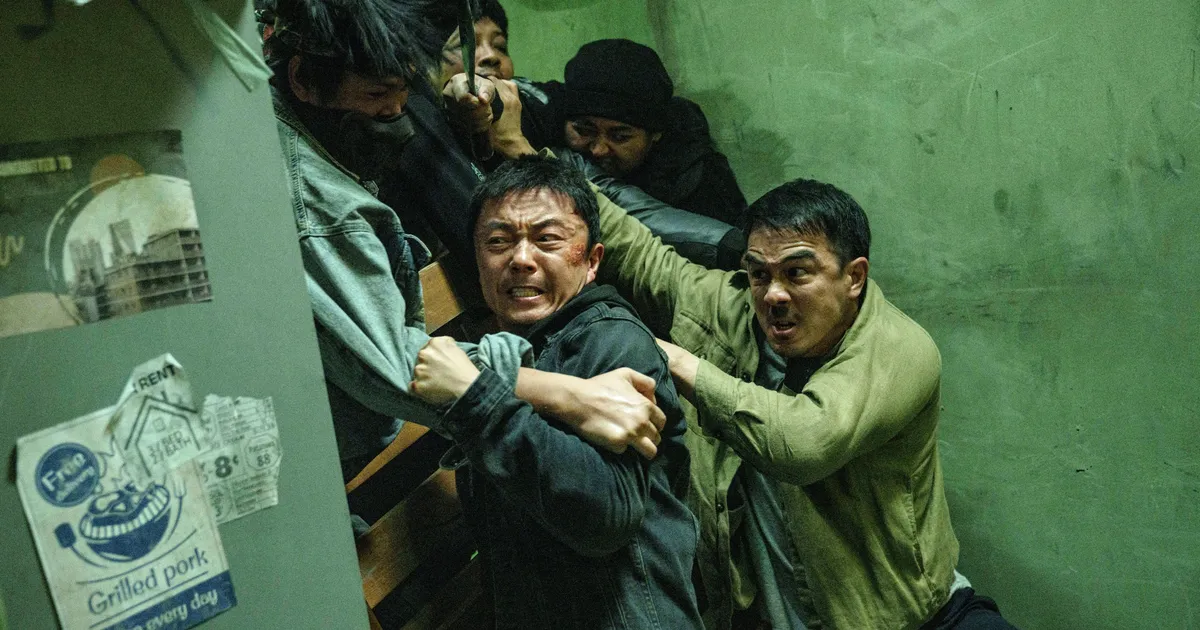
That philosophy pays off most spectacularly in the film’s climactic showdown. Tanigaki revealed that he spent 18 days shooting the police station finale, a 20-minute battle that grew in scope thanks to last-minute ingenuity during production. Rather than building toward a traditional one-on-one confrontation, ‘The Furious’ orchestrates a sprawling five-way battle that simultaneously puts Xie Miao’s precision striking, Taslim’s grappling, Joey Iwanaga’s kicks, Brian Le’s brawling power, and Yayan Ruhian’s weapon-based combat on a constantly shifting battlefield.
The performers brought their own lived expertise to the chaos. Xie Miao was a child wushu champion in China before becoming a well-known action star, while Joe Taslim is a former judo champion who broke out internationally with ‘The Raid: Redemption’. Taslim told UPI that the way audiences consume action has changed fundamentally, with viewers now wanting to feel the character’s story and emotional reality through the fight rather than simply watching athletic spectacle.
Xie Miao, whose character Wang Wei is mute throughout the film, reflected on that dynamic by saying that when someone cannot express themselves through language, the anger the body expresses becomes even stronger. Critics have called the fight scenes closer to environmental puzzles than traditional bouts, with the protagonist using opponents’ own bodies as tools in ways that feel genuinely ground-breaking for the genre.
Producer Bill Kong, whose credits include ‘Crouching Tiger, Hidden Dragon’ and ‘Hero,’ assembled the pan-Asian cast with the explicit goal of proving that Asian martial arts films can still rival the high-tech thrills of Hollywood blockbusters. If the response to ‘The Furious’ is any indication, that bet has paid off in spectacular fashion.
Whether you think this is the martial arts film that finally fills the void left by ‘The Raid,’ or something altogether new, is exactly the argument worth having in the comments.