Netflix’s ‘Shipwrecked: Nightmare at Sea’ Revisits the Costa Concordia Tragedy and the Captain Who Fled First

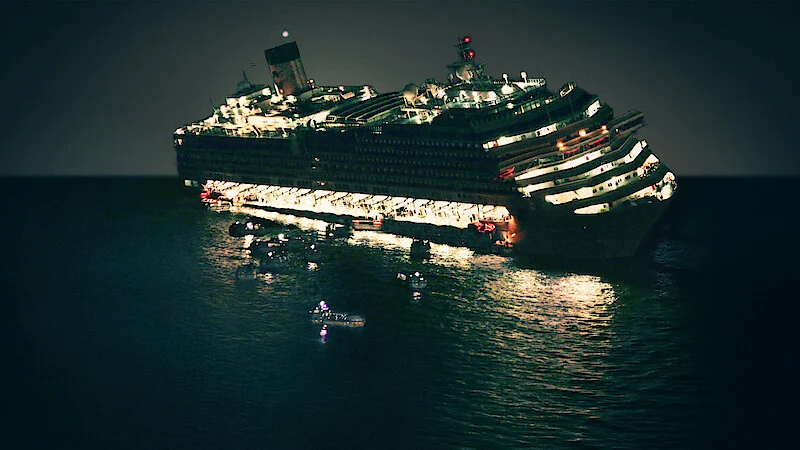

Fourteen years after the Costa Concordia rolled onto its side off the coast of Tuscany, Netflix has returned to one of the modern era’s most infamous maritime disasters. The documentary ‘Shipwrecked: Nightmare at Sea’ interweaves eyewitness accounts from survivors, cell phone footage taken the night of the tragedy, and translations of the ship’s black box recordings, which expose dangerous decisions made by the captain.
Director Chiara Messineo, known for Stanley Tucci Searching for Italy, interviews passengers, crew, and members of the rescue and forensics teams to dissect what went so horribly wrong during the 2012 disaster. The film arrives as Netflix continues to mine real world catastrophe for its true crime slate, and it lands with a level of access that gives the Costa Concordia story fresh weight even for viewers who remember the headlines from over a decade ago.
The Night the Costa Concordia Sailed Off Course
On January 13, 2012, more than 4,000 people set sail aboard the luxury cruise ship Costa Concordia from Civitavecchia, Italy, for what was meant to be a routine voyage. Naturally one of the most luxurious cruise ships operating in Italy at the time, the Concordia was fourteen stories high with roughly 1,500 cabins, several restaurants, and thirteen bars, making it a first choice for foreign tourists looking for a Mediterranean trip.
That night the ship diverted from its planned course after Captain Francesco Schettino decided to treat a crew member to a sail-by salute past the island of Giglio, where the staff member’s family lived. The detour was never part of the ship’s original itinerary, and Schettino approved it as a favor to the head waiter of one of the ship’s restaurants.
Minutes later, at 21:45, the Costa Concordia struck a rocky outcrop while traveling at around 16 knots, and the impact tore a 53 meter gash into the hull. The vessel began taking on water and tilting almost immediately, with engine rooms flooding and power lost across the ship. As passengers began to panic, the Italian Coast Guard radioed to ask whether the Concordia needed help, and Schettino and the bridge crew minimized the danger by claiming they were only experiencing a blackout.
The general emergency alarm was not raised until 22:33, and the order to abandon ship did not come until 22:54, more than an hour after the initial collision. By midnight, dozens of passengers were still on board, some clinging to the exposed side of the tilting vessel as rescue boats and helicopters worked to reach them.
Survivor Accounts Ground the Documentary in Real Fear
‘Shipwrecked: Nightmare at Sea’ draws on interviews with passengers who lost loved ones in the disaster, alongside crew members including a chef, a dancer, and the ship’s hotel manager. The film also features a fire brigade diver, a forensic investigator, and a CNN correspondent, giving the documentary a rounded view of both the emotional toll and the legal fallout.
Passenger recollections describe scenes of chaos as thousands scrambled for the lifeboats. Alaska resident Nate Lukes, who was aboard with his wife and four daughters, recalled to the Today show that there was really a melee, comparing it to the film Titanic, with people jumping onto the tops of lifeboats and pushing down women and children to try to reach them. He described holding his daughters close and letting the crowd rush past to keep them from being trampled.
The documentary also follows a cruise ship employee who quit on the spot after a demand made of her in the middle of the unfolding shipwreck, one of several crew perspectives that humanize the response effort rather than treating it as a footnote to the captain’s failures. Among the standout figures is Rose Metcalf, a dancer on the ship who is described in the film as an absolute hero for her role during the evacuation.
Reviewers have noted that the blend of first person testimony with archival footage sets the film apart from a straightforward disaster recap. One review called it a true crime disaster documentary hybrid that is extremely well made and absolutely heartbreaking, noting that the footage and firsthand accounts make the fear and horror feel palpable.
What the Black Box Recordings Reveal
Black box voice recordings referenced in the ministry’s investigation captured the chaos unfolding on the bridge in real time, and one exchange in particular has come to define how the disaster is remembered. Positioning data cited in the investigation shows the Concordia drifted back toward Giglio’s port before listing in the opposite direction, an effect investigators believe was caused by water in the damaged hull rushing to the far side of the ship as it turned.
As the ship began to list to starboard, Schettino dropped anchors to try to stop further tipping, but too much line went out and the anchors failed to catch, leaving them useless. Schettino later said he fell into a lifeboat and called the Coast Guard, reportedly begging the officer on the line not to send rescuers back to the ship to search for survivors.
Coverage from the time of the disaster added further detail to the captain’s conduct that night. One passenger accused Schettino of drinking wine before the incident, and he was also accused of traveling too fast and navigating by his own eyesight rather than using maps and radar before the ship struck the reef, a version of events the documentary revisits through the translated recordings.
The Legal Reckoning for Captain Schettino
The disaster claimed 32 lives and led to a 16 year prison sentence for Schettino, drawing global media attention that has never fully faded. In 2015, Schettino was found guilty on multiple counts of manslaughter and sentenced accordingly, and he was also found guilty of causing the disaster and abandoning ship before all 4,200 people had been evacuated.
Five other cruise ship employees were convicted of manslaughter, negligence, and shipwreck, but none of them served prison time. Costa Cruises, the parent company of the vessel, paid a corporate fine of about 1 million euros and did not face a criminal trial, though it did pay various settlements to passengers ranging from 11,000 to nearly 93,000 euros each.
The verdict did not sit well with everyone who lived through the tragedy. Survivor Blake Miller, from Austin, Texas, told reporters that the sentence amounted to less than four months per person who died, a sentiment the documentary revisits as it weighs the legal outcome against the scale of the loss. Schettino is currently serving his sentence in Rome and had exhausted all his appeals as of 2017.
The Italian press dubbed Schettino the coward captain, and he became public enemy number one in the aftermath of the sinking. That framing has followed him ever since, and ‘Shipwrecked: Nightmare at Sea’ treats it less as tabloid shorthand and more as the starting point for a wider reckoning over who bears responsibility when a disaster like this unfolds in real time.
Netflix describes the film as tracing the 2012 shipwreck of the luxury cruise and the disaster that ensued through never before seen footage and survivor accounts, and it is available to stream now. For anyone who lived through the original news coverage of the Costa Concordia in 2012, or for viewers discovering the story for the first time through this documentary, the question of how a routine sail-by salute turned into one of the deadliest cruise disasters in modern history is worth sitting with in the comments below.