The Most Comprehensive Guide to Every Mythological Figure and Legend Behind ‘The Odyssey’

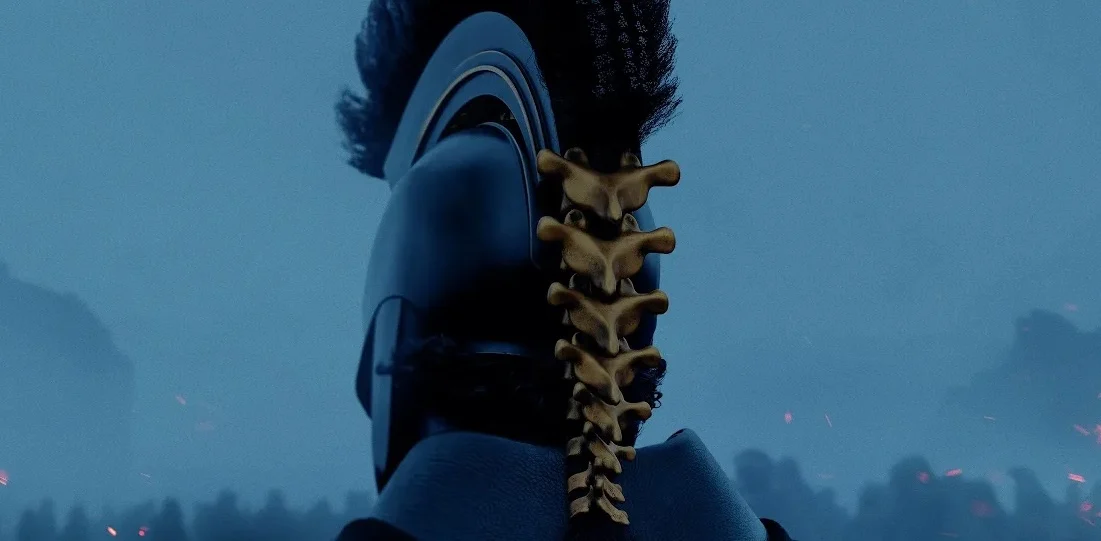

‘The Odyssey’ draws its power from a mythological world that existed long before Homer ever put stylus to wax. Understanding the gods, monsters, and doomed royal families that surround Odysseus makes every stop on his journey home land with more weight.
This guide sets aside the plot of the poem itself to focus on the background figures and legends that inform it, from the nymph who kept Odysseus captive for years to the real ruins that may have inspired the war he was sailing home from.
Who Is Calypso and Was Her Punishment Fair?
Calypso is described across ancient sources as a nymph, and sometimes a minor goddess, who lived alone on the island of Ogygia before Odysseus washed ashore there. Her origin story varies depending on the source, but Homer identifies her as the daughter of the Titan Atlas, while other accounts name Oceanus and Tethys as her parents.
So what is a nymph, exactly. In Greek mythology, nymphs were a broad class of minor female deities tied to nature, and while they were not immortal, they were extremely long lived and generally well disposed toward men. This puts Calypso in an unusual middle category, more powerful than a mortal but not one of the ruling Olympians, which is part of why sources disagree on whether she counts as a goddess at all.
As for why Calypso was banished, most retellings agree she was punished for choosing the losing side in the Titanomachy, the war between the Titans and the younger Olympian gods. She had sided with the Titan gods in that ten year conflict, and as punishment she was confined to Ogygia, where she would later keep Odysseus for seven years, offering him immortality if he agreed to stay.
Some scholars have tried to locate Ogygia on a map, with the remote Maltese island of Gozo suggested as a possible real world candidate. Whether or not that identification holds up, the story of Calypso raises a theme that runs throughout Greek myth, where the gods punish disloyalty severely and rarely let their subjects forget it.
Who Was Agamemnon and Was He a Real Historical King?
Agamemnon commands the Greek forces throughout the Trojan War and looms over ‘The Odyssey’ as a cautionary tale for what awaits a hero who finally makes it home. In the Homeric epics he is named king of Mycenae, a fortified city in the Peloponnese that held major power in early Greek history, though later writers sometimes placed him instead in the nearby city of Argos.
Was Agamemnon a real person. The honest answer is that scholars are not certain. Mycenae itself was a genuine and powerful Bronze Age city, and archaeologists including Heinrich Schliemann uncovered elaborate gold burial artifacts there in the nineteenth century, but no evidence conclusively proves a king named Agamemnon ever ruled it. He remains, at best, a legendary figure possibly inspired by real Mycenaean rulers.
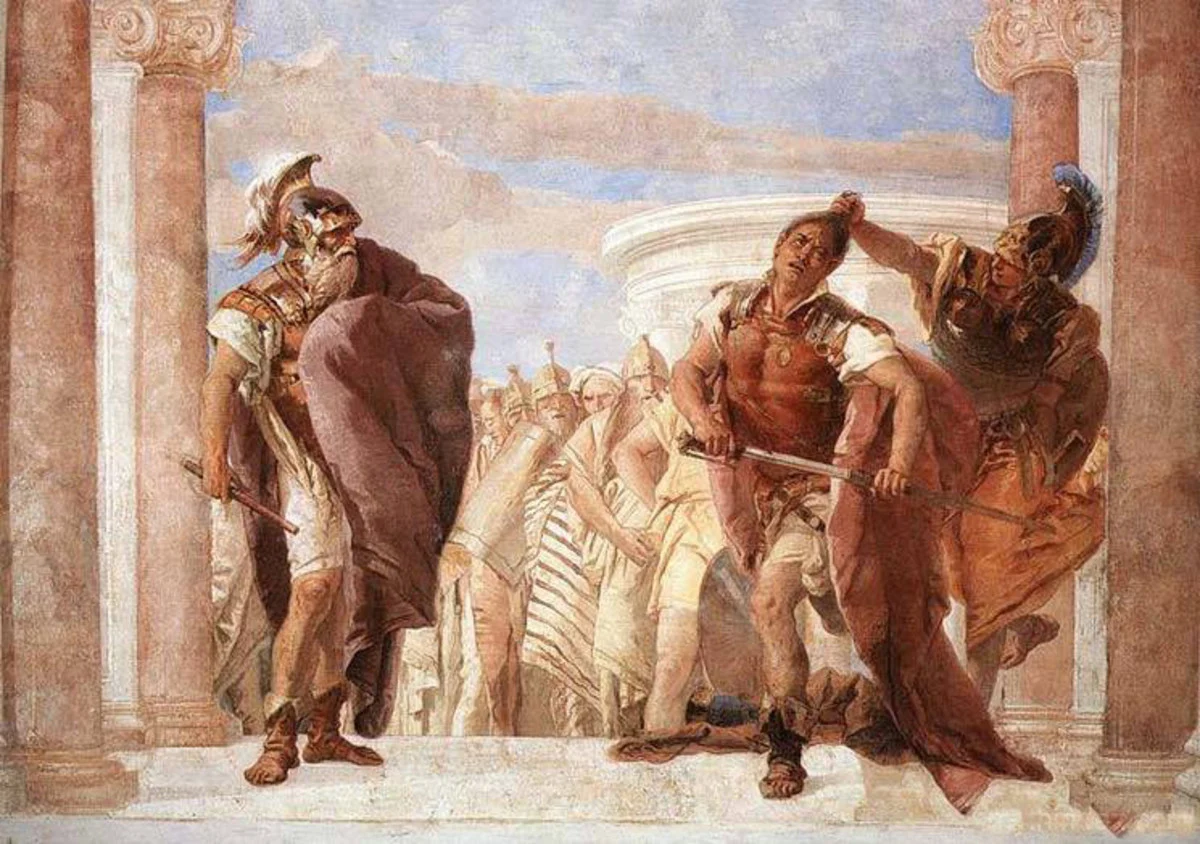
His death is one of the most famous cautionary tales in Greek tragedy. Agamemnon’s wife Clytemnestra took a lover named Aegisthus while her husband was away at war, and together the pair murdered Agamemnon upon his return to Greece. Ancient accounts differ on the method, with some describing an ambush during a bath and others describing him trapped in robes before being struck down.
Clytemnestra’s motives were layered. Agamemnon had sacrificed their daughter Iphigenia to secure safe passage for his fleet to Troy, and Clytemnestra never forgave him for it. The murder set off a cycle of vengeance, since Clytemnestra was later killed by her own son Orestes, with help from his sister Electra, in retaliation for his father’s death. It is a family history soaked in blood well before Odysseus ever left for Troy.
Helen of Troy, Her Husband, and the Man Who Tricked the City
Helen’s marriage is central to why the Trojan War happened at all. She was originally from Sparta and married to Menelaus, before fleeing to Troy with the Trojan prince Paris, which is what set the war in motion. Menelaus was the younger son of Atreus and king of Sparta, and he served under his older brother Agamemnon as commander in chief of the Greek forces.
After Troy fell, Menelaus intended to kill Helen for her betrayal, but he was overcome by her beauty and pleading, and the couple reconciled and resumed their marriage back in Sparta. That reunion is depicted directly within ‘The Odyssey’, when Telemachus visits the couple while searching for news of his missing father.
One name that never appears in Homer but shows up constantly in discussions of the Trojan Horse is Sinon. Sinon does not appear in Homer’s own text, but his story is detailed in Virgil’s Aeneid and other later accounts, where he is portrayed as a treacherous Greek agent who convinces the Trojans to bring the horse inside their walls. According to that later tradition, Sinon was left behind deliberately when the rest of the Greek army pretended to sail away, and he told the Trojans the wooden horse was a gift meant to secure a safe voyage home for the Greeks.
Interestingly, Sinon was also said to be a cousin of Odysseus through his mother Anticlea, tying the deception directly back to the hero of the later poem. It is one of many quiet threads connecting the war at Troy to the family Odysseus eventually struggles to return to.
Where Is Troy and What Made It So Difficult to Conquer?
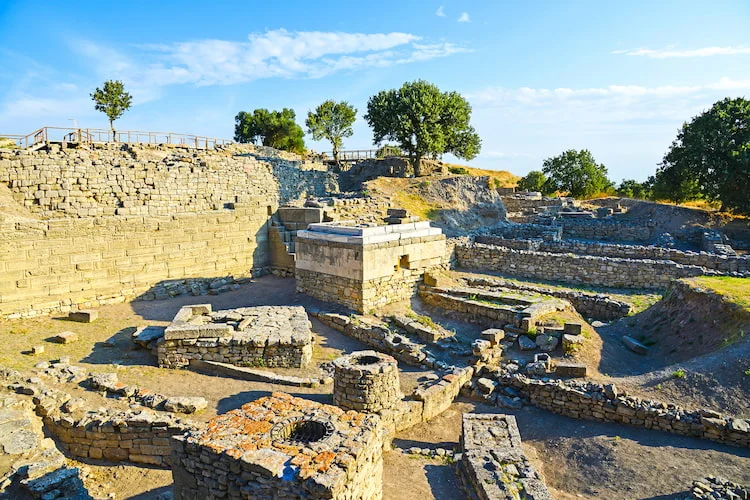
Unlike Ogygia, Troy has a real, confirmed location. The ruins of Troy sit at Hisarlik in northwestern Turkey, a site whose layered remains illustrate the gradual development of civilization in that region of Asia Minor. The mound contains nine distinct layers of settlement spanning roughly 3,000 BCE to 500 CE, making it one of the longest continuously occupied sites in the ancient Mediterranean.
For centuries scholars assumed Troy was pure fiction. That changed when the German archaeologist Heinrich Schliemann began excavating the site in 1870, ultimately demonstrating that a real fortified city had existed there. Troy was later inscribed as a UNESCO World Heritage site, recognized as one of the most significant points of contact between the civilizations of Anatolia and the Mediterranean world.
Troy’s reputation for being nearly impossible to capture was not exaggerated within the myth. According to accounts of the war, the Greeks struggled to capture the city because its walls were incredibly high and thick, which is a major reason the conflict dragged on far longer than anyone expected. That defensive strength is why the Greeks eventually turned to deception rather than brute force, engineering the Trojan Horse instead of continuing a direct siege.
The human cost inside those walls is symbolized by Hector, the eldest son of Troy’s king. As the eldest son of King Priam and Queen Hecuba, Hector was heir to the Trojan throne and carried the burden of defending his city on his shoulders. His death at the hands of Achilles, following the death of Achilles’s companion Patroclus, effectively broke the spirit of the Trojan resistance and sealed the city’s fate even though the siege continued a while longer.
Odysseus, His Family, and Why Poseidon Turned Against Him
A common question surrounding the hero is whether Odysseus counts as a demigod, given how many Greek heroes were the children of gods. The answer, according to most classical sources, is no. In most accounts Odysseus is simply a mortal man born of mortal parents, Laertes and Anticlea, and while there is some distant divine lineage through Hermes as a maternal great grandfather, it is not close enough to make him a demigod. For that title to apply, one of his actual parents would have needed to be a god rather than a distant ancestor.
His home has never been in dispute the way Troy once was. Odysseus ruled as king of Ithaca, a small island off the western coast of Greece, and it was to that island he was desperately trying to return throughout the entire poem. Waiting there for him was his son, Telemachus, who spends much of the story searching for word of his missing father while also fending off suitors trying to marry his mother and claim the throne for themselves.
The animosity between Odysseus and Poseidon has a very specific origin point, and it happens after the events most readers associate with ‘The Odyssey’ begin. Polyphemus is a Cyclops, one of a race of one eyed giants, and specifically a son of Poseidon and the nymph Thoosa. After Odysseus blinded him to escape his cave, Polyphemus prayed to his father Poseidon to curse Odysseus’s journey home, and Poseidon granted the request, condemning Odysseus to lose his companions and wander for years before finally reaching Ithaca alone.
Do you think Odysseus makes it home safely in 'The Odyssey?'
The insult was made worse by Odysseus’s own pride. By shouting his real name back at the Cyclops as his ship sailed away, Odysseus effectively handed Poseidon a target, turning a personal grudge into an act of divine vengeance that cost him the safety of his entire crew. It is a moment classical scholars often point to as textbook hubris, the kind of excessive pride that Greek mythology consistently punishes.
What Are the Sirens and Why Were They So Dangerous
Few creatures in Greek mythology are as misunderstood in modern pop culture as the Sirens. In Greek mythology a Siren was a half bird and half woman creature who lured sailors to destruction through the sweetness of her song, and Homer describes two of them living on an island in the western sea. Later writers expanded that number to three, and even placed them on the western coast of Italy near Naples.
Their parentage varies depending on the source, with different accounts naming the sea god Phorcys or the river god Achelous as their father, paired with one of the Muses as their mother. That divine mix explains their most famous power, since their song was said to be genuinely irresistible rather than simply pleasant, capable of driving sailors to steer straight toward the rocks that surrounded them.
Odysseus is one of the few figures in mythology known to have heard their song and lived. On the advice of the sorceress Circe, he had his crew plug their ears with wax while he had himself bound to the mast so he alone could listen without being able to act on the temptation. Some ancient traditions add a darker detail to this encounter, claiming the Sirens were fated to die if a sailor ever survived hearing them, which would make Odysseus responsible for their destruction simply by surviving.
The visual image most people carry today, a beautiful mermaid singing from the waves, is largely a later invention. Classical Greek audiences pictured something closer to a bird woman associated with mourning and the underworld, since some ancient writers connected the Sirens to the goddess Persephone and cast them as searchers who never found what they were looking for after her abduction by Hades.
Scylla and Charybdis and the Monsters of the Strait
Among the most dreaded parts of Odysseus’s journey home was a narrow strait guarded on either side by two immortal and inescapable monsters. Scylla was a six headed creature with twelve feet and rows of sharp teeth on each head, while directly across from her Charybdis took the form of an enormous whirlpool that swallowed and spat out the sea three times a day.
Later writers gave Scylla a much more tragic backstory than her monstrous appearance suggests. In some accounts, Scylla was originally a beautiful nymph loved by the sea god Glaucus, who then sought help from the sorceress Circe to win her affection. Instead, the jealous Circe poisoned the waters where Scylla bathed, transforming her permanently into the monster later sailors would come to fear.
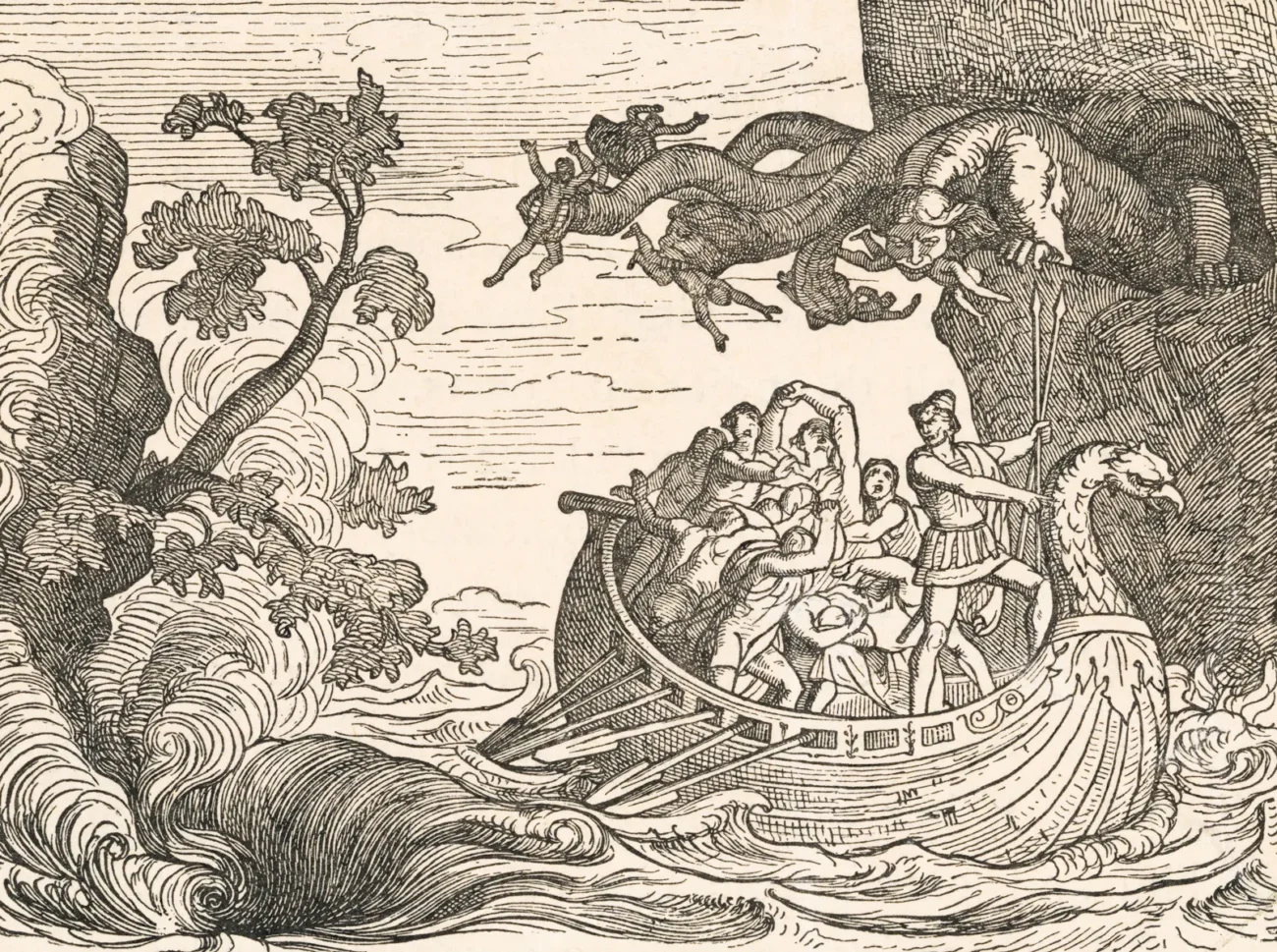
Charybdis has an equally violent origin in some tellings, described as a daughter of Poseidon who was punished and confined to the sea floor by Zeus, forced for eternity to swallow and disgorge the tides. Together the two monsters created a passage where a ship essentially had no safe option, since staying too far from one meant drifting directly into the other.
When Odysseus faced this exact dilemma, Circe had already warned him what to expect and told him to steer closer to Scylla rather than Charybdis, since losing six men to Scylla’s snapping heads was a smaller cost than losing his entire ship and crew to the whirlpool. The strait is traditionally identified with the Strait of Messina, the real channel separating Sicily from mainland Italy, giving this particular myth an actual geographic home much like Troy.
Why Athena Champions Odysseus Above Other Mortals
Odysseus does not survive his journey purely through his own cunning, and much of that survival depends on Athena, goddess of wisdom and war. Athena is considered the most important goddess in ‘The Odyssey’ given both the frequency of her appearances and the weight of her interventions, acting as the patron goddess of Odysseus and his entire household throughout the story.
Their bond is explained within the poem itself as a kind of mutual recognition. Athena tells Odysseus directly that the two of them share a talent for tricks and strategic thinking, since she is renowned among the gods for wit and cunning in the same way he is renowned among men. That shared temperament, favoring clever solutions over brute strength, is precisely the quality Athena tends to reward across Greek mythology, having also aided heroes like Heracles and Perseus in the past.
Athena’s help takes many forms across the story, and she rarely acts as bluntly as Poseidon does. She frequently disguises herself, most notably as Mentor, a family friend who guides Telemachus while his father is away, and she is credited with transforming Odysseus’s appearance at key moments to help him gain trust or avoid danger. She is also said to have calmed waters that Poseidon whipped into a storm, giving Odysseus a chance to survive at sea when the god of the sea was actively trying to kill him.
It is worth noting that Athena’s support was not automatic or unconditional at the start of the story. Some accounts trace an earlier falling out to the sack of Troy itself, when a Greek warrior desecrated one of Athena’s temples, contributing to the goddess’s early anger toward the returning Greek fleet. Her eventual devotion to Odysseus specifically suggests that respect, once earned through his intelligence and his piety toward her, mattered more to Athena than any lingering resentment over the war.
The Greek Underworld That Odysseus Is Forced to Visit
Understanding the stakes of Odysseus’s most harrowing detour requires some background on the realm the ancient Greeks believed awaited everyone after death. The Underworld, ruled by Hades and his wife Persephone, was imagined as a dark and hidden kingdom rather than a place of fire and torment, a realm where the vast majority of ordinary souls wandered the grey Asphodel Meadows rather than facing punishment or reward.
Ancient sources generally describe the realm as encircled by five rivers, each carrying its own symbolic weight. The Styx represented hatred and was the water on which the gods swore their most unbreakable oaths, while other rivers including the Acheron, the Cocytus, the Phlegethon, and the Lethe represented woe, lamentation, fire, and forgetfulness respectively. Later tradition also divided the realm into distinct regions, including Tartarus for the worst offenders and Elysium as a reward reserved for only the most excellent souls.
This is the realm Odysseus is forced to travel to in order to consult the dead prophet Tiresias for guidance on completing his journey home. While there, he encounters the spirits of people from his own life, including his mother Anticlea, who explains that her grief over his prolonged absence contributed to her death and updates him on the state of his father, his wife, and his son back on Ithaca.
The Underworld was not something the ancient Greeks treated lightly even in myth, since living visitors were exceedingly rare and typically only heroes of significant standing, such as Heracles or Orpheus, were said to have entered and returned. That Odysseus is granted the same rare passage underscores just how far his journey has already pushed him beyond the limits of an ordinary mortal life, even without ever technically becoming a god.
The deeper you dig into the mythology surrounding ‘The Odyssey’, the clearer it becomes that Odysseus was never navigating a random string of dangers, but a coordinated web of grudges, debts, and family curses that long predate his own voyage. Which of these background figures, Athena, Sinon, Scylla, or the doomed house of Agamemnon, do you think shapes the poem’s world the most once you look past Odysseus himself?